

compounds suggests further progress will be possible. Ultimately, our predictive
power should enable the matching of a given therapeutic indication with the optimum inhibitor profile and thereby reduce the incidence of side effects.
7 Therapeutic Applications Targeting Nonhuman HDACs
Although the therapeutic targeting of HDACs has predominantly concentrated on the
human enzymes, it can be extrapolated to other species. The natural product trichostatin
A (1), for example, was first identified due to its potent antifungal activity. MethylGene
have reported the compound MGCD290 (structure undisclosed) as an inhibitor of the
fungal HDAC Hos2 [118]. Although a phase II trial in acute vulvovaginal candidiasis
with a combination of MGCD290 and fluconazole did not demonstrate superior efficacy
over fluconazole alone, fungal HDACs remain an interesting target for drug discovery
[119]. Meanwhile, there is extensive literature on the inhibition of parasitic HDACs for
the treatment of malaria and other neglected diseases [120]. The cancer clinical candidate pracinostat, for example, was active upon oral administration in a Plasmodium
berghei-infected malaria mouse model while romidepsin inhibited adult worm pairing
and egg production in Schistosoma mansoni [121, 122]. Medicinal chemistry efforts
have aimed to selectively target the parasite HDACs. For example, compound 57
(Fig. 17) with an amide zinc-binding group inhibited the P. falciparum HDAC1 with
more than 50-fold selectivity over the human enzyme [123], while hydroxamic acid 58
displays some selectivity for the S. mansoni HDAC8 over the human isoform
[124]. Finally, although bacteria do not contain histones, they do have histone
deacetylase-like proteins. Interestingly, the vorinostat analogue 59 with a perfluorinated
linker showed selectivity against Pseudomonas aeruginosa HDAC-like enzymes over
the human enzymes and is potentially a lead for antibacterial agents [125].
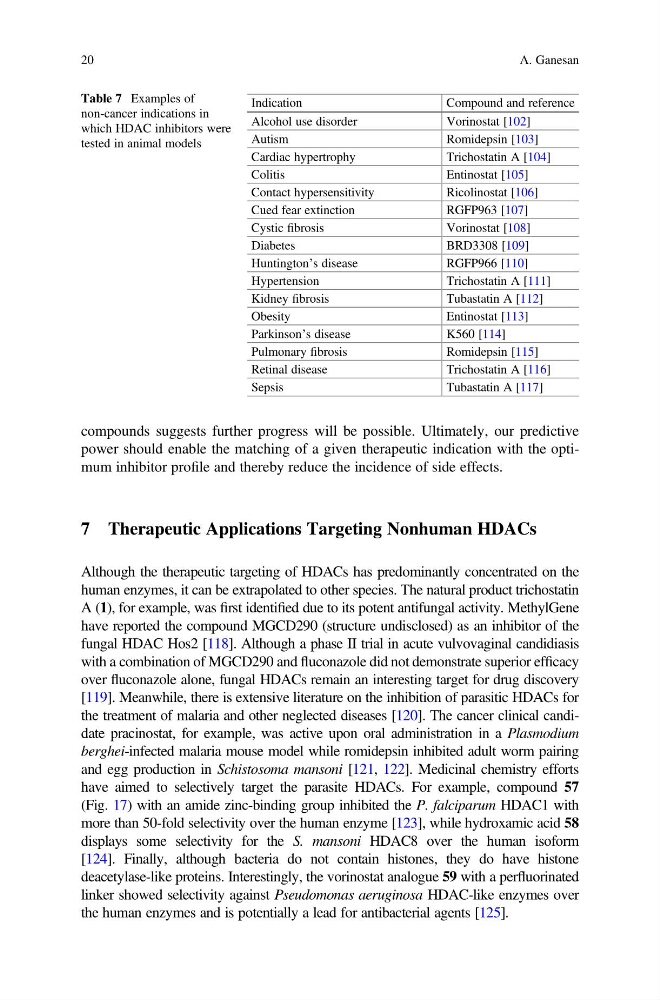
Table 7 Examples of
non-cancer indications in
which HDAC inhibitors were
tested in animal models
Indication
Compound and reference
Alcohol use disorder
Vorinostat [102]
Autism
Romidepsin [103]
Cardiac hypertrophy
Trichostatin A [104]
Colitis
Entinostat [105]
Contact hypersensitivity
Ricolinostat [106]
Cued fear extinction
RGFP963 [107]
Cystic fibrosis
Vorinostat [108]
Diabetes
BRD3308 [109]
Huntington’s disease
RGFP966 [110]
Hypertension
Trichostatin A [111]
Kidney fibrosis
Tubastatin A [112]
Obesity
Entinostat [113]
Parkinson’s disease
K560 [114]
Pulmonary fibrosis
Romidepsin [115]
Retinal disease
Trichostatin A [116]
Sepsis
Tubastatin A [117]
20
A. Ganesan
power should enable the matching of a given therapeutic indication with the optimum inhibitor profile and thereby reduce the incidence of side effects.
7 Therapeutic Applications Targeting Nonhuman HDACs
Although the therapeutic targeting of HDACs has predominantly concentrated on the
human enzymes, it can be extrapolated to other species. The natural product trichostatin
A (1), for example, was first identified due to its potent antifungal activity. MethylGene
have reported the compound MGCD290 (structure undisclosed) as an inhibitor of the
fungal HDAC Hos2 [118]. Although a phase II trial in acute vulvovaginal candidiasis
with a combination of MGCD290 and fluconazole did not demonstrate superior efficacy
over fluconazole alone, fungal HDACs remain an interesting target for drug discovery
[119]. Meanwhile, there is extensive literature on the inhibition of parasitic HDACs for
the treatment of malaria and other neglected diseases [120]. The cancer clinical candidate pracinostat, for example, was active upon oral administration in a Plasmodium
berghei-infected malaria mouse model while romidepsin inhibited adult worm pairing
and egg production in Schistosoma mansoni [121, 122]. Medicinal chemistry efforts
have aimed to selectively target the parasite HDACs. For example, compound 57
(Fig. 17) with an amide zinc-binding group inhibited the P. falciparum HDAC1 with
more than 50-fold selectivity over the human enzyme [123], while hydroxamic acid 58
displays some selectivity for the S. mansoni HDAC8 over the human isoform
[124]. Finally, although bacteria do not contain histones, they do have histone
deacetylase-like proteins. Interestingly, the vorinostat analogue 59 with a perfluorinated
linker showed selectivity against Pseudomonas aeruginosa HDAC-like enzymes over
the human enzymes and is potentially a lead for antibacterial agents [125].
Table 7 Examples of
non-cancer indications in
which HDAC inhibitors were
tested in animal models
Indication
Compound and reference
Alcohol use disorder
Vorinostat [102]
Autism
Romidepsin [103]
Cardiac hypertrophy
Trichostatin A [104]
Colitis
Entinostat [105]
Contact hypersensitivity
Ricolinostat [106]
Cued fear extinction
RGFP963 [107]
Cystic fibrosis
Vorinostat [108]
Diabetes
BRD3308 [109]
Huntington’s disease
RGFP966 [110]
Hypertension
Trichostatin A [111]
Kidney fibrosis
Tubastatin A [112]
Obesity
Entinostat [113]
Parkinson’s disease
K560 [114]
Pulmonary fibrosis
Romidepsin [115]
Retinal disease
Trichostatin A [116]
Sepsis
Tubastatin A [117]
20
A. Ganesan