

tapped into a more lucrative market, receiving FDA and EMA approval in 2015 for
use against multiple myeloma.
In addition to the hematological indications, multiple clinical trials are investigating the approved HDAC inhibitors in other cancer types including solid tumors.
Besides monotherapy, combinations of HDAC inhibitors with a second agent are
also being explored. These avenues of investigation may result in further approvals
for the established drugs, provided a therapeutic window for efficacy and tolerability
can be identified.
The history of HDAC inhibitors as anticancer agents suggests utility against other
conditions that have a proliferative or immunological profile [98, 99]. Indeed, the
approved drugs are undergoing evaluation as both monotherapy and in combinations
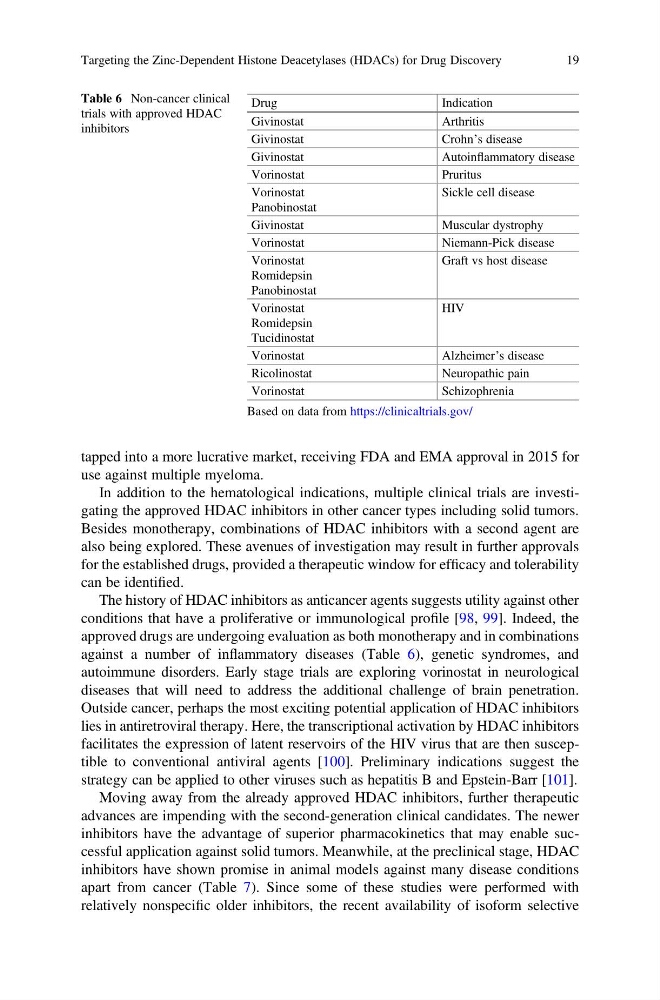
against a number of inflammatory diseases (Table 6), genetic syndromes, and
autoimmune disorders. Early stage trials are exploring vorinostat in neurological
diseases that will need to address the additional challenge of brain penetration.
Outside cancer, perhaps the most exciting potential application of HDAC inhibitors
lies in antiretroviral therapy. Here, the transcriptional activation by HDAC inhibitors
facilitates the expression of latent reservoirs of the HIV virus that are then susceptible to conventional antiviral agents [100]. Preliminary indications suggest the
strategy can be applied to other viruses such as hepatitis B and Epstein-Barr [101].
Moving away from the already approved HDAC inhibitors, further therapeutic
advances are impending with the second-generation clinical candidates. The newer
inhibitors have the advantage of superior pharmacokinetics that may enable successful application against solid tumors. Meanwhile, at the preclinical stage, HDAC
inhibitors have shown promise in animal models against many disease conditions
apart from cancer (Table 7). Since some of these studies were performed with
relatively nonspecific older inhibitors, the recent availability of isoform selective
Table 6 Non-cancer clinical
trials with approved HDAC
inhibitors
Drug
Indication
Givinostat
Arthritis
Givinostat
Crohn’s disease
Givinostat
Autoinflammatory disease
Vorinostat
Pruritus
Vorinostat
Panobinostat
Sickle cell disease
Givinostat
Muscular dystrophy
Vorinostat
Niemann-Pick disease
Vorinostat
Romidepsin
Panobinostat
Graft vs host disease
Vorinostat
Romidepsin
Tucidinostat
HIV
Vorinostat
Alzheimer’s disease
Ricolinostat
Neuropathic pain
Vorinostat
Schizophrenia
Based on data from https://clinicaltrials.gov/
Targeting the Zinc-Dependent Histone Deacetylases (HDACs) for Drug Discovery
19
use against multiple myeloma.
In addition to the hematological indications, multiple clinical trials are investigating the approved HDAC inhibitors in other cancer types including solid tumors.
Besides monotherapy, combinations of HDAC inhibitors with a second agent are
also being explored. These avenues of investigation may result in further approvals
for the established drugs, provided a therapeutic window for efficacy and tolerability
can be identified.
The history of HDAC inhibitors as anticancer agents suggests utility against other
conditions that have a proliferative or immunological profile [98, 99]. Indeed, the
approved drugs are undergoing evaluation as both monotherapy and in combinations
against a number of inflammatory diseases (Table 6), genetic syndromes, and
autoimmune disorders. Early stage trials are exploring vorinostat in neurological
diseases that will need to address the additional challenge of brain penetration.
Outside cancer, perhaps the most exciting potential application of HDAC inhibitors
lies in antiretroviral therapy. Here, the transcriptional activation by HDAC inhibitors
facilitates the expression of latent reservoirs of the HIV virus that are then susceptible to conventional antiviral agents [100]. Preliminary indications suggest the
strategy can be applied to other viruses such as hepatitis B and Epstein-Barr [101].
Moving away from the already approved HDAC inhibitors, further therapeutic
advances are impending with the second-generation clinical candidates. The newer
inhibitors have the advantage of superior pharmacokinetics that may enable successful application against solid tumors. Meanwhile, at the preclinical stage, HDAC
inhibitors have shown promise in animal models against many disease conditions
apart from cancer (Table 7). Since some of these studies were performed with
relatively nonspecific older inhibitors, the recent availability of isoform selective
Table 6 Non-cancer clinical
trials with approved HDAC
inhibitors
Drug
Indication
Givinostat
Arthritis
Givinostat
Crohn’s disease
Givinostat
Autoinflammatory disease
Vorinostat
Pruritus
Vorinostat
Panobinostat
Sickle cell disease
Givinostat
Muscular dystrophy
Vorinostat
Niemann-Pick disease
Vorinostat
Romidepsin
Panobinostat
Graft vs host disease
Vorinostat
Romidepsin
Tucidinostat
HIV
Vorinostat
Alzheimer’s disease
Ricolinostat
Neuropathic pain
Vorinostat
Schizophrenia
Based on data from https://clinicaltrials.gov/
Targeting the Zinc-Dependent Histone Deacetylases (HDACs) for Drug Discovery
19