

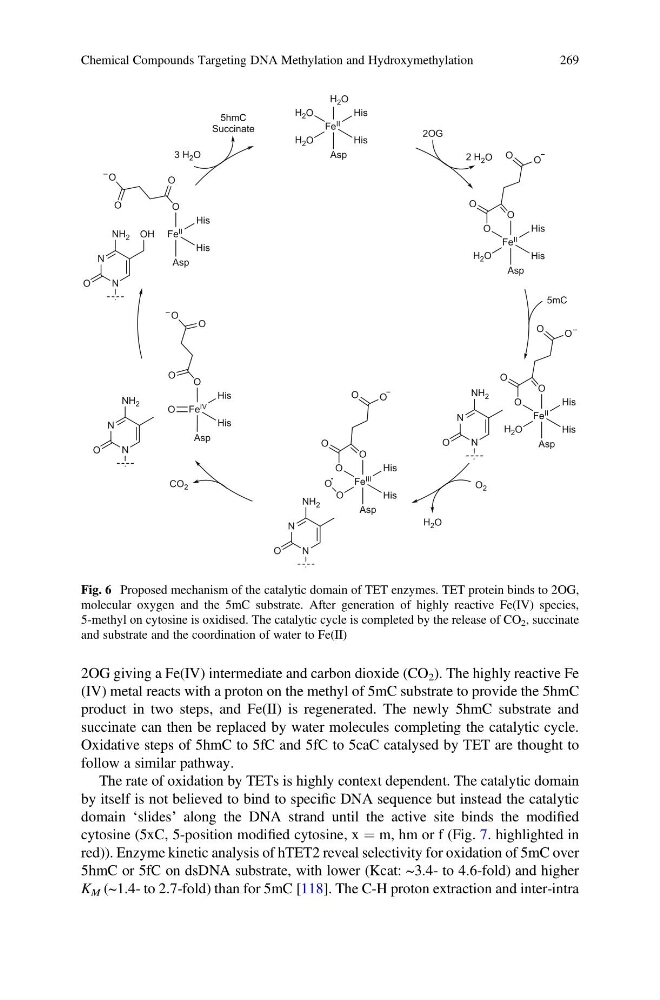
2OG giving a Fe(IV) intermediate and carbon dioxide (CO 2 ). The highly reactive Fe
(IV) metal reacts with a proton on the methyl of 5mC substrate to provide the 5hmC
product in two steps, and Fe(II) is regenerated. The newly 5hmC substrate and
succinate can then be replaced by water molecules completing the catalytic cycle.
Oxidative steps of 5hmC to 5fC and 5fC to 5caC catalysed by TET are thought to
follow a similar pathway.
The rate of oxidation by TETs is highly context dependent. The catalytic domain
by itself is not believed to bind to specific DNA sequence but instead the catalytic
domain ‘slides’ along the DNA strand until the active site binds the modified
cytosine (5xC, 5-position modified cytosine, x ¼ m, hm or f (Fig. 7. highlighted in
red)). Enzyme kinetic analysis of hTET2 reveal selectivity for oxidation of 5mC over
5hmC or 5fC on dsDNA substrate, with lower (Kcat: ~3.4- to 4.6-fold) and higher
K M (~1.4- to 2.7-fold) than for 5mC [118]. The C-H proton extraction and inter-intra
Fe II
His
H 2 O
Asp
His
H 2 O
H 2 O
Fe II
His
O
Asp
His
O
H 2 O
2OG
2 H 2 O
N
N
NH 2
O
Fe II
His
O
Asp
His
O
O
H 2 O
N
N
NH 2
O
Fe III
His
O
Asp
His
O
O
O
O
N
N
NH 2
O
Fe IV
His
O
Asp
His
O
O
N
N
NH 2
O
Fe II
His
O
Asp
His
OH
O
5mC
3 H 2 O
5hmC
Succinate
O 2
H 2 O
CO 2
O
O
O
O
O
O
O
O
O
O
O
Fig. 6 Proposed mechanism of the catalytic domain of TET enzymes. TET protein binds to 2OG,
molecular oxygen and the 5mC substrate. After generation of highly reactive Fe(IV) species,
5-methyl on cytosine is oxidised. The catalytic cycle is completed by the release of CO 2 , succinate
and substrate and the coordination of water to Fe(II)
Chemical Compounds Targeting DNA Methylation and Hydroxymethylation
269
(IV) metal reacts with a proton on the methyl of 5mC substrate to provide the 5hmC
product in two steps, and Fe(II) is regenerated. The newly 5hmC substrate and
succinate can then be replaced by water molecules completing the catalytic cycle.
Oxidative steps of 5hmC to 5fC and 5fC to 5caC catalysed by TET are thought to
follow a similar pathway.
The rate of oxidation by TETs is highly context dependent. The catalytic domain
by itself is not believed to bind to specific DNA sequence but instead the catalytic
domain ‘slides’ along the DNA strand until the active site binds the modified
cytosine (5xC, 5-position modified cytosine, x ¼ m, hm or f (Fig. 7. highlighted in
red)). Enzyme kinetic analysis of hTET2 reveal selectivity for oxidation of 5mC over
5hmC or 5fC on dsDNA substrate, with lower (Kcat: ~3.4- to 4.6-fold) and higher
K M (~1.4- to 2.7-fold) than for 5mC [118]. The C-H proton extraction and inter-intra
Fe II
His
H 2 O
Asp
His
H 2 O
H 2 O
Fe II
His
O
Asp
His
O
H 2 O
2OG
2 H 2 O
N
N
NH 2
O
Fe II
His
O
Asp
His
O
O
H 2 O
N
N
NH 2
O
Fe III
His
O
Asp
His
O
O
O
O
N
N
NH 2
O
Fe IV
His
O
Asp
His
O
O
N
N
NH 2
O
Fe II
His
O
Asp
His
OH
O
5mC
3 H 2 O
5hmC
Succinate
O 2
H 2 O
CO 2
O
O
O
O
O
O
O
O
O
O
O
Fig. 6 Proposed mechanism of the catalytic domain of TET enzymes. TET protein binds to 2OG,
molecular oxygen and the 5mC substrate. After generation of highly reactive Fe(IV) species,
5-methyl on cytosine is oxidised. The catalytic cycle is completed by the release of CO 2 , succinate
and substrate and the coordination of water to Fe(II)
Chemical Compounds Targeting DNA Methylation and Hydroxymethylation
269