

molecular proton stabilisation are understood to be important in determining the
differential rates of catalysis. Furthermore, hydroxyl group at the 2
0 position on the
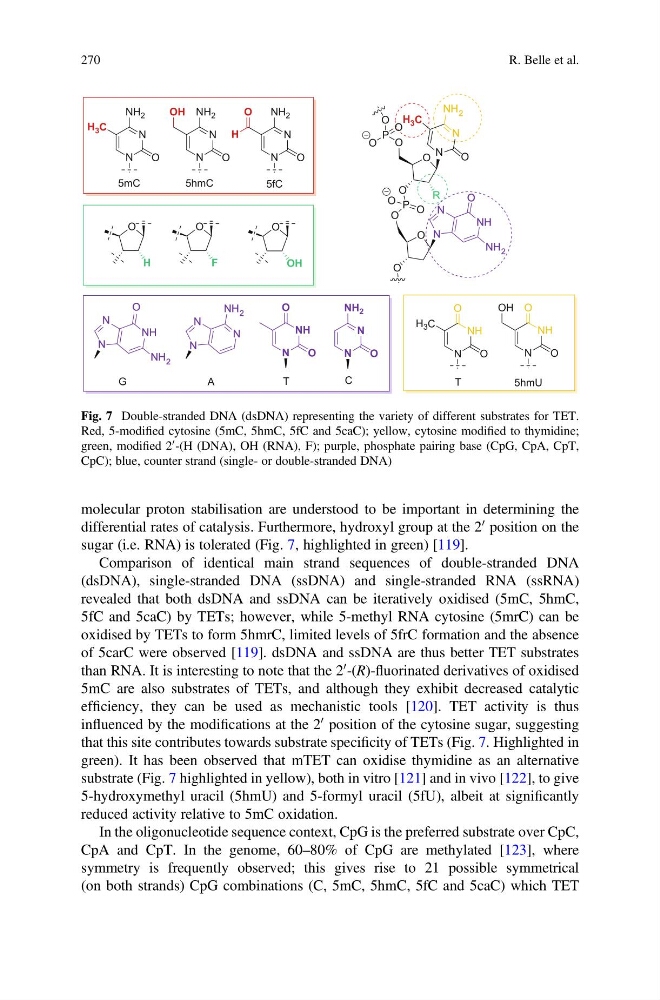
sugar (i.e. RNA) is tolerated (Fig. 7, highlighted in green) [119].
Comparison of identical main strand sequences of double-stranded DNA
(dsDNA), single-stranded DNA (ssDNA) and single-stranded RNA (ssRNA)
revealed that both dsDNA and ssDNA can be iteratively oxidised (5mC, 5hmC,
5fC and 5caC) by TETs; however, while 5-methyl RNA cytosine (5mrC) can be
oxidised by TETs to form 5hmrC, limited levels of 5frC formation and the absence
of 5carC were observed [119]. dsDNA and ssDNA are thus better TET substrates
than RNA. It is interesting to note that the 2
0 -(R)-fluorinated derivatives of oxidised
5mC are also substrates of TETs, and although they exhibit decreased catalytic
efficiency, they can be used as mechanistic tools [120]. TET activity is thus
influenced by the modifications at the 2
0 position of the cytosine sugar, suggesting
that this site contributes towards substrate specificity of TETs (Fig. 7. Highlighted in
green). It has been observed that mTET can oxidise thymidine as an alternative
substrate (Fig. 7 highlighted in yellow), both in vitro [121] and in vivo [122], to give
5-hydroxymethyl uracil (5hmU) and 5-formyl uracil (5fU), albeit at significantly
reduced activity relative to 5mC oxidation.
In the oligonucleotide sequence context, CpG is the preferred substrate over CpC,
CpA and CpT. In the genome, 60–80% of CpG are methylated [123], where
symmetry is frequently observed; this gives rise to 21 possible symmetrical
(on both strands) CpG combinations (C, 5mC, 5hmC, 5fC and 5caC) which TET
O
1
1
O
P
O
O
O
O 1
1
1+ 1+
O
1+ 1+
H 3 C
2
2
1+ 1+
O
P
O
O
O
5
N
NH
H 3 C
O
O
N
N
O
NH 2
H 3 C
N
N
O
NH 2
OH
N
N
O
NH 2
O
H
N
NH
O
O
OH
O
H
O
F
O
OH
1
1
1+ 1+
2
1+ 1+
1
1
1
1+ 1+
N
NH
N
N
O
O
NH 2
O
5mC
5hmC
5fC
G
A
T
C
T
5hmU
Fig. 7 Double-stranded DNA (dsDNA) representing the variety of different substrates for TET.
Red, 5-modified cytosine (5mC, 5hmC, 5fC and 5caC); yellow, cytosine modified to thymidine;
green, modified 2
0 -(H (DNA), OH (RNA), F); purple, phosphate pairing base (CpG, CpA, CpT,
CpC); blue, counter strand (single- or double-stranded DNA)
270
R. Belle et al.
differential rates of catalysis. Furthermore, hydroxyl group at the 2
0 position on the
sugar (i.e. RNA) is tolerated (Fig. 7, highlighted in green) [119].
Comparison of identical main strand sequences of double-stranded DNA
(dsDNA), single-stranded DNA (ssDNA) and single-stranded RNA (ssRNA)
revealed that both dsDNA and ssDNA can be iteratively oxidised (5mC, 5hmC,
5fC and 5caC) by TETs; however, while 5-methyl RNA cytosine (5mrC) can be
oxidised by TETs to form 5hmrC, limited levels of 5frC formation and the absence
of 5carC were observed [119]. dsDNA and ssDNA are thus better TET substrates
than RNA. It is interesting to note that the 2
0 -(R)-fluorinated derivatives of oxidised
5mC are also substrates of TETs, and although they exhibit decreased catalytic
efficiency, they can be used as mechanistic tools [120]. TET activity is thus
influenced by the modifications at the 2
0 position of the cytosine sugar, suggesting
that this site contributes towards substrate specificity of TETs (Fig. 7. Highlighted in
green). It has been observed that mTET can oxidise thymidine as an alternative
substrate (Fig. 7 highlighted in yellow), both in vitro [121] and in vivo [122], to give
5-hydroxymethyl uracil (5hmU) and 5-formyl uracil (5fU), albeit at significantly
reduced activity relative to 5mC oxidation.
In the oligonucleotide sequence context, CpG is the preferred substrate over CpC,
CpA and CpT. In the genome, 60–80% of CpG are methylated [123], where
symmetry is frequently observed; this gives rise to 21 possible symmetrical
(on both strands) CpG combinations (C, 5mC, 5hmC, 5fC and 5caC) which TET
O
1
1
O
P
O
O
O
O 1
1
1+ 1+
O
1+ 1+
H 3 C
2
2
1+ 1+
O
P
O
O
O
5
N
NH
H 3 C
O
O
N
N
O
NH 2
H 3 C
N
N
O
NH 2
OH
N
N
O
NH 2
O
H
N
NH
O
O
OH
O
H
O
F
O
OH
1
1
1+ 1+
2
1+ 1+
1
1
1
1+ 1+
N
NH
N
N
O
O
NH 2
O
5mC
5hmC
5fC
G
A
T
C
T
5hmU
Fig. 7 Double-stranded DNA (dsDNA) representing the variety of different substrates for TET.
Red, 5-modified cytosine (5mC, 5hmC, 5fC and 5caC); yellow, cytosine modified to thymidine;
green, modified 2
0 -(H (DNA), OH (RNA), F); purple, phosphate pairing base (CpG, CpA, CpT,
CpC); blue, counter strand (single- or double-stranded DNA)
270
R. Belle et al.