

3.2 Substrate Competitive Inhibitors
3.2.1 Histone Peptide-Derived Inhibitors
As discussed in Sect. 2.1.2, histone peptide sequences and methylation states can
provide remarkable selectivity towards individual JmjC-KDMs/subfamilies. However, the affinities of histone peptides are generally weaker for the JmjC-domains
(as reflected in their K M values (10
À5
–10
À4 M)), compared to ‘reader’ binding
domains, where the K d values can be in the sub-micromolar range. Thus, efforts
have been made to combine the histone peptides with metal-chelating inhibitors to
achieve both selectivity and potency. Woon et al. used dynamic chemistry (using
multiple thiols) linked to mass spectrometry analysis to identify optimal positions to
conjugate a 2OG cofactor mimic, N-oxalylcysteine (NOC), to histone peptides
[73]. H3K9me3 peptides with Cys at varying positions along the histone peptide
were incubated with L-NOC or D-NOC, and various products were tested.
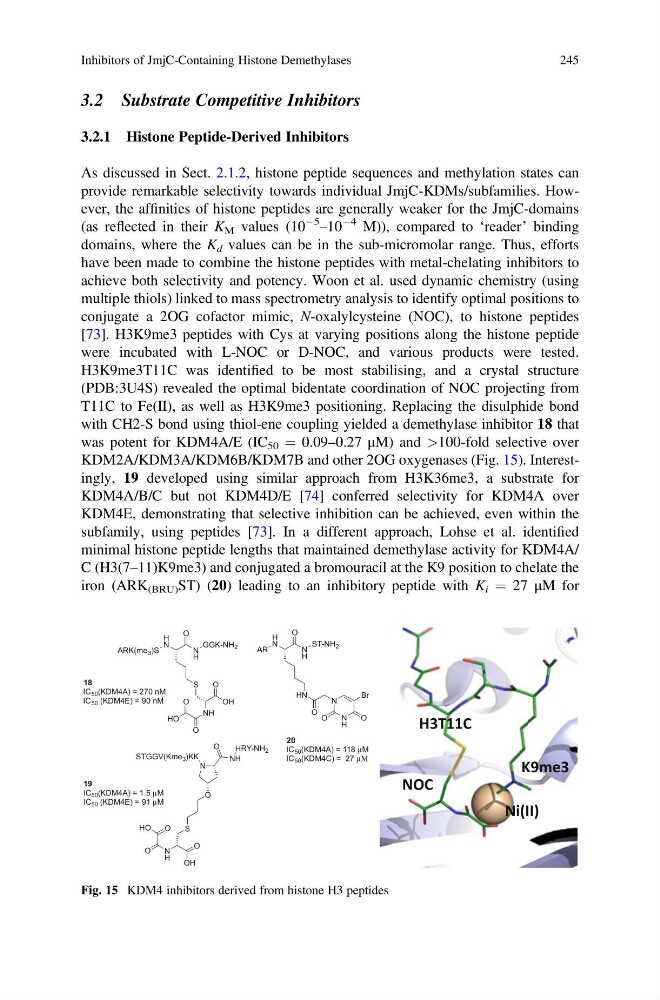
H3K9me3T11C was identified to be most stabilising, and a crystal structure
(PDB:3U4S) revealed the optimal bidentate coordination of NOC projecting from
T11C to Fe(II), as well as H3K9me3 positioning. Replacing the disulphide bond
with CH2-S bond using thiol-ene coupling yielded a demethylase inhibitor 18 that
was potent for KDM4A/E (IC 50 ¼ 0.09–0.27 μM) and >100-fold selective over
KDM2A/KDM3A/KDM6B/KDM7B and other 2OG oxygenases (Fig. 15). Interestingly, 19 developed using similar approach from H3K36me3, a substrate for
KDM4A/B/C but not KDM4D/E [74] conferred selectivity for KDM4A over
KDM4E, demonstrating that selective inhibition can be achieved, even within the
subfamily, using peptides [73]. In a different approach, Lohse et al. identified
minimal histone peptide lengths that maintained demethylase activity for KDM4A/
C (H3(7–11)K9me3) and conjugated a bromouracil at the K9 position to chelate the
iron (ARK (BRU) ST) (20) leading to an inhibitory peptide with K i ¼ 27 μM for
NOC
Ni(II)
K9me3
H3T11C
O
N
H
GGK-NH 2
H
N
S
NH
OH
O
O
O
HO
ARK(me 3 )S
S
N
H
OH
O
O
O
HO
O
N
NH
O
H
STGGV(Kme 3 )KK
RY-NH 2
O
N
H
ST-NH 2
H
N
HN
O
AR
N
N
H
O
O
18
IC 50 (KDM4A) = 270 nM
IC 50 (KDM4E) = 90 nM
19
IC 50 (KDM4A) = 1.5 μM
IC 50 (KDM4E) = 91 μM
20
IC 50 (KDM4A) = 118 μM
IC 50 (KDM4C) = 27 μΜ
Br
Fig. 15 KDM4 inhibitors derived from histone H3 peptides
Inhibitors of JmjC-Containing Histone Demethylases
245
3.2.1 Histone Peptide-Derived Inhibitors
As discussed in Sect. 2.1.2, histone peptide sequences and methylation states can
provide remarkable selectivity towards individual JmjC-KDMs/subfamilies. However, the affinities of histone peptides are generally weaker for the JmjC-domains
(as reflected in their K M values (10
À5
–10
À4 M)), compared to ‘reader’ binding
domains, where the K d values can be in the sub-micromolar range. Thus, efforts
have been made to combine the histone peptides with metal-chelating inhibitors to
achieve both selectivity and potency. Woon et al. used dynamic chemistry (using
multiple thiols) linked to mass spectrometry analysis to identify optimal positions to
conjugate a 2OG cofactor mimic, N-oxalylcysteine (NOC), to histone peptides
[73]. H3K9me3 peptides with Cys at varying positions along the histone peptide
were incubated with L-NOC or D-NOC, and various products were tested.
H3K9me3T11C was identified to be most stabilising, and a crystal structure
(PDB:3U4S) revealed the optimal bidentate coordination of NOC projecting from
T11C to Fe(II), as well as H3K9me3 positioning. Replacing the disulphide bond
with CH2-S bond using thiol-ene coupling yielded a demethylase inhibitor 18 that
was potent for KDM4A/E (IC 50 ¼ 0.09–0.27 μM) and >100-fold selective over
KDM2A/KDM3A/KDM6B/KDM7B and other 2OG oxygenases (Fig. 15). Interestingly, 19 developed using similar approach from H3K36me3, a substrate for
KDM4A/B/C but not KDM4D/E [74] conferred selectivity for KDM4A over
KDM4E, demonstrating that selective inhibition can be achieved, even within the
subfamily, using peptides [73]. In a different approach, Lohse et al. identified
minimal histone peptide lengths that maintained demethylase activity for KDM4A/
C (H3(7–11)K9me3) and conjugated a bromouracil at the K9 position to chelate the
iron (ARK (BRU) ST) (20) leading to an inhibitory peptide with K i ¼ 27 μM for
NOC
Ni(II)
K9me3
H3T11C
O
N
H
GGK-NH 2
H
N
S
NH
OH
O
O
O
HO
ARK(me 3 )S
S
N
H
OH
O
O
O
HO
O
N
NH
O
H
STGGV(Kme 3 )KK
RY-NH 2
O
N
H
ST-NH 2
H
N
HN
O
AR
N
N
H
O
O
18
IC 50 (KDM4A) = 270 nM
IC 50 (KDM4E) = 90 nM
19
IC 50 (KDM4A) = 1.5 μM
IC 50 (KDM4E) = 91 μM
20
IC 50 (KDM4A) = 118 μM
IC 50 (KDM4C) = 27 μΜ
Br
Fig. 15 KDM4 inhibitors derived from histone H3 peptides
Inhibitors of JmjC-Containing Histone Demethylases
245