

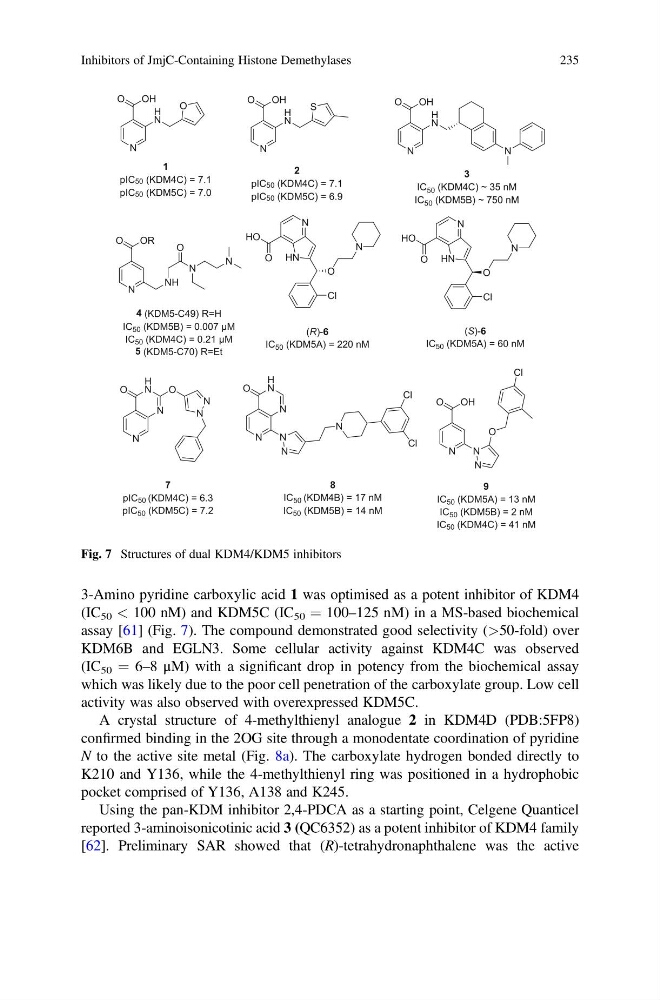
3-Amino pyridine carboxylic acid 1 was optimised as a potent inhibitor of KDM4
(IC 50 < 100 nM) and KDM5C (IC 50 ¼ 100–125 nM) in a MS-based biochemical
assay [61] (Fig. 7). The compound demonstrated good selectivity (>50-fold) over
KDM6B and EGLN3. Some cellular activity against KDM4C was observed
(IC 50 ¼ 6–8 μM) with a significant drop in potency from the biochemical assay
which was likely due to the poor cell penetration of the carboxylate group. Low cell
activity was also observed with overexpressed KDM5C.
A crystal structure of 4-methylthienyl analogue 2 in KDM4D (PDB:5FP8)
confirmed binding in the 2OG site through a monodentate coordination of pyridine
N to the active site metal (Fig. 8a). The carboxylate hydrogen bonded directly to
K210 and Y136, while the 4-methylthienyl ring was positioned in a hydrophobic
pocket comprised of Y136, A138 and K245.
Using the pan-KDM inhibitor 2,4-PDCA as a starting point, Celgene Quanticel
reported 3-aminoisonicotinic acid 3 (QC6352) as a potent inhibitor of KDM4 family
[62]. Preliminary SAR showed that (R)-tetrahydronaphthalene was the active
N
OH
O
H
N
O
N
OH
O
H
N
S
1
pIC50 (KDM4C) = 7.1
pIC50 (KDM5C) = 7.0
2
pIC50 (KDM4C) = 7.1
pIC50 (KDM5C) = 6.9
N
OH
O
H
N
N
3
IC 50 (KDM4C) ~ 35 nM
IC 50 (KDM5B) ~ 750 nM
N
O
OR
NH
O
N
N
4 (KDM5-C49) R=H
IC 50 (KDM5B) = 0.007 μM
IC 50 (KDM4C) = 0.21 μM
5 (KDM5-C70) R=Et
HO
O
N
HN
O
Cl
N
(R)-6
IC 50 (KDM5A) = 220 nM
HO
O
N
HN
O
Cl
N
(S)-6
IC 50 (KDM5A) = 60 nM
N
N
H
N
O
O
N
N
7
pIC 50 (KDM4C) = 6.3
pIC 50 (KDM5C) = 7.2
N
N
H
N
N
O
N
N
Cl
Cl
8
IC 50 (KDM4B) = 17 nM
IC 50 (KDM5B) = 14 nM
N
O
OH
N
N
O
Cl
9
IC 50 (KDM5A) = 13 nM
IC 50 (KDM5B) = 2 nM
IC 50 (KDM4C) = 41 nM
Fig. 7 Structures of dual KDM4/KDM5 inhibitors
Inhibitors of JmjC-Containing Histone Demethylases
235
(IC 50 < 100 nM) and KDM5C (IC 50 ¼ 100–125 nM) in a MS-based biochemical
assay [61] (Fig. 7). The compound demonstrated good selectivity (>50-fold) over
KDM6B and EGLN3. Some cellular activity against KDM4C was observed
(IC 50 ¼ 6–8 μM) with a significant drop in potency from the biochemical assay
which was likely due to the poor cell penetration of the carboxylate group. Low cell
activity was also observed with overexpressed KDM5C.
A crystal structure of 4-methylthienyl analogue 2 in KDM4D (PDB:5FP8)
confirmed binding in the 2OG site through a monodentate coordination of pyridine
N to the active site metal (Fig. 8a). The carboxylate hydrogen bonded directly to
K210 and Y136, while the 4-methylthienyl ring was positioned in a hydrophobic
pocket comprised of Y136, A138 and K245.
Using the pan-KDM inhibitor 2,4-PDCA as a starting point, Celgene Quanticel
reported 3-aminoisonicotinic acid 3 (QC6352) as a potent inhibitor of KDM4 family
[62]. Preliminary SAR showed that (R)-tetrahydronaphthalene was the active
N
OH
O
H
N
O
N
OH
O
H
N
S
1
pIC50 (KDM4C) = 7.1
pIC50 (KDM5C) = 7.0
2
pIC50 (KDM4C) = 7.1
pIC50 (KDM5C) = 6.9
N
OH
O
H
N
N
3
IC 50 (KDM4C) ~ 35 nM
IC 50 (KDM5B) ~ 750 nM
N
O
OR
NH
O
N
N
4 (KDM5-C49) R=H
IC 50 (KDM5B) = 0.007 μM
IC 50 (KDM4C) = 0.21 μM
5 (KDM5-C70) R=Et
HO
O
N
HN
O
Cl
N
(R)-6
IC 50 (KDM5A) = 220 nM
HO
O
N
HN
O
Cl
N
(S)-6
IC 50 (KDM5A) = 60 nM
N
N
H
N
O
O
N
N
7
pIC 50 (KDM4C) = 6.3
pIC 50 (KDM5C) = 7.2
N
N
H
N
N
O
N
N
Cl
Cl
8
IC 50 (KDM4B) = 17 nM
IC 50 (KDM5B) = 14 nM
N
O
OH
N
N
O
Cl
9
IC 50 (KDM5A) = 13 nM
IC 50 (KDM5B) = 2 nM
IC 50 (KDM4C) = 41 nM
Fig. 7 Structures of dual KDM4/KDM5 inhibitors
Inhibitors of JmjC-Containing Histone Demethylases
235