

3 Development of JmjC-KDM Inhibitors
There has been significant progress in the development of JmjC-KDM inhibitors
since the first inhibitors were reported in 2008 [57]. The overwhelming majority
targets the catalytic domain and inhibits the enzyme activity via chelating the active
site Fe(II), often competing with 2OG binding. Due to the similarity in the active site
pockets of JmjC-KDMs, achieving selectivity has proved challenging, not only
between different JmjC-KDM subfamilies but also across a wider 2OG oxygenases
superfamily [58]. The recent availability of crystal structures of JmjC-KDM has
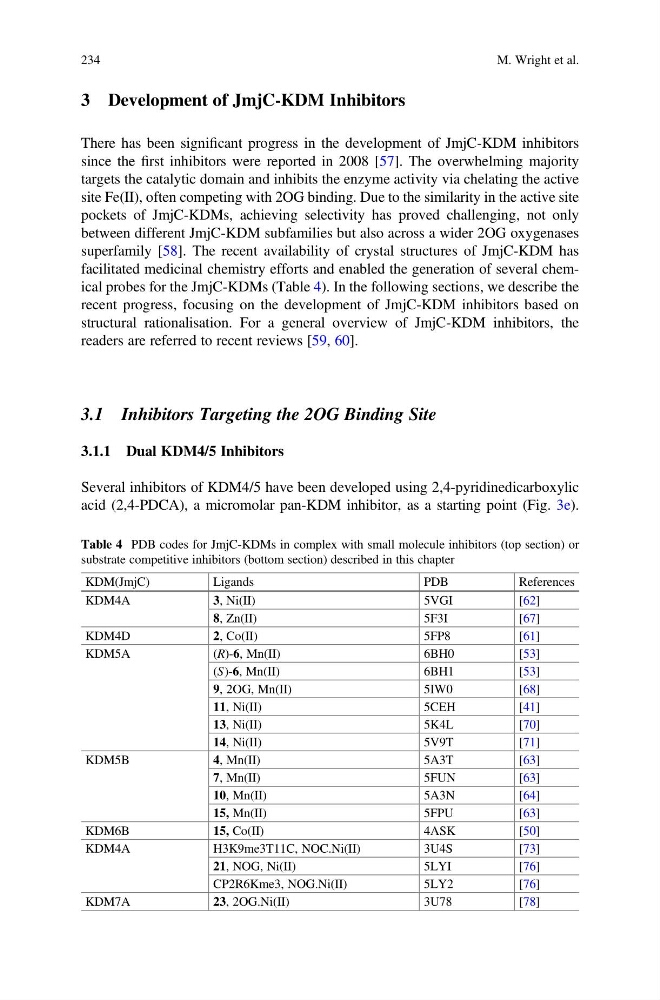
facilitated medicinal chemistry efforts and enabled the generation of several chemical probes for the JmjC-KDMs (Table 4). In the following sections, we describe the
recent progress, focusing on the development of JmjC-KDM inhibitors based on
structural rationalisation. For a general overview of JmjC-KDM inhibitors, the
readers are referred to recent reviews [59, 60].
3.1 Inhibitors Targeting the 2OG Binding Site
3.1.1 Dual KDM4/5 Inhibitors
Several inhibitors of KDM4/5 have been developed using 2,4-pyridinedicarboxylic
acid (2,4-PDCA), a micromolar pan-KDM inhibitor, as a starting point (Fig. 3e).
Table 4 PDB codes for JmjC-KDMs in complex with small molecule inhibitors (top section) or
substrate competitive inhibitors (bottom section) described in this chapter
KDM(JmjC)
Ligands
PDB
References
KDM4A
3, Ni(II)
5VGI
[62]
8, Zn(II)
5F3I
[67]
KDM4D
2, Co(II)
5FP8
[61]
KDM5A
(R)-6, Mn(II)
6BH0
[53]
(S)-6, Mn(II)
6BH1
[53]
9, 2OG, Mn(II)
5IW0
[68]
11, Ni(II)
5CEH
[41]
13, Ni(II)
5K4L
[70]
14, Ni(II)
5V9T
[71]
KDM5B
4, Mn(II)
5A3T
[63]
7, Mn(II)
5FUN
[63]
10, Mn(II)
5A3N
[64]
15, Mn(II)
5FPU
[63]
KDM6B
15, Co(II)
4ASK
[50]
KDM4A
H3K9me3T11C, NOC.Ni(II)
3U4S
[73]
21, NOG, Ni(II)
5LYI
[76]
CP2R6Kme3, NOG.Ni(II)
5LY2
[76]
KDM7A
23, 2OG.Ni(II)
3U78
[78]
234
M. Wright et al.
There has been significant progress in the development of JmjC-KDM inhibitors
since the first inhibitors were reported in 2008 [57]. The overwhelming majority
targets the catalytic domain and inhibits the enzyme activity via chelating the active
site Fe(II), often competing with 2OG binding. Due to the similarity in the active site
pockets of JmjC-KDMs, achieving selectivity has proved challenging, not only
between different JmjC-KDM subfamilies but also across a wider 2OG oxygenases
superfamily [58]. The recent availability of crystal structures of JmjC-KDM has
facilitated medicinal chemistry efforts and enabled the generation of several chemical probes for the JmjC-KDMs (Table 4). In the following sections, we describe the
recent progress, focusing on the development of JmjC-KDM inhibitors based on
structural rationalisation. For a general overview of JmjC-KDM inhibitors, the
readers are referred to recent reviews [59, 60].
3.1 Inhibitors Targeting the 2OG Binding Site
3.1.1 Dual KDM4/5 Inhibitors
Several inhibitors of KDM4/5 have been developed using 2,4-pyridinedicarboxylic
acid (2,4-PDCA), a micromolar pan-KDM inhibitor, as a starting point (Fig. 3e).
Table 4 PDB codes for JmjC-KDMs in complex with small molecule inhibitors (top section) or
substrate competitive inhibitors (bottom section) described in this chapter
KDM(JmjC)
Ligands
PDB
References
KDM4A
3, Ni(II)
5VGI
[62]
8, Zn(II)
5F3I
[67]
KDM4D
2, Co(II)
5FP8
[61]
KDM5A
(R)-6, Mn(II)
6BH0
[53]
(S)-6, Mn(II)
6BH1
[53]
9, 2OG, Mn(II)
5IW0
[68]
11, Ni(II)
5CEH
[41]
13, Ni(II)
5K4L
[70]
14, Ni(II)
5V9T
[71]
KDM5B
4, Mn(II)
5A3T
[63]
7, Mn(II)
5FUN
[63]
10, Mn(II)
5A3N
[64]
15, Mn(II)
5FPU
[63]
KDM6B
15, Co(II)
4ASK
[50]
KDM4A
H3K9me3T11C, NOC.Ni(II)
3U4S
[73]
21, NOG, Ni(II)
5LYI
[76]
CP2R6Kme3, NOG.Ni(II)
5LY2
[76]
KDM7A
23, 2OG.Ni(II)
3U78
[78]
234
M. Wright et al.