

subcutaneously with hormone-resistant prostate cancer PCai1 cells without adverse
effects, suggesting the potential of LSD1 inhibitors as therapeutic agents for
hormone-resistant prostate cancer [59]. These results point to the possibility of
NCL1 as an anticancer agent.
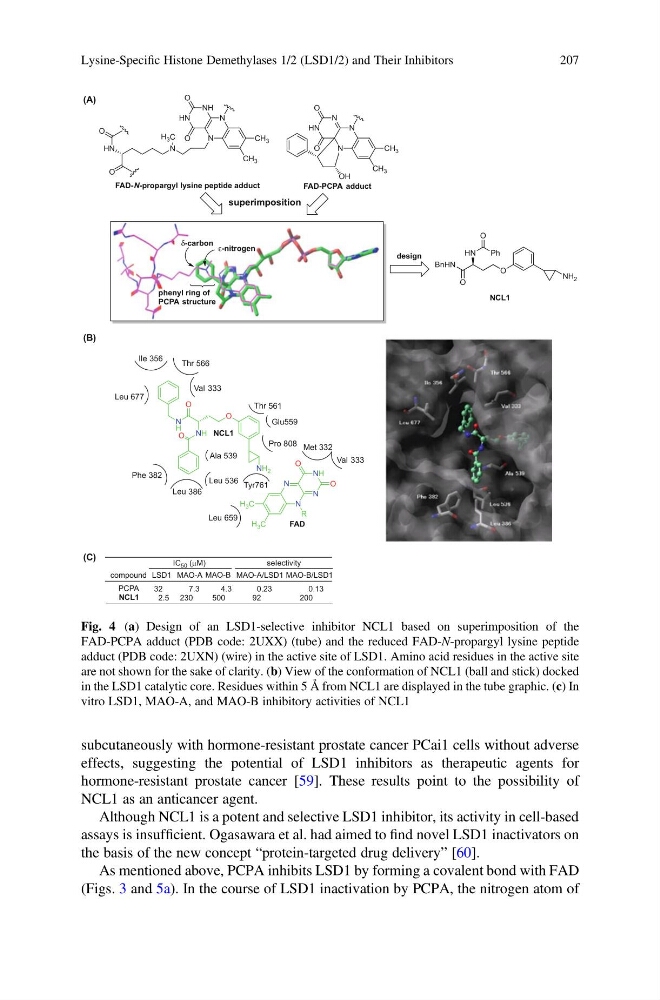
Although NCL1 is a potent and selective LSD1 inhibitor, its activity in cell-based
assays is insufficient. Ogasawara et al. had aimed to find novel LSD1 inactivators on
the basis of the new concept “protein-targeted drug delivery” [60].
As mentioned above, PCPA inhibits LSD1 by forming a covalent bond with FAD
(Figs. 3 and 5a). In the course of LSD1 inactivation by PCPA, the nitrogen atom of
FAD-PCPA adduct
superimposition
δ-carbon ε-nitrogen
phenyl ring of
PCPA structure
N
HN
N
N
CH 3
CH 3
O
O
OH
NH
HN
N
N
CH 3
CH 3
O
O
N
H 3 C
O
HN
O
FAD-N-propargyl lysine peptide adduct
HN
BnHN
O
O
Ph
O
design
(A)
(B)
N
H
O
NH
O
O
NH 2
NCL1
N
N
H 3 C
H 3 C
R
N
NH
O
O
FAD
Ile 356
Leu 677
Thr 566
Val 333
Phe 382
Leu 386
Leu 536
Ala 539
Tyr761
Thr 561
Glu559
Pro 808 Met 332
Val 333
Leu 659
(C)
compound LSD1
IC 50 (M)
PCPA
NCL1
32
2.5
MAO-A MAO-B MAO-A/LSD1
seIectivity
MAO-B/LSD1
7.3
230
4.3
500
0.23
92
0.13
200
NH 2
NCL1
Fig. 4 (a) Design of an LSD1-selective inhibitor NCL1 based on superimposition of the
FAD-PCPA adduct (PDB code: 2UXX) (tube) and the reduced FAD-N-propargyl lysine peptide
adduct (PDB code: 2UXN) (wire) in the active site of LSD1. Amino acid residues in the active site
are not shown for the sake of clarity. (b) View of the conformation of NCL1 (ball and stick) docked
in the LSD1 catalytic core. Residues within 5 Å from NCL1 are displayed in the tube graphic. (c) In
vitro LSD1, MAO-A, and MAO-B inhibitory activities of NCL1
Lysine-Specific Histone Demethylases 1/2 (LSD1/2) and Their Inhibitors
207
effects, suggesting the potential of LSD1 inhibitors as therapeutic agents for
hormone-resistant prostate cancer [59]. These results point to the possibility of
NCL1 as an anticancer agent.
Although NCL1 is a potent and selective LSD1 inhibitor, its activity in cell-based
assays is insufficient. Ogasawara et al. had aimed to find novel LSD1 inactivators on
the basis of the new concept “protein-targeted drug delivery” [60].
As mentioned above, PCPA inhibits LSD1 by forming a covalent bond with FAD
(Figs. 3 and 5a). In the course of LSD1 inactivation by PCPA, the nitrogen atom of
FAD-PCPA adduct
superimposition
δ-carbon ε-nitrogen
phenyl ring of
PCPA structure
N
HN
N
N
CH 3
CH 3
O
O
OH
NH
HN
N
N
CH 3
CH 3
O
O
N
H 3 C
O
HN
O
FAD-N-propargyl lysine peptide adduct
HN
BnHN
O
O
Ph
O
design
(A)
(B)
N
H
O
NH
O
O
NH 2
NCL1
N
N
H 3 C
H 3 C
R
N
NH
O
O
FAD
Ile 356
Leu 677
Thr 566
Val 333
Phe 382
Leu 386
Leu 536
Ala 539
Tyr761
Thr 561
Glu559
Pro 808 Met 332
Val 333
Leu 659
(C)
compound LSD1
IC 50 (M)
PCPA
NCL1
32
2.5
MAO-A MAO-B MAO-A/LSD1
seIectivity
MAO-B/LSD1
7.3
230
4.3
500
0.23
92
0.13
200
NH 2
NCL1
Fig. 4 (a) Design of an LSD1-selective inhibitor NCL1 based on superimposition of the
FAD-PCPA adduct (PDB code: 2UXX) (tube) and the reduced FAD-N-propargyl lysine peptide
adduct (PDB code: 2UXN) (wire) in the active site of LSD1. Amino acid residues in the active site
are not shown for the sake of clarity. (b) View of the conformation of NCL1 (ball and stick) docked
in the LSD1 catalytic core. Residues within 5 Å from NCL1 are displayed in the tube graphic. (c) In
vitro LSD1, MAO-A, and MAO-B inhibitory activities of NCL1
Lysine-Specific Histone Demethylases 1/2 (LSD1/2) and Their Inhibitors
207