

bind to the methylated lysine substrate-binding site of LSD1 and they possess the
PCPA structure that reacts with FAD in the active site of LSD1. Small-molecule
PCPA-lysine analog hybrid compounds were designed on the basis of the X-ray
crystal structures of the FAD-PCPA adduct and the FAD-N-propargyl lysine peptide
adduct in the active site of LSD1 [17, 52]. The superimposition of the two structures
is shown in Fig. 4a. The FAD parts of the two adducts are well superimposed, and
the phenyl ring of the FAD-PCPA adduct overlaps with ε-N and δ-C of the FAD-Npropargyl lysine peptide adduct. Based on these superimposed structures, PCPAlysine analog hybrid compound NCL1 was designed (Figs. 2 and 4a), in which the
side chain of the amino acid is linked to the phenyl ring of PCPA through an ether
bond at the meta and para positions, respectively. Benzylamino and benzoyl groups
were chosen as the substituents of the carbonyl and amino groups of the amino acid,
respectively, because they were expected to be recognized by hydrophobic amino
acid residues (Val 333, Ile 356, Phe 382, Leu 386, Leu 536, Ala 539, Thr 566, and
Leu 677) at the entrance to the N-methylated lysine binding channel of LSD1
(Fig. 4b). In addition, the attachment of these small, hydrophobic groups could
enhance membrane permeability. Furthermore, NCL1 was expected to selectively
inhibit LSD1 over MAO-A and MAO-B, as the X-ray crystal structures of MAO-A
and MAO-B indicated that their active-site cavities are not sufficiently capacious to
accommodate the large group attached to the phenyl ring of PCPA in NCL1. NCL1
was prepared and its inhibitory activities toward human LSD1 and MAO-A and
MAO-B were evaluated. Kinetic analysis and MS analysis suggested that the
inhibitory activity of NCL1 occurs via the LSD1-directed synthesis of the
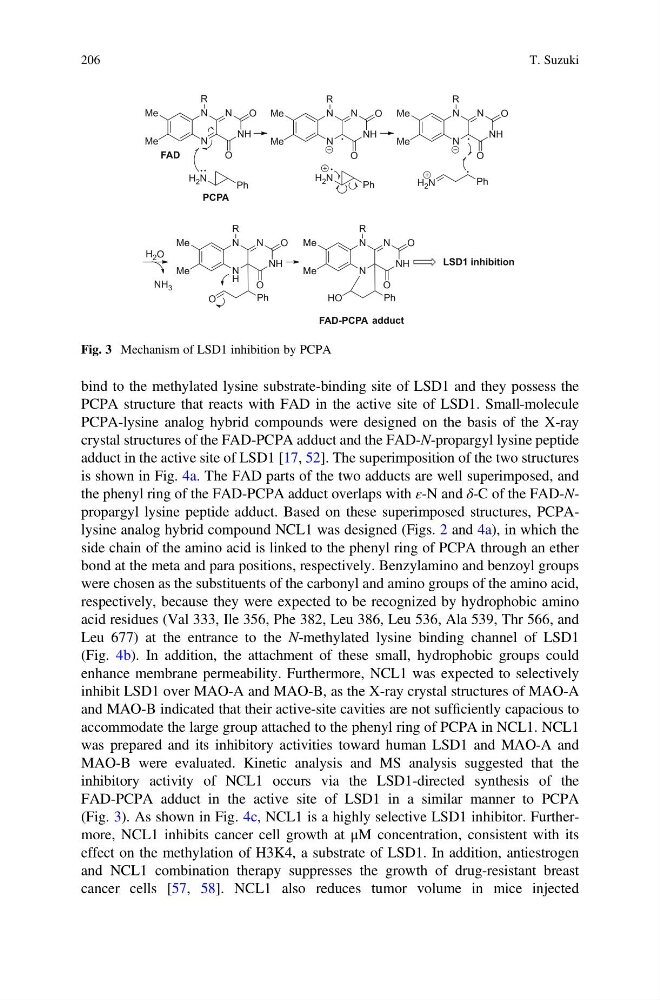
FAD-PCPA adduct in the active site of LSD1 in a similar manner to PCPA
(Fig. 3). As shown in Fig. 4c, NCL1 is a highly selective LSD1 inhibitor. Furthermore, NCL1 inhibits cancer cell growth at μM concentration, consistent with its
effect on the methylation of H3K4, a substrate of LSD1. In addition, antiestrogen
and NCL1 combination therapy suppresses the growth of drug-resistant breast
cancer cells [57, 58]. NCL1 also reduces tumor volume in mice injected
N
N
NH
N
Me
Me
R
O
O
FAD
PCPA
N
N
NH
N
Me
Me
R
O
O
Ph
H 2 N
Ph
H 2 N
N
N
NH
N
Me
Me
R
O
O
H 2 N
Ph
N
N
NH
N
Me
Me
R
O
O
Ph
HO
N
H
N
NH
N
Me
Me
R
O
O
Ph
O
H 2 O
NH 3
FAD-PCPA adduct
LSD1 inhibition
Fig. 3 Mechanism of LSD1 inhibition by PCPA
206
T. Suzuki
PCPA structure that reacts with FAD in the active site of LSD1. Small-molecule
PCPA-lysine analog hybrid compounds were designed on the basis of the X-ray
crystal structures of the FAD-PCPA adduct and the FAD-N-propargyl lysine peptide
adduct in the active site of LSD1 [17, 52]. The superimposition of the two structures
is shown in Fig. 4a. The FAD parts of the two adducts are well superimposed, and
the phenyl ring of the FAD-PCPA adduct overlaps with ε-N and δ-C of the FAD-Npropargyl lysine peptide adduct. Based on these superimposed structures, PCPAlysine analog hybrid compound NCL1 was designed (Figs. 2 and 4a), in which the
side chain of the amino acid is linked to the phenyl ring of PCPA through an ether
bond at the meta and para positions, respectively. Benzylamino and benzoyl groups
were chosen as the substituents of the carbonyl and amino groups of the amino acid,
respectively, because they were expected to be recognized by hydrophobic amino
acid residues (Val 333, Ile 356, Phe 382, Leu 386, Leu 536, Ala 539, Thr 566, and
Leu 677) at the entrance to the N-methylated lysine binding channel of LSD1
(Fig. 4b). In addition, the attachment of these small, hydrophobic groups could
enhance membrane permeability. Furthermore, NCL1 was expected to selectively
inhibit LSD1 over MAO-A and MAO-B, as the X-ray crystal structures of MAO-A
and MAO-B indicated that their active-site cavities are not sufficiently capacious to
accommodate the large group attached to the phenyl ring of PCPA in NCL1. NCL1
was prepared and its inhibitory activities toward human LSD1 and MAO-A and
MAO-B were evaluated. Kinetic analysis and MS analysis suggested that the
inhibitory activity of NCL1 occurs via the LSD1-directed synthesis of the
FAD-PCPA adduct in the active site of LSD1 in a similar manner to PCPA
(Fig. 3). As shown in Fig. 4c, NCL1 is a highly selective LSD1 inhibitor. Furthermore, NCL1 inhibits cancer cell growth at μM concentration, consistent with its
effect on the methylation of H3K4, a substrate of LSD1. In addition, antiestrogen
and NCL1 combination therapy suppresses the growth of drug-resistant breast
cancer cells [57, 58]. NCL1 also reduces tumor volume in mice injected
N
N
NH
N
Me
Me
R
O
O
FAD
PCPA
N
N
NH
N
Me
Me
R
O
O
Ph
H 2 N
Ph
H 2 N
N
N
NH
N
Me
Me
R
O
O
H 2 N
Ph
N
N
NH
N
Me
Me
R
O
O
Ph
HO
N
H
N
NH
N
Me
Me
R
O
O
Ph
O
H 2 O
NH 3
FAD-PCPA adduct
LSD1 inhibition
Fig. 3 Mechanism of LSD1 inhibition by PCPA
206
T. Suzuki