

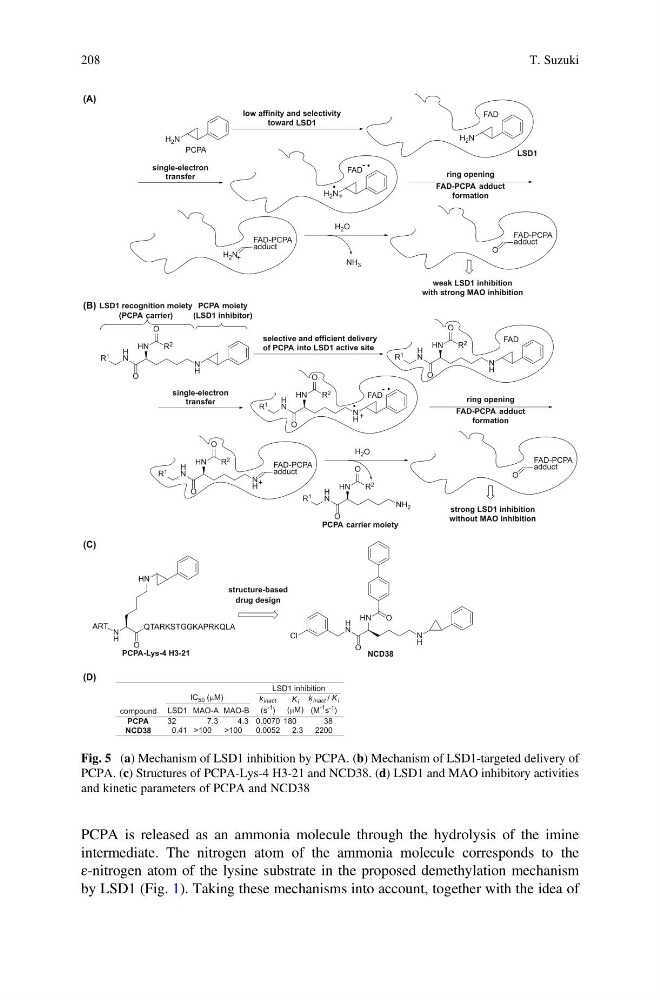
PCPA is released as an ammonia molecule through the hydrolysis of the imine
intermediate. The nitrogen atom of the ammonia molecule corresponds to the
ε-nitrogen atom of the lysine substrate in the proposed demethylation mechanism
by LSD1 (Fig. 1). Taking these mechanisms into account, together with the idea of
H 2 O
selective and efficient delivery
of PCPA into LSD1 active site
single-electron
transfer
FAD-PCPA adduct
formation
(A)
NH 2
HN
O
H
N
O
R 2
N
H
HN
O
H
N
O
R 2
FAD
N
H
HN
O
H
N
O
R 2
FAD-PCPA
adduct
PCPA moiety
(LSD1 inhibitor)
LSD1 recognition moiety
(PCPA carrier)
ring opening
(B)
strong LSD1 inhibition
without MAO inhibition
R 1
R 1
R 1
O
FAD-PCPA
adduct
N
H
HN
O
H
N
O
R 2
R 1
FAD
N
H
HN
O
H
N
O
R 2
R 1
H 2 O
low affinity and selectivity
toward LSD1
single-electron
transfer
FAD-PCPA adduct
formation
NH 3
H 2 N
FAD
H 2 N
FAD-PCPA
adduct
ring opening
weak LSD1 inhibition
with strong MAO inhibition
O
FAD-PCPA
adduct
H 2 N
FAD
H 2 N
PCPA
LSD1
+
-
+
-
+
+
PCPA-Lys-4 H3-21
N
H
ART
O
QTARKSTGGKAPRKQLA
HN
H
N
HN
O
O
N
H
Cl
(C)
structure-based
drug design
NCD38
(D)
LSD1
IC 50 (M)
32
0.41
MAO-A MAO-B
7.3
>100
4.3
>100
compound
PCPA
NCD38
0.0070
0.0052
180
2.3
38
2200
k inact
(s
-1 )
Ki
(M)
k inact / K i
(M
-1 s -1 )
LSD1 inhibition
PCPA carrier moiety
Fig. 5 (a) Mechanism of LSD1 inhibition by PCPA. (b) Mechanism of LSD1-targeted delivery of
PCPA. (c) Structures of PCPA-Lys-4 H3-21 and NCD38. (d) LSD1 and MAO inhibitory activities
and kinetic parameters of PCPA and NCD38
208
T. Suzuki
intermediate. The nitrogen atom of the ammonia molecule corresponds to the
ε-nitrogen atom of the lysine substrate in the proposed demethylation mechanism
by LSD1 (Fig. 1). Taking these mechanisms into account, together with the idea of
H 2 O
selective and efficient delivery
of PCPA into LSD1 active site
single-electron
transfer
FAD-PCPA adduct
formation
(A)
NH 2
HN
O
H
N
O
R 2
N
H
HN
O
H
N
O
R 2
FAD
N
H
HN
O
H
N
O
R 2
FAD-PCPA
adduct
PCPA moiety
(LSD1 inhibitor)
LSD1 recognition moiety
(PCPA carrier)
ring opening
(B)
strong LSD1 inhibition
without MAO inhibition
R 1
R 1
R 1
O
FAD-PCPA
adduct
N
H
HN
O
H
N
O
R 2
R 1
FAD
N
H
HN
O
H
N
O
R 2
R 1
H 2 O
low affinity and selectivity
toward LSD1
single-electron
transfer
FAD-PCPA adduct
formation
NH 3
H 2 N
FAD
H 2 N
FAD-PCPA
adduct
ring opening
weak LSD1 inhibition
with strong MAO inhibition
O
FAD-PCPA
adduct
H 2 N
FAD
H 2 N
PCPA
LSD1
+
-
+
-
+
+
PCPA-Lys-4 H3-21
N
H
ART
O
QTARKSTGGKAPRKQLA
HN
H
N
HN
O
O
N
H
Cl
(C)
structure-based
drug design
NCD38
(D)
LSD1
IC 50 (M)
32
0.41
MAO-A MAO-B
7.3
>100
4.3
>100
compound
PCPA
NCD38
0.0070
0.0052
180
2.3
38
2200
k inact
(s
-1 )
Ki
(M)
k inact / K i
(M
-1 s -1 )
LSD1 inhibition
PCPA carrier moiety
Fig. 5 (a) Mechanism of LSD1 inhibition by PCPA. (b) Mechanism of LSD1-targeted delivery of
PCPA. (c) Structures of PCPA-Lys-4 H3-21 and NCD38. (d) LSD1 and MAO inhibitory activities
and kinetic parameters of PCPA and NCD38
208
T. Suzuki