

(IC 50 3.2 μM) towards PRMT6 over PRMT1, CARM1 and lysine methyltransferase
G9a [106].
Epizyme developed compound EPZ020411 (72, Fig. 17), which exhibited an
IC 50 of 10 nM against PRMT6 [178]. It also showed IC 50 values of 119 nM against
PRMT1 and 223 nM against PRMT8 but was more than 100-fold selective over
PRMT3, PRMT4, PRMT5 and PRMT7. In fact, most of the ethylenediamino aryl
pyrazole compounds tested showed high affinity for PRMT1, PRMT6 and PRMT8.
The crystal structure obtained with compound EPZ020411 showed the interactions
in the active site of PRMT6, although the structure of the inhibitor was not fully
resolved. Treatment of A375 cells with EPZ020411 resulted in a dose-dependent
decrease in H3R2 methylation (IC 50 0.64 μM).
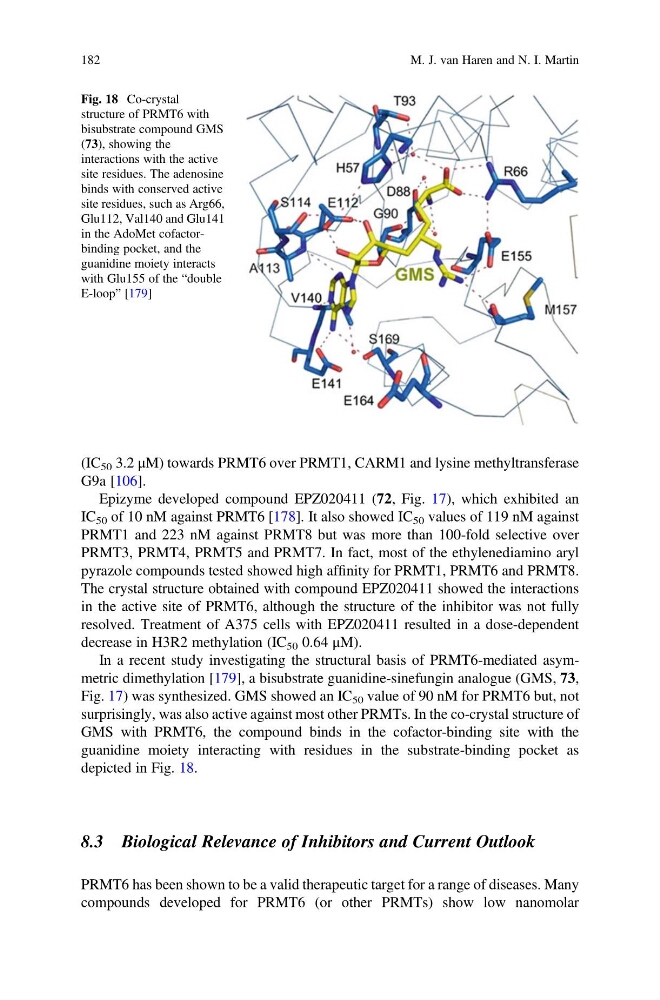
In a recent study investigating the structural basis of PRMT6-mediated asymmetric dimethylation [179], a bisubstrate guanidine-sinefungin analogue (GMS, 73,
Fig. 17) was synthesized. GMS showed an IC 50 value of 90 nM for PRMT6 but, not
surprisingly, was also active against most other PRMTs. In the co-crystal structure of
GMS with PRMT6, the compound binds in the cofactor-binding site with the
guanidine moiety interacting with residues in the substrate-binding pocket as
depicted in Fig. 18.
8.3 Biological Relevance of Inhibitors and Current Outlook
PRMT6 has been shown to be a valid therapeutic target for a range of diseases. Many
compounds developed for PRMT6 (or other PRMTs) show low nanomolar
Fig. 18 Co-crystal
structure of PRMT6 with
bisubstrate compound GMS
(73), showing the
interactions with the active
site residues. The adenosine
binds with conserved active
site residues, such as Arg66,
Glu112, Val140 and Glu141
in the AdoMet cofactorbinding pocket, and the
guanidine moiety interacts
with Glu155 of the “double
E-loop” [179]
182
M. J. van Haren and N. I. Martin
G9a [106].
Epizyme developed compound EPZ020411 (72, Fig. 17), which exhibited an
IC 50 of 10 nM against PRMT6 [178]. It also showed IC 50 values of 119 nM against
PRMT1 and 223 nM against PRMT8 but was more than 100-fold selective over
PRMT3, PRMT4, PRMT5 and PRMT7. In fact, most of the ethylenediamino aryl
pyrazole compounds tested showed high affinity for PRMT1, PRMT6 and PRMT8.
The crystal structure obtained with compound EPZ020411 showed the interactions
in the active site of PRMT6, although the structure of the inhibitor was not fully
resolved. Treatment of A375 cells with EPZ020411 resulted in a dose-dependent
decrease in H3R2 methylation (IC 50 0.64 μM).
In a recent study investigating the structural basis of PRMT6-mediated asymmetric dimethylation [179], a bisubstrate guanidine-sinefungin analogue (GMS, 73,
Fig. 17) was synthesized. GMS showed an IC 50 value of 90 nM for PRMT6 but, not
surprisingly, was also active against most other PRMTs. In the co-crystal structure of
GMS with PRMT6, the compound binds in the cofactor-binding site with the
guanidine moiety interacting with residues in the substrate-binding pocket as
depicted in Fig. 18.
8.3 Biological Relevance of Inhibitors and Current Outlook
PRMT6 has been shown to be a valid therapeutic target for a range of diseases. Many
compounds developed for PRMT6 (or other PRMTs) show low nanomolar
Fig. 18 Co-crystal
structure of PRMT6 with
bisubstrate compound GMS
(73), showing the
interactions with the active
site residues. The adenosine
binds with conserved active
site residues, such as Arg66,
Glu112, Val140 and Glu141
in the AdoMet cofactorbinding pocket, and the
guanidine moiety interacts
with Glu155 of the “double
E-loop” [179]
182
M. J. van Haren and N. I. Martin