

inhibition but often lack PRMT6 selectivity. To date, only limited cellular assays
have been performed with the aim of establishing PRMT6 inhibition and its potential
role in specific disease relevance. In this regard, more work is necessary in the
development of potent, selective, and biologically relevant inhibitors of PRMT6.
9 PRMT7
9.1 Background
In 2004, the first type III PRMT, PRMT7, was identified by Clarke and co-workers
[16]. As a type III arginine methyltransferase, PRMT7 produces only monomethylarginine (MMA) and preferentially methylates RxR motifs in lysine- and
arginine-rich regions of target proteins [180]. Known substrates for PRMT7 include
histones H2AR3, H2BR29, H2BR31 H2BR33, H4R3, H4R17 and H4R19 [180]. In
addition, in conjunction with PRMT5, PRMT7 aids in the sDMA methylation of Sm
proteins non-redundantly [181]. Interestingly, mutation of the Glu181 residue to Asp
in the double E-loop in the PRMT7 active site switched the type III PRMT activity
into type I, producing aDMA [182]. Furthermore, the additional mutation of Gln329
to Ala in the canonical THW-loop converted PRMT7 into a type II PRMT, capable
of producing sDMA [183].
As related to human disease, PRMT7 has been linked to breast cancer metastasis
[184, 185], DNA damage [186] and parasite infection [187]. Interestingly, several
studies have also demonstrated the involvement of PRMT7 in increasing the sensitivity of tumour cells to chemotherapeutic agents [186, 188–190].
9.2 Inhibitors: In Vitro and Cell-Based Activities
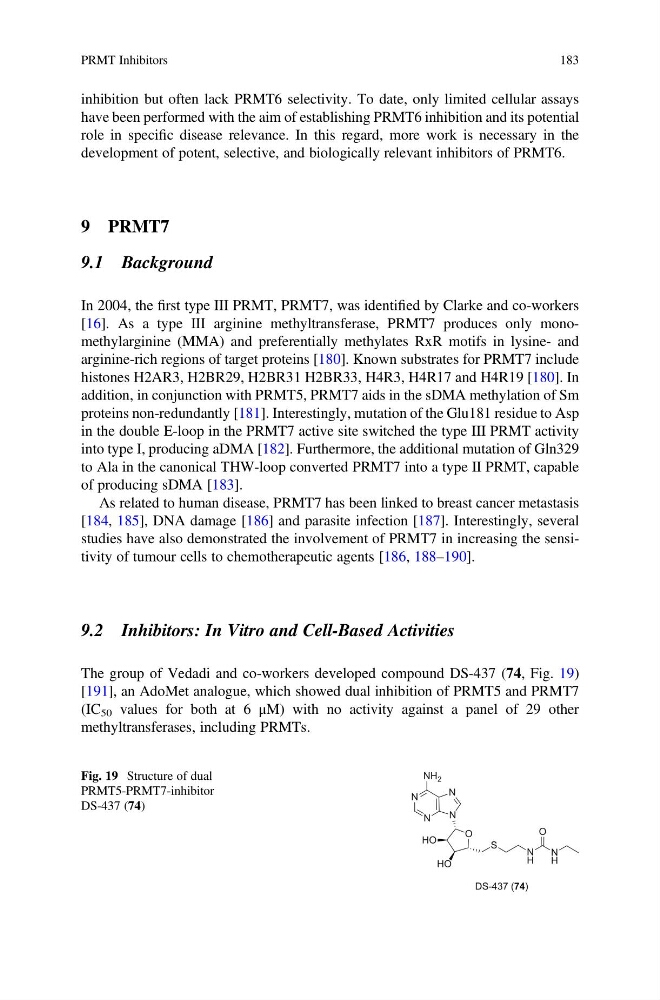
The group of Vedadi and co-workers developed compound DS-437 (74, Fig. 19)
[191], an AdoMet analogue, which showed dual inhibition of PRMT5 and PRMT7
(IC 50 values for both at 6 μM) with no activity against a panel of 29 other
methyltransferases, including PRMTs.
O
HO
HO
N
N
N
N
NH 2
S
N
H
N
H
O
DS-437 (74)
Fig. 19 Structure of dual
PRMT5-PRMT7-inhibitor
DS-437 (74)
PRMT Inhibitors
183
have been performed with the aim of establishing PRMT6 inhibition and its potential
role in specific disease relevance. In this regard, more work is necessary in the
development of potent, selective, and biologically relevant inhibitors of PRMT6.
9 PRMT7
9.1 Background
In 2004, the first type III PRMT, PRMT7, was identified by Clarke and co-workers
[16]. As a type III arginine methyltransferase, PRMT7 produces only monomethylarginine (MMA) and preferentially methylates RxR motifs in lysine- and
arginine-rich regions of target proteins [180]. Known substrates for PRMT7 include
histones H2AR3, H2BR29, H2BR31 H2BR33, H4R3, H4R17 and H4R19 [180]. In
addition, in conjunction with PRMT5, PRMT7 aids in the sDMA methylation of Sm
proteins non-redundantly [181]. Interestingly, mutation of the Glu181 residue to Asp
in the double E-loop in the PRMT7 active site switched the type III PRMT activity
into type I, producing aDMA [182]. Furthermore, the additional mutation of Gln329
to Ala in the canonical THW-loop converted PRMT7 into a type II PRMT, capable
of producing sDMA [183].
As related to human disease, PRMT7 has been linked to breast cancer metastasis
[184, 185], DNA damage [186] and parasite infection [187]. Interestingly, several
studies have also demonstrated the involvement of PRMT7 in increasing the sensitivity of tumour cells to chemotherapeutic agents [186, 188–190].
9.2 Inhibitors: In Vitro and Cell-Based Activities
The group of Vedadi and co-workers developed compound DS-437 (74, Fig. 19)
[191], an AdoMet analogue, which showed dual inhibition of PRMT5 and PRMT7
(IC 50 values for both at 6 μM) with no activity against a panel of 29 other
methyltransferases, including PRMTs.
O
HO
HO
N
N
N
N
NH 2
S
N
H
N
H
O
DS-437 (74)
Fig. 19 Structure of dual
PRMT5-PRMT7-inhibitor
DS-437 (74)
PRMT Inhibitors
183