

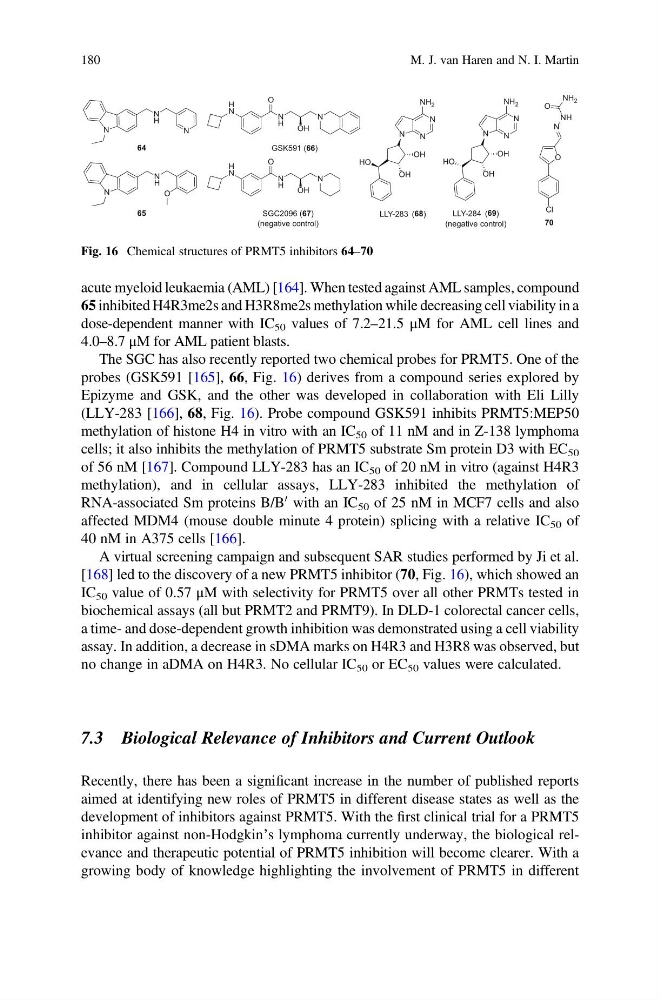
acute myeloid leukaemia (AML) [164]. When tested against AML samples, compound
65 inhibited H4R3me2s and H3R8me2s methylation while decreasing cell viability in a
dose-dependent manner with IC 50 values of 7.2–21.5 μM for AML cell lines and
4.0–8.7 μM for AML patient blasts.
The SGC has also recently reported two chemical probes for PRMT5. One of the
probes (GSK591 [165], 66, Fig. 16) derives from a compound series explored by
Epizyme and GSK, and the other was developed in collaboration with Eli Lilly
(LLY-283 [166], 68, Fig. 16). Probe compound GSK591 inhibits PRMT5:MEP50
methylation of histone H4 in vitro with an IC 50 of 11 nM and in Z-138 lymphoma
cells; it also inhibits the methylation of PRMT5 substrate Sm protein D3 with EC 50
of 56 nM [167]. Compound LLY-283 has an IC 50 of 20 nM in vitro (against H4R3
methylation), and in cellular assays, LLY-283 inhibited the methylation of
RNA-associated Sm proteins B/B
0 with an IC 50 of 25 nM in MCF7 cells and also
affected MDM4 (mouse double minute 4 protein) splicing with a relative IC 50 of
40 nM in A375 cells [166].
A virtual screening campaign and subsequent SAR studies performed by Ji et al.
[168] led to the discovery of a new PRMT5 inhibitor (70, Fig. 16), which showed an
IC 50 value of 0.57 μM with selectivity for PRMT5 over all other PRMTs tested in
biochemical assays (all but PRMT2 and PRMT9). In DLD-1 colorectal cancer cells,
a time- and dose-dependent growth inhibition was demonstrated using a cell viability
assay. In addition, a decrease in sDMA marks on H4R3 and H3R8 was observed, but
no change in aDMA on H4R3. No cellular IC 50 or EC 50 values were calculated.
7.3 Biological Relevance of Inhibitors and Current Outlook
Recently, there has been a significant increase in the number of published reports
aimed at identifying new roles of PRMT5 in different disease states as well as the
development of inhibitors against PRMT5. With the first clinical trial for a PRMT5
inhibitor against non-Hodgkin’s lymphoma currently underway, the biological relevance and therapeutic potential of PRMT5 inhibition will become clearer. With a
growing body of knowledge highlighting the involvement of PRMT5 in different
N
N
H
N
64
N
N
H
65
O
N
N
N
HO
NH 2
OH
OH
N
N
N
HO
NH 2
OH
OH
LLY-283 (68)
LLY-284 (69)
(negative control)
N
N
H
O
H
N
OH
N
N
H
O
H
N
OH
GSK591 (66)
SGC2096 (67)
(negative control)
Cl
O
N
NH
NH 2
O
70
Fig. 16 Chemical structures of PRMT5 inhibitors 64–70
180
M. J. van Haren and N. I. Martin
65 inhibited H4R3me2s and H3R8me2s methylation while decreasing cell viability in a
dose-dependent manner with IC 50 values of 7.2–21.5 μM for AML cell lines and
4.0–8.7 μM for AML patient blasts.
The SGC has also recently reported two chemical probes for PRMT5. One of the
probes (GSK591 [165], 66, Fig. 16) derives from a compound series explored by
Epizyme and GSK, and the other was developed in collaboration with Eli Lilly
(LLY-283 [166], 68, Fig. 16). Probe compound GSK591 inhibits PRMT5:MEP50
methylation of histone H4 in vitro with an IC 50 of 11 nM and in Z-138 lymphoma
cells; it also inhibits the methylation of PRMT5 substrate Sm protein D3 with EC 50
of 56 nM [167]. Compound LLY-283 has an IC 50 of 20 nM in vitro (against H4R3
methylation), and in cellular assays, LLY-283 inhibited the methylation of
RNA-associated Sm proteins B/B
0 with an IC 50 of 25 nM in MCF7 cells and also
affected MDM4 (mouse double minute 4 protein) splicing with a relative IC 50 of
40 nM in A375 cells [166].
A virtual screening campaign and subsequent SAR studies performed by Ji et al.
[168] led to the discovery of a new PRMT5 inhibitor (70, Fig. 16), which showed an
IC 50 value of 0.57 μM with selectivity for PRMT5 over all other PRMTs tested in
biochemical assays (all but PRMT2 and PRMT9). In DLD-1 colorectal cancer cells,
a time- and dose-dependent growth inhibition was demonstrated using a cell viability
assay. In addition, a decrease in sDMA marks on H4R3 and H3R8 was observed, but
no change in aDMA on H4R3. No cellular IC 50 or EC 50 values were calculated.
7.3 Biological Relevance of Inhibitors and Current Outlook
Recently, there has been a significant increase in the number of published reports
aimed at identifying new roles of PRMT5 in different disease states as well as the
development of inhibitors against PRMT5. With the first clinical trial for a PRMT5
inhibitor against non-Hodgkin’s lymphoma currently underway, the biological relevance and therapeutic potential of PRMT5 inhibition will become clearer. With a
growing body of knowledge highlighting the involvement of PRMT5 in different
N
N
H
N
64
N
N
H
65
O
N
N
N
HO
NH 2
OH
OH
N
N
N
HO
NH 2
OH
OH
LLY-283 (68)
LLY-284 (69)
(negative control)
N
N
H
O
H
N
OH
N
N
H
O
H
N
OH
GSK591 (66)
SGC2096 (67)
(negative control)
Cl
O
N
NH
NH 2
O
70
Fig. 16 Chemical structures of PRMT5 inhibitors 64–70
180
M. J. van Haren and N. I. Martin