

in the presence of AdoMet or a cofactor analogue like AdoHcy or sinefungin. When
testing the compound in mantle cell lymphoma (MCL) cells, EPZ015666 showed
concentration-dependent antiproliferative effects, with IC 50 values of 96 nM and
450 nM against Z-138 and Maver-1 MCL cells, respectively. In addition, upon oral
dosing in mice, the compound showed dose-dependent antitumour activity in MCL
xenograft models. The correlating decrease in sDMA strongly suggests a direct link
with PRMT5 inhibition. Compound EPZ015666 has subsequently been further
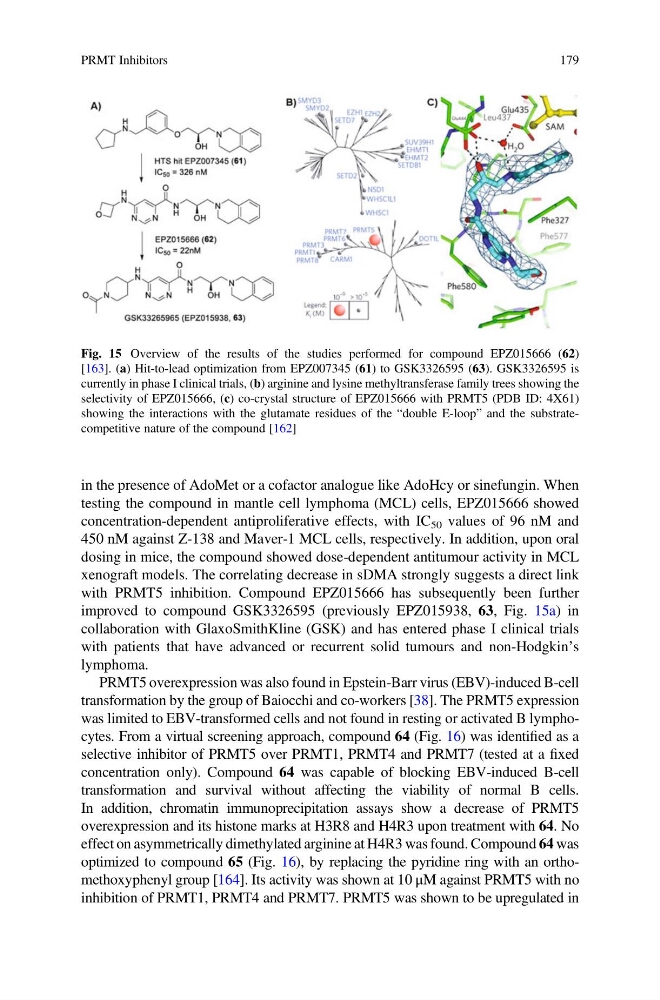
improved to compound GSK3326595 (previously EPZ015938, 63, Fig. 15a) in
collaboration with GlaxoSmithKline (GSK) and has entered phase I clinical trials
with patients that have advanced or recurrent solid tumours and non-Hodgkin’s
lymphoma.
PRMT5 overexpression was also found in Epstein-Barr virus (EBV)-induced B-cell
transformation by the group of Baiocchi and co-workers [38]. The PRMT5 expression
was limited to EBV-transformed cells and not found in resting or activated B lymphocytes. From a virtual screening approach, compound 64 (Fig. 16) was identified as a
selective inhibitor of PRMT5 over PRMT1, PRMT4 and PRMT7 (tested at a fixed
concentration only). Compound 64 was capable of blocking EBV-induced B-cell
transformation and survival without affecting the viability of normal B cells.
In addition, chromatin immunoprecipitation assays show a decrease of PRMT5
overexpression and its histone marks at H3R8 and H4R3 upon treatment with 64. No
effect on asymmetrically dimethylated arginine at H4R3 was found. Compound 64 was
optimized to compound 65 (Fig. 16), by replacing the pyridine ring with an orthomethoxyphenyl group [164]. Its activity was shown at 10 μM against PRMT5 with no
inhibition of PRMT1, PRMT4 and PRMT7. PRMT5 was shown to be upregulated in
Fig. 15 Overview of the results of the studies performed for compound EPZ015666 (62)
[163]. (a) Hit-to-lead optimization from EPZ007345 (61) to GSK3326595 (63). GSK3326595 is
currently in phase I clinical trials, (b) arginine and lysine methyltransferase family trees showing the
selectivity of EPZ015666, (c) co-crystal structure of EPZ015666 with PRMT5 (PDB ID: 4X61)
showing the interactions with the glutamate residues of the “double E-loop” and the substratecompetitive nature of the compound [162]
PRMT Inhibitors
179
testing the compound in mantle cell lymphoma (MCL) cells, EPZ015666 showed
concentration-dependent antiproliferative effects, with IC 50 values of 96 nM and
450 nM against Z-138 and Maver-1 MCL cells, respectively. In addition, upon oral
dosing in mice, the compound showed dose-dependent antitumour activity in MCL
xenograft models. The correlating decrease in sDMA strongly suggests a direct link
with PRMT5 inhibition. Compound EPZ015666 has subsequently been further
improved to compound GSK3326595 (previously EPZ015938, 63, Fig. 15a) in
collaboration with GlaxoSmithKline (GSK) and has entered phase I clinical trials
with patients that have advanced or recurrent solid tumours and non-Hodgkin’s
lymphoma.
PRMT5 overexpression was also found in Epstein-Barr virus (EBV)-induced B-cell
transformation by the group of Baiocchi and co-workers [38]. The PRMT5 expression
was limited to EBV-transformed cells and not found in resting or activated B lymphocytes. From a virtual screening approach, compound 64 (Fig. 16) was identified as a
selective inhibitor of PRMT5 over PRMT1, PRMT4 and PRMT7 (tested at a fixed
concentration only). Compound 64 was capable of blocking EBV-induced B-cell
transformation and survival without affecting the viability of normal B cells.
In addition, chromatin immunoprecipitation assays show a decrease of PRMT5
overexpression and its histone marks at H3R8 and H4R3 upon treatment with 64. No
effect on asymmetrically dimethylated arginine at H4R3 was found. Compound 64 was
optimized to compound 65 (Fig. 16), by replacing the pyridine ring with an orthomethoxyphenyl group [164]. Its activity was shown at 10 μM against PRMT5 with no
inhibition of PRMT1, PRMT4 and PRMT7. PRMT5 was shown to be upregulated in
Fig. 15 Overview of the results of the studies performed for compound EPZ015666 (62)
[163]. (a) Hit-to-lead optimization from EPZ007345 (61) to GSK3326595 (63). GSK3326595 is
currently in phase I clinical trials, (b) arginine and lysine methyltransferase family trees showing the
selectivity of EPZ015666, (c) co-crystal structure of EPZ015666 with PRMT5 (PDB ID: 4X61)
showing the interactions with the glutamate residues of the “double E-loop” and the substratecompetitive nature of the compound [162]
PRMT Inhibitors
179