

group for the rational design of HDAC inhibitors. However, not all hydroxamic
acids are equal: the geometry of the HDAC active site dictates the use of
monosubstituted compounds of type 4 rather than N-substituted examples 5. On
the other hand, zinc-binding groups such as sulfonamides or carboxylic acids that are
widely found in metal-binding inhibitors for other drug targets rarely achieve high
potency against HDACs [30]. Such differences in enzyme topology help reduce the
potential for side effects arising from the nonspecific binding of hydroxamic acid
HDAC inhibitors to other metalloenzymes. Nevertheless, the pharmacokinetic limitations of hydroxamic acids should not be forgotten – phase I glucuronidation
accelerates drug clearance, while Lossen-type rearrangements at alkaline pH can
lead to the creation of mutagenic species [31].
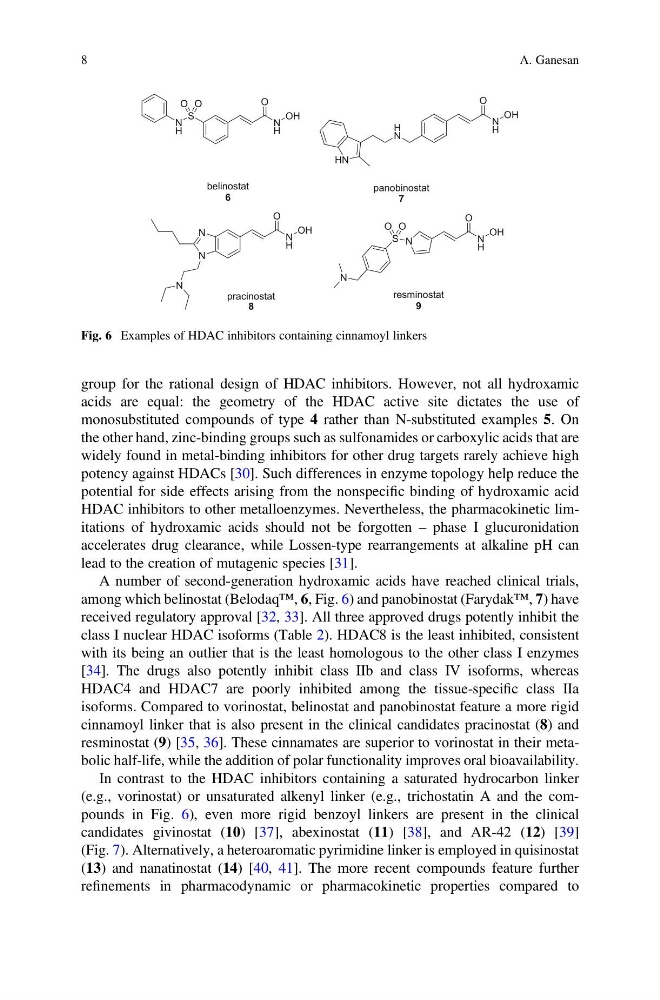
A number of second-generation hydroxamic acids have reached clinical trials,
among which belinostat (Belodaq™, 6, Fig. 6) and panobinostat (Farydak™, 7) have
received regulatory approval [32, 33]. All three approved drugs potently inhibit the
class I nuclear HDAC isoforms (Table 2). HDAC8 is the least inhibited, consistent
with its being an outlier that is the least homologous to the other class I enzymes
[34]. The drugs also potently inhibit class IIb and class IV isoforms, whereas
HDAC4 and HDAC7 are poorly inhibited among the tissue-specific class IIa
isoforms. Compared to vorinostat, belinostat and panobinostat feature a more rigid
cinnamoyl linker that is also present in the clinical candidates pracinostat (8) and
resminostat (9) [35, 36]. These cinnamates are superior to vorinostat in their metabolic half-life, while the addition of polar functionality improves oral bioavailability.
In contrast to the HDAC inhibitors containing a saturated hydrocarbon linker
(e.g., vorinostat) or unsaturated alkenyl linker (e.g., trichostatin A and the compounds in Fig. 6), even more rigid benzoyl linkers are present in the clinical
candidates givinostat (10) [37], abexinostat (11) [38], and AR-42 (12) [39]
(Fig. 7). Alternatively, a heteroaromatic pyrimidine linker is employed in quisinostat
(13) and nanatinostat (14) [40, 41]. The more recent compounds feature further
refinements in pharmacodynamic or pharmacokinetic properties compared to
N
H
OH
O
H
N
HN
N
H
OH
O
belinostat
6
N
H
OH
O
N
S
O O
N
resminostat
9
N
H
OH
O
N
N
N
pracinostat
8
panobinostat
7
S
N
H
O O
Fig. 6 Examples of HDAC inhibitors containing cinnamoyl linkers
8
A. Ganesan
acids are equal: the geometry of the HDAC active site dictates the use of
monosubstituted compounds of type 4 rather than N-substituted examples 5. On
the other hand, zinc-binding groups such as sulfonamides or carboxylic acids that are
widely found in metal-binding inhibitors for other drug targets rarely achieve high
potency against HDACs [30]. Such differences in enzyme topology help reduce the
potential for side effects arising from the nonspecific binding of hydroxamic acid
HDAC inhibitors to other metalloenzymes. Nevertheless, the pharmacokinetic limitations of hydroxamic acids should not be forgotten – phase I glucuronidation
accelerates drug clearance, while Lossen-type rearrangements at alkaline pH can
lead to the creation of mutagenic species [31].
A number of second-generation hydroxamic acids have reached clinical trials,
among which belinostat (Belodaq™, 6, Fig. 6) and panobinostat (Farydak™, 7) have
received regulatory approval [32, 33]. All three approved drugs potently inhibit the
class I nuclear HDAC isoforms (Table 2). HDAC8 is the least inhibited, consistent
with its being an outlier that is the least homologous to the other class I enzymes
[34]. The drugs also potently inhibit class IIb and class IV isoforms, whereas
HDAC4 and HDAC7 are poorly inhibited among the tissue-specific class IIa
isoforms. Compared to vorinostat, belinostat and panobinostat feature a more rigid
cinnamoyl linker that is also present in the clinical candidates pracinostat (8) and
resminostat (9) [35, 36]. These cinnamates are superior to vorinostat in their metabolic half-life, while the addition of polar functionality improves oral bioavailability.
In contrast to the HDAC inhibitors containing a saturated hydrocarbon linker
(e.g., vorinostat) or unsaturated alkenyl linker (e.g., trichostatin A and the compounds in Fig. 6), even more rigid benzoyl linkers are present in the clinical
candidates givinostat (10) [37], abexinostat (11) [38], and AR-42 (12) [39]
(Fig. 7). Alternatively, a heteroaromatic pyrimidine linker is employed in quisinostat
(13) and nanatinostat (14) [40, 41]. The more recent compounds feature further
refinements in pharmacodynamic or pharmacokinetic properties compared to
N
H
OH
O
H
N
HN
N
H
OH
O
belinostat
6
N
H
OH
O
N
S
O O
N
resminostat
9
N
H
OH
O
N
N
N
pracinostat
8
panobinostat
7
S
N
H
O O
Fig. 6 Examples of HDAC inhibitors containing cinnamoyl linkers
8
A. Ganesan