

protein substrate’s surface beyond the acetyllysine, a small-sized cap is sufficient
and allows potent inhibition with low MW compounds that fit guidelines for oral
bioavailability. Furthermore, as the cap is not involved in major interactions with the
active site, large variations are possible in this region including modifications
introduced to improve pharmacokinetics rather than influence binding.
3 Hydroxamic Acid HDAC Inhibitors
Hydroxamic acids are an effective bidentate metal chelating functional group that
are widely used by microorganisms in iron-binding siderophores [25]. Their coordinating ability is also used to advantage in natural products and synthetic compounds that are inhibitors of metalloenzymes including carbonic anhydrase, matrix
metalloproteinases, ribonucleotide reductase, and urease [26]. The potent antifungal
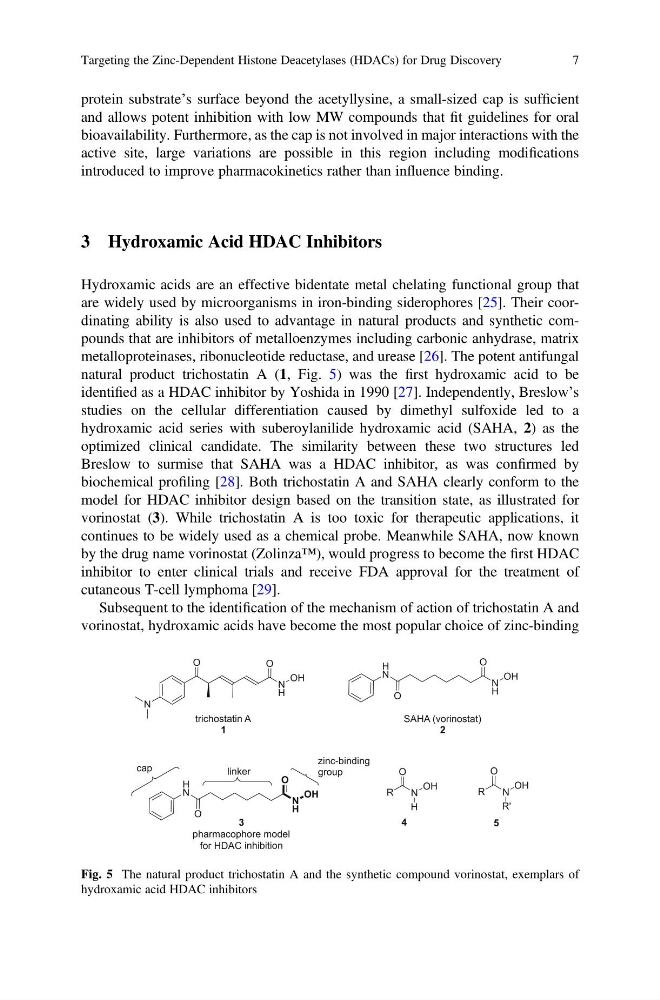
natural product trichostatin A (1, Fig. 5) was the first hydroxamic acid to be
identified as a HDAC inhibitor by Yoshida in 1990 [27]. Independently, Breslow’s
studies on the cellular differentiation caused by dimethyl sulfoxide led to a
hydroxamic acid series with suberoylanilide hydroxamic acid (SAHA, 2) as the
optimized clinical candidate. The similarity between these two structures led
Breslow to surmise that SAHA was a HDAC inhibitor, as was confirmed by
biochemical profiling [28]. Both trichostatin A and SAHA clearly conform to the
model for HDAC inhibitor design based on the transition state, as illustrated for
vorinostat (3). While trichostatin A is too toxic for therapeutic applications, it
continues to be widely used as a chemical probe. Meanwhile SAHA, now known
by the drug name vorinostat (Zolinza™), would progress to become the first HDAC
inhibitor to enter clinical trials and receive FDA approval for the treatment of
cutaneous T-cell lymphoma [29].
Subsequent to the identification of the mechanism of action of trichostatin A and
vorinostat, hydroxamic acids have become the most popular choice of zinc-binding
H
N
N
H
O
O
OH
N
H
O
OH
O
N
trichostatin A
1
SAHA (vorinostat)
2
R
N
O
OH
H
R
N
O
OH
R'
5
4
H
N
N
H
O
O
OH
zinc-binding
group
cap
linker
3
pharmacophore model
for HDAC inhibition
Fig. 5 The natural product trichostatin A and the synthetic compound vorinostat, exemplars of
hydroxamic acid HDAC inhibitors
Targeting the Zinc-Dependent Histone Deacetylases (HDACs) for Drug Discovery
7
and allows potent inhibition with low MW compounds that fit guidelines for oral
bioavailability. Furthermore, as the cap is not involved in major interactions with the
active site, large variations are possible in this region including modifications
introduced to improve pharmacokinetics rather than influence binding.
3 Hydroxamic Acid HDAC Inhibitors
Hydroxamic acids are an effective bidentate metal chelating functional group that
are widely used by microorganisms in iron-binding siderophores [25]. Their coordinating ability is also used to advantage in natural products and synthetic compounds that are inhibitors of metalloenzymes including carbonic anhydrase, matrix
metalloproteinases, ribonucleotide reductase, and urease [26]. The potent antifungal
natural product trichostatin A (1, Fig. 5) was the first hydroxamic acid to be
identified as a HDAC inhibitor by Yoshida in 1990 [27]. Independently, Breslow’s
studies on the cellular differentiation caused by dimethyl sulfoxide led to a
hydroxamic acid series with suberoylanilide hydroxamic acid (SAHA, 2) as the
optimized clinical candidate. The similarity between these two structures led
Breslow to surmise that SAHA was a HDAC inhibitor, as was confirmed by
biochemical profiling [28]. Both trichostatin A and SAHA clearly conform to the
model for HDAC inhibitor design based on the transition state, as illustrated for
vorinostat (3). While trichostatin A is too toxic for therapeutic applications, it
continues to be widely used as a chemical probe. Meanwhile SAHA, now known
by the drug name vorinostat (Zolinza™), would progress to become the first HDAC
inhibitor to enter clinical trials and receive FDA approval for the treatment of
cutaneous T-cell lymphoma [29].
Subsequent to the identification of the mechanism of action of trichostatin A and
vorinostat, hydroxamic acids have become the most popular choice of zinc-binding
H
N
N
H
O
O
OH
N
H
O
OH
O
N
trichostatin A
1
SAHA (vorinostat)
2
R
N
O
OH
H
R
N
O
OH
R'
5
4
H
N
N
H
O
O
OH
zinc-binding
group
cap
linker
3
pharmacophore model
for HDAC inhibition
Fig. 5 The natural product trichostatin A and the synthetic compound vorinostat, exemplars of
hydroxamic acid HDAC inhibitors
Targeting the Zinc-Dependent Histone Deacetylases (HDACs) for Drug Discovery
7