

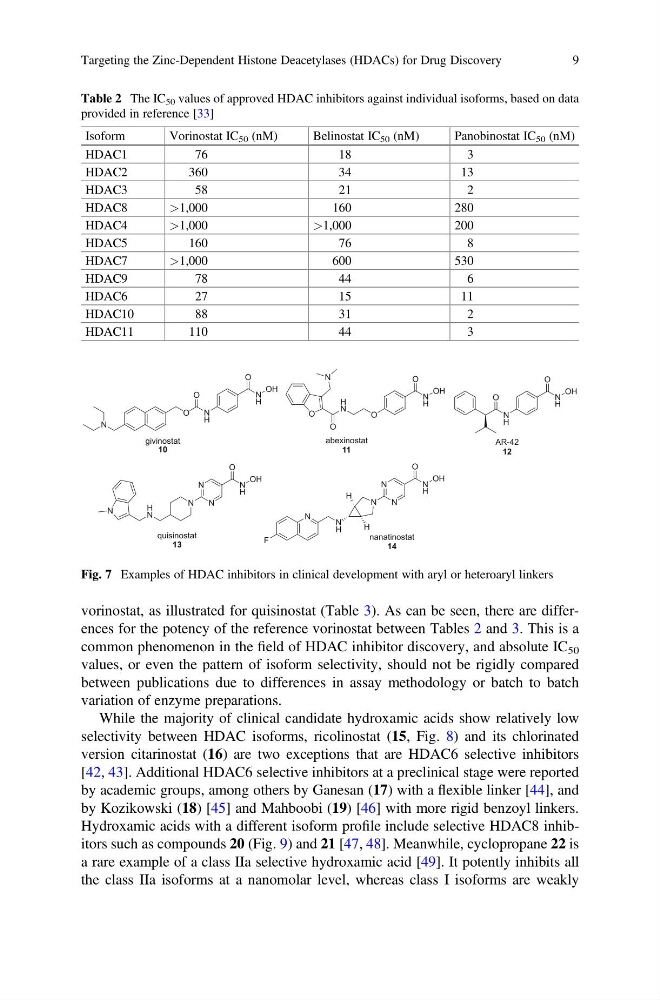
vorinostat, as illustrated for quisinostat (Table 3). As can be seen, there are differences for the potency of the reference vorinostat between Tables 2 and 3. This is a
common phenomenon in the field of HDAC inhibitor discovery, and absolute IC 50
values, or even the pattern of isoform selectivity, should not be rigidly compared
between publications due to differences in assay methodology or batch to batch
variation of enzyme preparations.
While the majority of clinical candidate hydroxamic acids show relatively low
selectivity between HDAC isoforms, ricolinostat (15, Fig. 8) and its chlorinated
version citarinostat (16) are two exceptions that are HDAC6 selective inhibitors
[42, 43]. Additional HDAC6 selective inhibitors at a preclinical stage were reported
by academic groups, among others by Ganesan (17) with a flexible linker [44], and
by Kozikowski (18) [45] and Mahboobi (19) [46] with more rigid benzoyl linkers.
Hydroxamic acids with a different isoform profile include selective HDAC8 inhibitors such as compounds 20 (Fig. 9) and 21 [47, 48]. Meanwhile, cyclopropane 22 is
a rare example of a class IIa selective hydroxamic acid [49]. It potently inhibits all
the class IIa isoforms at a nanomolar level, whereas class I isoforms are weakly
Table 2 The IC 50 values of approved HDAC inhibitors against individual isoforms, based on data
provided in reference [33]
Isoform
Vorinostat IC 50 (nM)
Belinostat IC 50 (nM)
Panobinostat IC 50 (nM)
HDAC1
76
18
3
HDAC2
360
34
13
HDAC3
58
21
2
HDAC8
>1,000
160
280
HDAC4
>1,000
>1,000
200
HDAC5
160
76
8
HDAC7
>1,000
600
530
HDAC9
78
44
6
HDAC6
27
15
11
HDAC10
88
31
2
HDAC11
110
44
3
N
H
OH
O
O
H
N
O
O
N
abexinostat
11
N
H
OH
O
N
H
O
O
N
givinostat
10
N
H
OH
O
N
N
N
H
N
N
quisinostat
13
N
H
OH
O
N
H
O
AR-42
12
N
H
OH
O
N
N
N
H
H
N
H
N
F
nanatinostat
14
Fig. 7 Examples of HDAC inhibitors in clinical development with aryl or heteroaryl linkers
Targeting the Zinc-Dependent Histone Deacetylases (HDACs) for Drug Discovery
9
common phenomenon in the field of HDAC inhibitor discovery, and absolute IC 50
values, or even the pattern of isoform selectivity, should not be rigidly compared
between publications due to differences in assay methodology or batch to batch
variation of enzyme preparations.
While the majority of clinical candidate hydroxamic acids show relatively low
selectivity between HDAC isoforms, ricolinostat (15, Fig. 8) and its chlorinated
version citarinostat (16) are two exceptions that are HDAC6 selective inhibitors
[42, 43]. Additional HDAC6 selective inhibitors at a preclinical stage were reported
by academic groups, among others by Ganesan (17) with a flexible linker [44], and
by Kozikowski (18) [45] and Mahboobi (19) [46] with more rigid benzoyl linkers.
Hydroxamic acids with a different isoform profile include selective HDAC8 inhibitors such as compounds 20 (Fig. 9) and 21 [47, 48]. Meanwhile, cyclopropane 22 is
a rare example of a class IIa selective hydroxamic acid [49]. It potently inhibits all
the class IIa isoforms at a nanomolar level, whereas class I isoforms are weakly
Table 2 The IC 50 values of approved HDAC inhibitors against individual isoforms, based on data
provided in reference [33]
Isoform
Vorinostat IC 50 (nM)
Belinostat IC 50 (nM)
Panobinostat IC 50 (nM)
HDAC1
76
18
3
HDAC2
360
34
13
HDAC3
58
21
2
HDAC8
>1,000
160
280
HDAC4
>1,000
>1,000
200
HDAC5
160
76
8
HDAC7
>1,000
600
530
HDAC9
78
44
6
HDAC6
27
15
11
HDAC10
88
31
2
HDAC11
110
44
3
N
H
OH
O
O
H
N
O
O
N
abexinostat
11
N
H
OH
O
N
H
O
O
N
givinostat
10
N
H
OH
O
N
N
N
H
N
N
quisinostat
13
N
H
OH
O
N
H
O
AR-42
12
N
H
OH
O
N
N
N
H
H
N
H
N
F
nanatinostat
14
Fig. 7 Examples of HDAC inhibitors in clinical development with aryl or heteroaryl linkers
Targeting the Zinc-Dependent Histone Deacetylases (HDACs) for Drug Discovery
9