

Rb, PARP1, HSP90, and ERα (SMYD2) [111] and the kinases MAP 3K2 and
VEGFR1 (SMYD3) [110].
SMYD2 and SMYD3 overexpression has been associated with various cancers
and correlated with bad prognosis [110]. Hence, the development of specific inhibitors became a point of interest.
SMYD2 inhibitors were developed first in 2011, as the result of an HTS campaign.
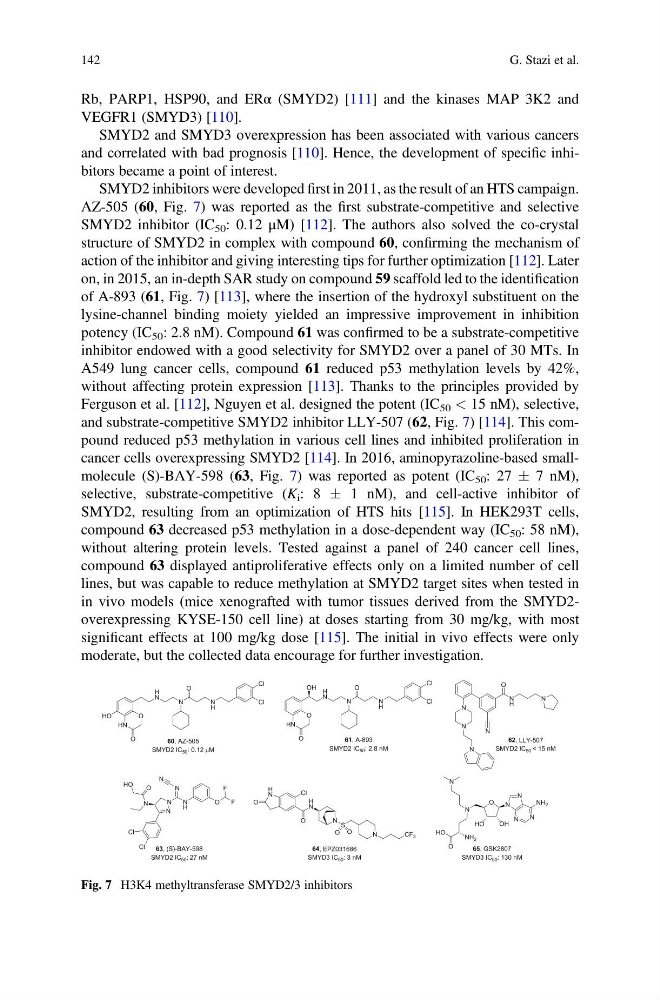
AZ-505 (60, Fig. 7) was reported as the first substrate-competitive and selective
SMYD2 inhibitor (IC 50 : 0.12 μM) [112]. The authors also solved the co-crystal
structure of SMYD2 in complex with compound 60, confirming the mechanism of
action of the inhibitor and giving interesting tips for further optimization [112]. Later
on, in 2015, an in-depth SAR study on compound 59 scaffold led to the identification
of A-893 (61, Fig. 7) [113], where the insertion of the hydroxyl substituent on the
lysine-channel binding moiety yielded an impressive improvement in inhibition
potency (IC 50 : 2.8 nM). Compound 61 was confirmed to be a substrate-competitive
inhibitor endowed with a good selectivity for SMYD2 over a panel of 30 MTs. In
A549 lung cancer cells, compound 61 reduced p53 methylation levels by 42%,
without affecting protein expression [113]. Thanks to the principles provided by
Ferguson et al. [112], Nguyen et al. designed the potent (IC 50 < 15 nM), selective,
and substrate-competitive SMYD2 inhibitor LLY-507 (62, Fig. 7) [114]. This compound reduced p53 methylation in various cell lines and inhibited proliferation in
cancer cells overexpressing SMYD2 [114]. In 2016, aminopyrazoline-based smallmolecule (S)-BAY-598 (63, Fig. 7) was reported as potent (IC 50 : 27 Æ 7 nM),
selective, substrate-competitive (K i : 8 Æ 1 nM), and cell-active inhibitor of
SMYD2, resulting from an optimization of HTS hits [115]. In HEK293T cells,
compound 63 decreased p53 methylation in a dose-dependent way (IC 50 : 58 nM),
without altering protein levels. Tested against a panel of 240 cancer cell lines,
compound 63 displayed antiproliferative effects only on a limited number of cell
lines, but was capable to reduce methylation at SMYD2 target sites when tested in
in vivo models (mice xenografted with tumor tissues derived from the SMYD2overexpressing KYSE-150 cell line) at doses starting from 30 mg/kg, with most
significant effects at 100 mg/kg dose [115]. The initial in vivo effects were only
moderate, but the collected data encourage for further investigation.
HN
O
O
HO
H
N
N
O
N
H
Cl
Cl
HN
O
O
H
N
N
O
N
H
Cl
Cl
OH
60, AZ-505
SMYD2 IC 50 : 0.12 M
61, A-893
SMYD2 IC 50 : 2.8 nM
N
N
N
N
H
O
N
N
62, LLY-507
SMYD2 IC 50 < 15 nM
63, (S)-BAY-598
SMYD2 IC 50 : 27 nM
N
N
H
N
N
N
O
HO
N
O
F
F
Cl
Cl
H
N
O
Cl
H
N
O
N S
N
O O
CF 3
64, EPZ031686
SMYD3 IC 50 : 3 nM
N
HO
OH
N
N
N
N
NH 2
O
N
HO
O
NH 2
65, GSK2807
SMYD3 IC 50 : 130 nM
Fig. 7 H3K4 methyltransferase SMYD2/3 inhibitors
142
G. Stazi et al.
VEGFR1 (SMYD3) [110].
SMYD2 and SMYD3 overexpression has been associated with various cancers
and correlated with bad prognosis [110]. Hence, the development of specific inhibitors became a point of interest.
SMYD2 inhibitors were developed first in 2011, as the result of an HTS campaign.
AZ-505 (60, Fig. 7) was reported as the first substrate-competitive and selective
SMYD2 inhibitor (IC 50 : 0.12 μM) [112]. The authors also solved the co-crystal
structure of SMYD2 in complex with compound 60, confirming the mechanism of
action of the inhibitor and giving interesting tips for further optimization [112]. Later
on, in 2015, an in-depth SAR study on compound 59 scaffold led to the identification
of A-893 (61, Fig. 7) [113], where the insertion of the hydroxyl substituent on the
lysine-channel binding moiety yielded an impressive improvement in inhibition
potency (IC 50 : 2.8 nM). Compound 61 was confirmed to be a substrate-competitive
inhibitor endowed with a good selectivity for SMYD2 over a panel of 30 MTs. In
A549 lung cancer cells, compound 61 reduced p53 methylation levels by 42%,
without affecting protein expression [113]. Thanks to the principles provided by
Ferguson et al. [112], Nguyen et al. designed the potent (IC 50 < 15 nM), selective,
and substrate-competitive SMYD2 inhibitor LLY-507 (62, Fig. 7) [114]. This compound reduced p53 methylation in various cell lines and inhibited proliferation in
cancer cells overexpressing SMYD2 [114]. In 2016, aminopyrazoline-based smallmolecule (S)-BAY-598 (63, Fig. 7) was reported as potent (IC 50 : 27 Æ 7 nM),
selective, substrate-competitive (K i : 8 Æ 1 nM), and cell-active inhibitor of
SMYD2, resulting from an optimization of HTS hits [115]. In HEK293T cells,
compound 63 decreased p53 methylation in a dose-dependent way (IC 50 : 58 nM),
without altering protein levels. Tested against a panel of 240 cancer cell lines,
compound 63 displayed antiproliferative effects only on a limited number of cell
lines, but was capable to reduce methylation at SMYD2 target sites when tested in
in vivo models (mice xenografted with tumor tissues derived from the SMYD2overexpressing KYSE-150 cell line) at doses starting from 30 mg/kg, with most
significant effects at 100 mg/kg dose [115]. The initial in vivo effects were only
moderate, but the collected data encourage for further investigation.
HN
O
O
HO
H
N
N
O
N
H
Cl
Cl
HN
O
O
H
N
N
O
N
H
Cl
Cl
OH
60, AZ-505
SMYD2 IC 50 : 0.12 M
61, A-893
SMYD2 IC 50 : 2.8 nM
N
N
N
N
H
O
N
N
62, LLY-507
SMYD2 IC 50 < 15 nM
63, (S)-BAY-598
SMYD2 IC 50 : 27 nM
N
N
H
N
N
N
O
HO
N
O
F
F
Cl
Cl
H
N
O
Cl
H
N
O
N S
N
O O
CF 3
64, EPZ031686
SMYD3 IC 50 : 3 nM
N
HO
OH
N
N
N
N
NH 2
O
N
HO
O
NH 2
65, GSK2807
SMYD3 IC 50 : 130 nM
Fig. 7 H3K4 methyltransferase SMYD2/3 inhibitors
142
G. Stazi et al.