

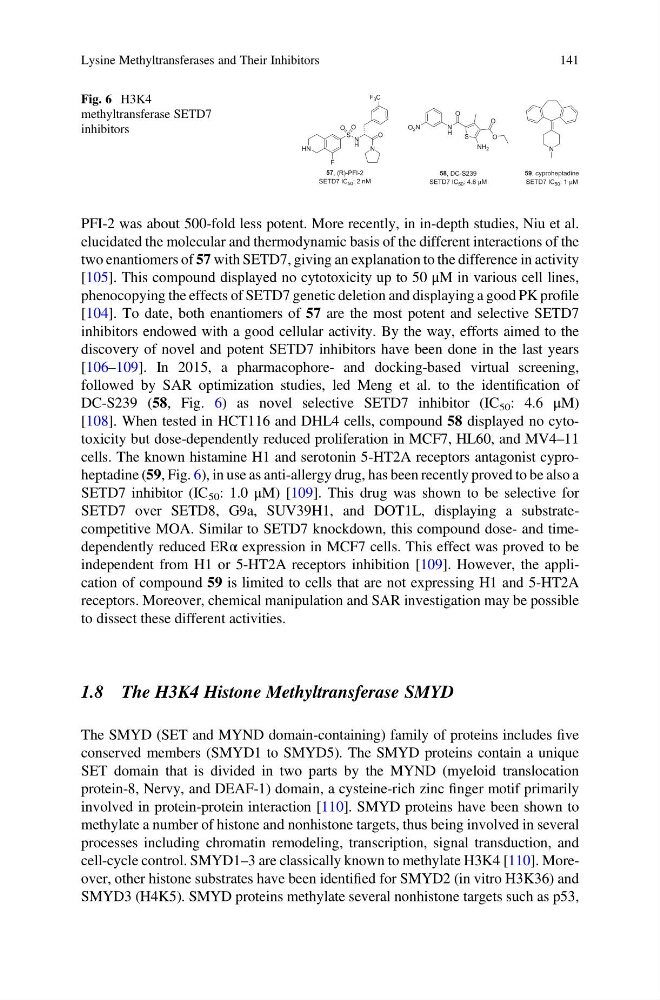
PFI-2 was about 500-fold less potent. More recently, in in-depth studies, Niu et al.
elucidated the molecular and thermodynamic basis of the different interactions of the
two enantiomers of 57 with SETD7, giving an explanation to the difference in activity
[105]. This compound displayed no cytotoxicity up to 50 μM in various cell lines,
phenocopying the effects of SETD7 genetic deletion and displaying a good PK profile
[104]. To date, both enantiomers of 57 are the most potent and selective SETD7
inhibitors endowed with a good cellular activity. By the way, efforts aimed to the
discovery of novel and potent SETD7 inhibitors have been done in the last years
[106–109]. In 2015, a pharmacophore- and docking-based virtual screening,
followed by SAR optimization studies, led Meng et al. to the identification of
DC-S239 (58, Fig. 6) as novel selective SETD7 inhibitor (IC 50 : 4.6 μM)
[108]. When tested in HCT116 and DHL4 cells, compound 58 displayed no cytotoxicity but dose-dependently reduced proliferation in MCF7, HL60, and MV4–11
cells. The known histamine H1 and serotonin 5-HT2A receptors antagonist cyproheptadine (59, Fig. 6), in use as anti-allergy drug, has been recently proved to be also a
SETD7 inhibitor (IC 50 : 1.0 μM) [109]. This drug was shown to be selective for
SETD7 over SETD8, G9a, SUV39H1, and DOT1L, displaying a substratecompetitive MOA. Similar to SETD7 knockdown, this compound dose- and timedependently reduced ERα expression in MCF7 cells. This effect was proved to be
independent from H1 or 5-HT2A receptors inhibition [109]. However, the application of compound 59 is limited to cells that are not expressing H1 and 5-HT2A
receptors. Moreover, chemical manipulation and SAR investigation may be possible
to dissect these different activities.
1.8 The H3K4 Histone Methyltransferase SMYD
The SMYD (SET and MYND domain-containing) family of proteins includes five
conserved members (SMYD1 to SMYD5). The SMYD proteins contain a unique
SET domain that is divided in two parts by the MYND (myeloid translocation
protein-8, Nervy, and DEAF-1) domain, a cysteine-rich zinc finger motif primarily
involved in protein-protein interaction [110]. SMYD proteins have been shown to
methylate a number of histone and nonhistone targets, thus being involved in several
processes including chromatin remodeling, transcription, signal transduction, and
cell-cycle control. SMYD1–3 are classically known to methylate H3K4 [110]. Moreover, other histone substrates have been identified for SMYD2 (in vitro H3K36) and
SMYD3 (H4K5). SMYD proteins methylate several nonhistone targets such as p53,
HN
F
S N
H
O
N
O O
F 3 C
57, (R)-PFI-2
SETD7 IC 50 : 2 nM
O 2 N
N
H
O
S
NH 2
O
O
58, DC-S239
SETD7 IC 50 : 4.6 M
N
59, cyproheptadine
SETD7 IC 50 : 1 M
Fig. 6 H3K4
methyltransferase SETD7
inhibitors
Lysine Methyltransferases and Their Inhibitors
141
elucidated the molecular and thermodynamic basis of the different interactions of the
two enantiomers of 57 with SETD7, giving an explanation to the difference in activity
[105]. This compound displayed no cytotoxicity up to 50 μM in various cell lines,
phenocopying the effects of SETD7 genetic deletion and displaying a good PK profile
[104]. To date, both enantiomers of 57 are the most potent and selective SETD7
inhibitors endowed with a good cellular activity. By the way, efforts aimed to the
discovery of novel and potent SETD7 inhibitors have been done in the last years
[106–109]. In 2015, a pharmacophore- and docking-based virtual screening,
followed by SAR optimization studies, led Meng et al. to the identification of
DC-S239 (58, Fig. 6) as novel selective SETD7 inhibitor (IC 50 : 4.6 μM)
[108]. When tested in HCT116 and DHL4 cells, compound 58 displayed no cytotoxicity but dose-dependently reduced proliferation in MCF7, HL60, and MV4–11
cells. The known histamine H1 and serotonin 5-HT2A receptors antagonist cyproheptadine (59, Fig. 6), in use as anti-allergy drug, has been recently proved to be also a
SETD7 inhibitor (IC 50 : 1.0 μM) [109]. This drug was shown to be selective for
SETD7 over SETD8, G9a, SUV39H1, and DOT1L, displaying a substratecompetitive MOA. Similar to SETD7 knockdown, this compound dose- and timedependently reduced ERα expression in MCF7 cells. This effect was proved to be
independent from H1 or 5-HT2A receptors inhibition [109]. However, the application of compound 59 is limited to cells that are not expressing H1 and 5-HT2A
receptors. Moreover, chemical manipulation and SAR investigation may be possible
to dissect these different activities.
1.8 The H3K4 Histone Methyltransferase SMYD
The SMYD (SET and MYND domain-containing) family of proteins includes five
conserved members (SMYD1 to SMYD5). The SMYD proteins contain a unique
SET domain that is divided in two parts by the MYND (myeloid translocation
protein-8, Nervy, and DEAF-1) domain, a cysteine-rich zinc finger motif primarily
involved in protein-protein interaction [110]. SMYD proteins have been shown to
methylate a number of histone and nonhistone targets, thus being involved in several
processes including chromatin remodeling, transcription, signal transduction, and
cell-cycle control. SMYD1–3 are classically known to methylate H3K4 [110]. Moreover, other histone substrates have been identified for SMYD2 (in vitro H3K36) and
SMYD3 (H4K5). SMYD proteins methylate several nonhistone targets such as p53,
HN
F
S N
H
O
N
O O
F 3 C
57, (R)-PFI-2
SETD7 IC 50 : 2 nM
O 2 N
N
H
O
S
NH 2
O
O
58, DC-S239
SETD7 IC 50 : 4.6 M
N
59, cyproheptadine
SETD7 IC 50 : 1 M
Fig. 6 H3K4
methyltransferase SETD7
inhibitors
Lysine Methyltransferases and Their Inhibitors
141