

Also SMYD3 is a promising target in cancer [116]; however SMYD3 inhibitors
appeared in literature just recently. As the result of an HTS followed by structureguided optimization, in 2016, Mitchell et al. described EPZ031686 (64, Fig. 7) as the
first in class SMYD3 inhibitor [117]. Compound 64 proved very potent (biochemical
IC 50 : 3 nM, cell IC 50 : 36 nM) and selective SMYD3 inhibitor. Compound 64, selected
for in vivo PK evaluation, proved to be orally bioavailable and eligible for in vivo
efficacy studies. In the same year, starting from structural studies on the SMYD3 and
a MAP 3K2 peptide co-crystal structure, bi-substrate-type inhibitors have been
designed by Van Aller et al. [118]. This study led to the identification of GSK2807
(65, Fig. 7), a SAH analogue with a dimethylaminopropyl side chain, that proved to
be a potent (IC 50 : 130 nM) and selective inhibitor. X-ray crystallography and kinetic
studies elucidated its binding mode and MOA. Due to its poor cell permeability,
compound 65 was not suitable for in-cell evaluation [118].
1.9 The H3K36 Histone Methyltransferase SETD2
H3K36 trimethylation is specifically catalyzed by SETD2 (KMT3A or SET2), and
this mark is associated with transcription elongation and RNA splicing, DNA repair,
and tumor suppression [119]. SETD2 mutations have been reported in different
cancers [119], and aberrant SETD2-H3K36 trimethylation patterns seem to be
involved in leukemia development [120].
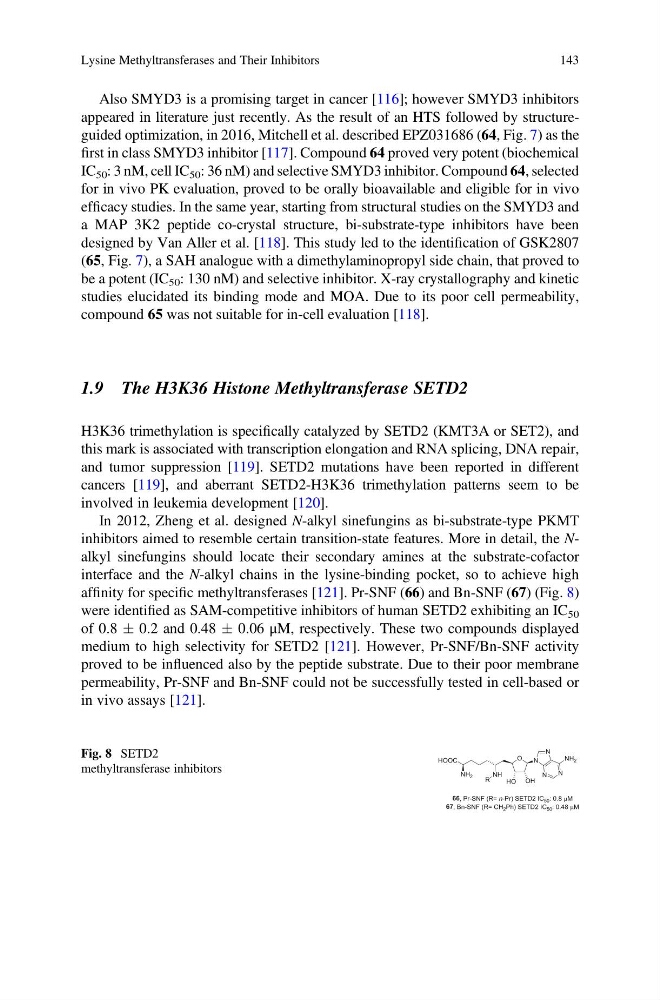
In 2012, Zheng et al. designed N-alkyl sinefungins as bi-substrate-type PKMT
inhibitors aimed to resemble certain transition-state features. More in detail, the Nalkyl sinefungins should locate their secondary amines at the substrate-cofactor
interface and the N-alkyl chains in the lysine-binding pocket, so to achieve high
affinity for specific methyltransferases [121]. Pr-SNF (66) and Bn-SNF (67) (Fig. 8)
were identified as SAM-competitive inhibitors of human SETD2 exhibiting an IC 50
of 0.8 Æ 0.2 and 0.48 Æ 0.06 μM, respectively. These two compounds displayed
medium to high selectivity for SETD2 [121]. However, Pr-SNF/Bn-SNF activity
proved to be influenced also by the peptide substrate. Due to their poor membrane
permeability, Pr-SNF and Bn-SNF could not be successfully tested in cell-based or
in vivo assays [121].
NH
HO OH
N
N
N
N
NH 2
O
66, Pr-SNF (R= n-Pr) SETD2 IC 50 : 0.8 M
67, Bn-SNF (R= CH 2 Ph) SETD2 IC 50 : 0.48 M
HOOC
NH 2
R
Fig. 8 SETD2
methyltransferase inhibitors
Lysine Methyltransferases and Their Inhibitors
143
appeared in literature just recently. As the result of an HTS followed by structureguided optimization, in 2016, Mitchell et al. described EPZ031686 (64, Fig. 7) as the
first in class SMYD3 inhibitor [117]. Compound 64 proved very potent (biochemical
IC 50 : 3 nM, cell IC 50 : 36 nM) and selective SMYD3 inhibitor. Compound 64, selected
for in vivo PK evaluation, proved to be orally bioavailable and eligible for in vivo
efficacy studies. In the same year, starting from structural studies on the SMYD3 and
a MAP 3K2 peptide co-crystal structure, bi-substrate-type inhibitors have been
designed by Van Aller et al. [118]. This study led to the identification of GSK2807
(65, Fig. 7), a SAH analogue with a dimethylaminopropyl side chain, that proved to
be a potent (IC 50 : 130 nM) and selective inhibitor. X-ray crystallography and kinetic
studies elucidated its binding mode and MOA. Due to its poor cell permeability,
compound 65 was not suitable for in-cell evaluation [118].
1.9 The H3K36 Histone Methyltransferase SETD2
H3K36 trimethylation is specifically catalyzed by SETD2 (KMT3A or SET2), and
this mark is associated with transcription elongation and RNA splicing, DNA repair,
and tumor suppression [119]. SETD2 mutations have been reported in different
cancers [119], and aberrant SETD2-H3K36 trimethylation patterns seem to be
involved in leukemia development [120].
In 2012, Zheng et al. designed N-alkyl sinefungins as bi-substrate-type PKMT
inhibitors aimed to resemble certain transition-state features. More in detail, the Nalkyl sinefungins should locate their secondary amines at the substrate-cofactor
interface and the N-alkyl chains in the lysine-binding pocket, so to achieve high
affinity for specific methyltransferases [121]. Pr-SNF (66) and Bn-SNF (67) (Fig. 8)
were identified as SAM-competitive inhibitors of human SETD2 exhibiting an IC 50
of 0.8 Æ 0.2 and 0.48 Æ 0.06 μM, respectively. These two compounds displayed
medium to high selectivity for SETD2 [121]. However, Pr-SNF/Bn-SNF activity
proved to be influenced also by the peptide substrate. Due to their poor membrane
permeability, Pr-SNF and Bn-SNF could not be successfully tested in cell-based or
in vivo assays [121].
NH
HO OH
N
N
N
N
NH 2
O
66, Pr-SNF (R= n-Pr) SETD2 IC 50 : 0.8 M
67, Bn-SNF (R= CH 2 Ph) SETD2 IC 50 : 0.48 M
HOOC
NH 2
R
Fig. 8 SETD2
methyltransferase inhibitors
Lysine Methyltransferases and Their Inhibitors
143