

After hydrolysis, the acetate is released through an ~14 Å long exit channel
perpendicular to the acetyl-lysine binding tunnel. In terms of substrate scope, there
are two variables for HDACs, the nature of the acyl group and the lysine. For the
majority of zinc-dependent HDACs, the acyl group is confined to the shorter chains
up to butyryl and crotonyl (Fig. 2), with the exception of HDAC11 that hydrolyses
longer acyl chains of 8–18 carbons [17]. As for the lysine, the endogenous substrates
are macromolecular proteins, but HDACs will competently hydrolyze single amino
acid lysine derivatives under cell-free conditions. Thus, HDACs predominantly
recognize the acyl-lysine sidechain and are not particularly sequence selective or
sensitive to the nature of the adjacent protein residues. Any specificity is imposed by
the cellular compartment within which the HDAC resides and its recruitment to
specific substrates by the multiprotein complexes with which it interacts.
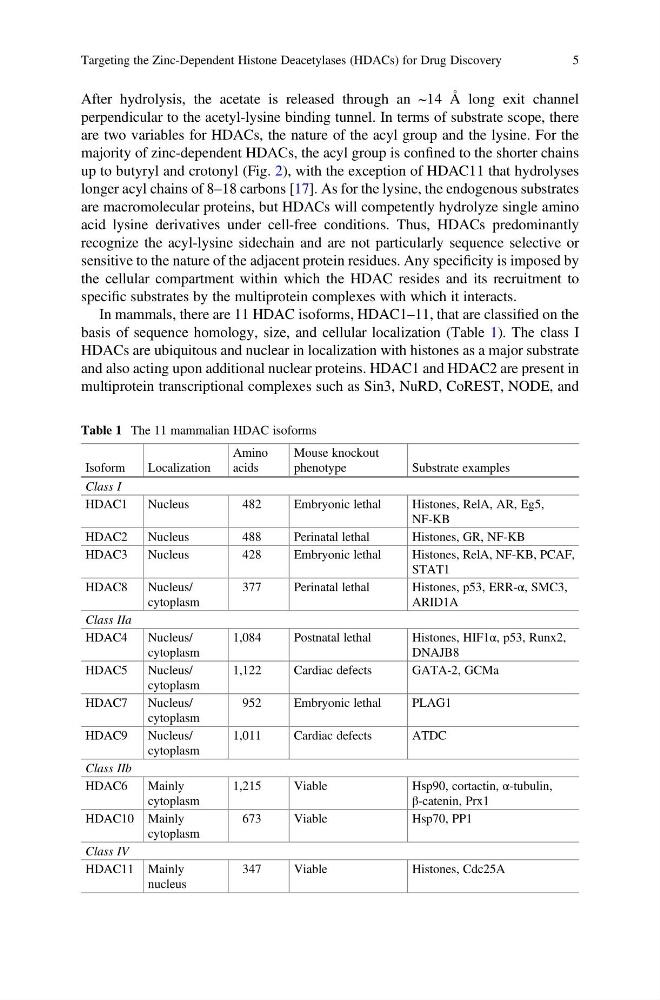
In mammals, there are 11 HDAC isoforms, HDAC1–11, that are classified on the
basis of sequence homology, size, and cellular localization (Table 1). The class I
HDACs are ubiquitous and nuclear in localization with histones as a major substrate
and also acting upon additional nuclear proteins. HDAC1 and HDAC2 are present in
multiprotein transcriptional complexes such as Sin3, NuRD, CoREST, NODE, and
Table 1 The 11 mammalian HDAC isoforms
Isoform
Localization
Amino
acids
Mouse knockout
phenotype
Substrate examples
Class I
HDAC1
Nucleus
482
Embryonic lethal
Histones, RelA, AR, Eg5,
NF-KB
HDAC2
Nucleus
488
Perinatal lethal
Histones, GR, NF-KB
HDAC3
Nucleus
428
Embryonic lethal
Histones, RelA, NF-KB, PCAF,
STAT1
HDAC8
Nucleus/
cytoplasm
377
Perinatal lethal
Histones, p53, ERR-α, SMC3,
ARID1A
Class IIa
HDAC4
Nucleus/
cytoplasm
1,084
Postnatal lethal
Histones, HIF1α, p53, Runx2,
DNAJB8
HDAC5
Nucleus/
cytoplasm
1,122
Cardiac defects
GATA-2, GCMa
HDAC7
Nucleus/
cytoplasm
952
Embryonic lethal
PLAG1
HDAC9
Nucleus/
cytoplasm
1,011
Cardiac defects
ATDC
Class IIb
HDAC6
Mainly
cytoplasm
1,215
Viable
Hsp90, cortactin, α-tubulin,
β-catenin, Prx1
HDAC10 Mainly
cytoplasm
673
Viable
Hsp70, PP1
Class IV
HDAC11 Mainly
nucleus
347
Viable
Histones, Cdc25A
Targeting the Zinc-Dependent Histone Deacetylases (HDACs) for Drug Discovery
5
perpendicular to the acetyl-lysine binding tunnel. In terms of substrate scope, there
are two variables for HDACs, the nature of the acyl group and the lysine. For the
majority of zinc-dependent HDACs, the acyl group is confined to the shorter chains
up to butyryl and crotonyl (Fig. 2), with the exception of HDAC11 that hydrolyses
longer acyl chains of 8–18 carbons [17]. As for the lysine, the endogenous substrates
are macromolecular proteins, but HDACs will competently hydrolyze single amino
acid lysine derivatives under cell-free conditions. Thus, HDACs predominantly
recognize the acyl-lysine sidechain and are not particularly sequence selective or
sensitive to the nature of the adjacent protein residues. Any specificity is imposed by
the cellular compartment within which the HDAC resides and its recruitment to
specific substrates by the multiprotein complexes with which it interacts.
In mammals, there are 11 HDAC isoforms, HDAC1–11, that are classified on the
basis of sequence homology, size, and cellular localization (Table 1). The class I
HDACs are ubiquitous and nuclear in localization with histones as a major substrate
and also acting upon additional nuclear proteins. HDAC1 and HDAC2 are present in
multiprotein transcriptional complexes such as Sin3, NuRD, CoREST, NODE, and
Table 1 The 11 mammalian HDAC isoforms
Isoform
Localization
Amino
acids
Mouse knockout
phenotype
Substrate examples
Class I
HDAC1
Nucleus
482
Embryonic lethal
Histones, RelA, AR, Eg5,
NF-KB
HDAC2
Nucleus
488
Perinatal lethal
Histones, GR, NF-KB
HDAC3
Nucleus
428
Embryonic lethal
Histones, RelA, NF-KB, PCAF,
STAT1
HDAC8
Nucleus/
cytoplasm
377
Perinatal lethal
Histones, p53, ERR-α, SMC3,
ARID1A
Class IIa
HDAC4
Nucleus/
cytoplasm
1,084
Postnatal lethal
Histones, HIF1α, p53, Runx2,
DNAJB8
HDAC5
Nucleus/
cytoplasm
1,122
Cardiac defects
GATA-2, GCMa
HDAC7
Nucleus/
cytoplasm
952
Embryonic lethal
PLAG1
HDAC9
Nucleus/
cytoplasm
1,011
Cardiac defects
ATDC
Class IIb
HDAC6
Mainly
cytoplasm
1,215
Viable
Hsp90, cortactin, α-tubulin,
β-catenin, Prx1
HDAC10 Mainly
cytoplasm
673
Viable
Hsp70, PP1
Class IV
HDAC11 Mainly
nucleus
347
Viable
Histones, Cdc25A
Targeting the Zinc-Dependent Histone Deacetylases (HDACs) for Drug Discovery
5