

2 The Zinc-Dependent HDACs
The deacylation of lysine residues is carried out by amide bond hydrolases grouped
together as HDACs. Within this family, there are two distinct catalytic mechanisms
in operation: the zinc-dependent HDACs contain an active site zinc(II) cation and are
the focus of this chapter, while the sirtuins are a distinct class of deacetylases that
transfer the acetyl group to the ribose sugar of their NAD
+ cofactor [12, 13]. X-ray
studies are available for a number of HDACs and HDAC-inhibitor complexes and
indicate a catalytic mechanism similar to that of other amide hydrolyzing
metalloenzymes [14–16]. The acetyl-lysine sidechain enters a narrow vertical tunnel
~11 Å long at the bottom of which sits the active site zinc(II) cation. The zinc
functions as a Lewis acid, simultaneously increasing the electrophilicity of the
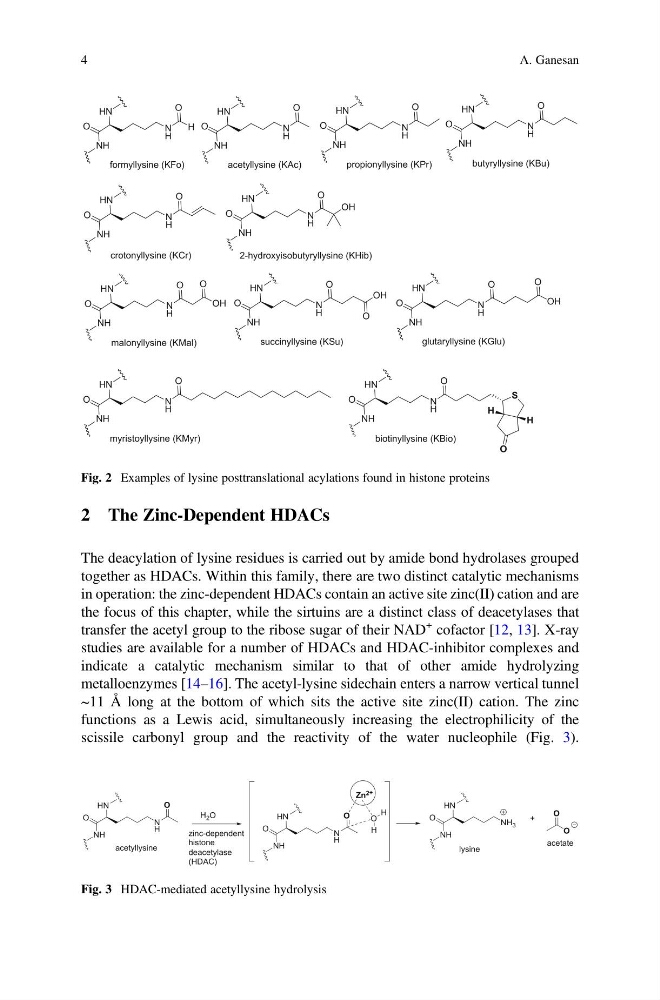
scissile carbonyl group and the reactivity of the water nucleophile (Fig. 3).
acetyllysine (KAc)
HN
NH
O
N
H
O
formyllysine (KFo)
HN
NH
O
N
H
H
O
propionyllysine (KPr)
HN
NH
O
N
H
O
butyryllysine (KBu)
HN
NH
O
N
H
O
crotonyllysine (KCr)
HN
NH
O
N
H
O
2-hydroxyisobutyryllysine (KHib)
HN
NH
O
N
H
O
OH
malonyllysine (KMal)
HN
NH
O
N
H
O
OH
O
succinyllysine (KSu)
HN
NH
O
N
H
O
OH
O
glutaryllysine (KGlu)
HN
NH
O
N
H
O
OH
O
myristoyllysine (KMyr)
HN
NH
O
N
H
O
S
H
H
O
biotinyllysine (KBio)
HN
NH
O
N
H
O
Fig. 2 Examples of lysine posttranslational acylations found in histone proteins
HN
NH
O
N
H
O
zinc-dependent
histone
deacetylase
(HDAC)
H 2 O
HN
NH
O
N
H
O
H
O
H
+
O
O
Zn 2+
HN
NH
O
NH 3
acetyllysine
lysine
acetate
Fig. 3 HDAC-mediated acetyllysine hydrolysis
4
A. Ganesan
The deacylation of lysine residues is carried out by amide bond hydrolases grouped
together as HDACs. Within this family, there are two distinct catalytic mechanisms
in operation: the zinc-dependent HDACs contain an active site zinc(II) cation and are
the focus of this chapter, while the sirtuins are a distinct class of deacetylases that
transfer the acetyl group to the ribose sugar of their NAD
+ cofactor [12, 13]. X-ray
studies are available for a number of HDACs and HDAC-inhibitor complexes and
indicate a catalytic mechanism similar to that of other amide hydrolyzing
metalloenzymes [14–16]. The acetyl-lysine sidechain enters a narrow vertical tunnel
~11 Å long at the bottom of which sits the active site zinc(II) cation. The zinc
functions as a Lewis acid, simultaneously increasing the electrophilicity of the
scissile carbonyl group and the reactivity of the water nucleophile (Fig. 3).
acetyllysine (KAc)
HN
NH
O
N
H
O
formyllysine (KFo)
HN
NH
O
N
H
H
O
propionyllysine (KPr)
HN
NH
O
N
H
O
butyryllysine (KBu)
HN
NH
O
N
H
O
crotonyllysine (KCr)
HN
NH
O
N
H
O
2-hydroxyisobutyryllysine (KHib)
HN
NH
O
N
H
O
OH
malonyllysine (KMal)
HN
NH
O
N
H
O
OH
O
succinyllysine (KSu)
HN
NH
O
N
H
O
OH
O
glutaryllysine (KGlu)
HN
NH
O
N
H
O
OH
O
myristoyllysine (KMyr)
HN
NH
O
N
H
O
S
H
H
O
biotinyllysine (KBio)
HN
NH
O
N
H
O
Fig. 2 Examples of lysine posttranslational acylations found in histone proteins
HN
NH
O
N
H
O
zinc-dependent
histone
deacetylase
(HDAC)
H 2 O
HN
NH
O
N
H
O
H
O
H
+
O
O
Zn 2+
HN
NH
O
NH 3
acetyllysine
lysine
acetate
Fig. 3 HDAC-mediated acetyllysine hydrolysis
4
A. Ganesan