

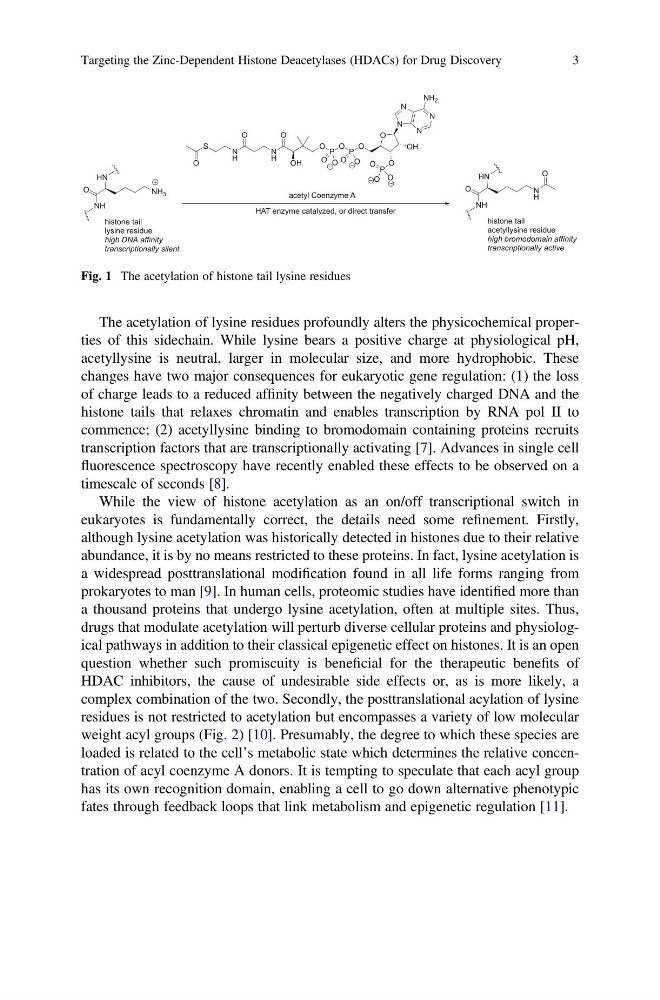
The acetylation of lysine residues profoundly alters the physicochemical properties of this sidechain. While lysine bears a positive charge at physiological pH,
acetyllysine is neutral, larger in molecular size, and more hydrophobic. These
changes have two major consequences for eukaryotic gene regulation: (1) the loss
of charge leads to a reduced affinity between the negatively charged DNA and the
histone tails that relaxes chromatin and enables transcription by RNA pol II to
commence; (2) acetyllysine binding to bromodomain containing proteins recruits
transcription factors that are transcriptionally activating [7]. Advances in single cell
fluorescence spectroscopy have recently enabled these effects to be observed on a
timescale of seconds [8].
While the view of histone acetylation as an on/off transcriptional switch in
eukaryotes is fundamentally correct, the details need some refinement. Firstly,
although lysine acetylation was historically detected in histones due to their relative
abundance, it is by no means restricted to these proteins. In fact, lysine acetylation is
a widespread posttranslational modification found in all life forms ranging from
prokaryotes to man [9]. In human cells, proteomic studies have identified more than
a thousand proteins that undergo lysine acetylation, often at multiple sites. Thus,
drugs that modulate acetylation will perturb diverse cellular proteins and physiological pathways in addition to their classical epigenetic effect on histones. It is an open
question whether such promiscuity is beneficial for the therapeutic benefits of
HDAC inhibitors, the cause of undesirable side effects or, as is more likely, a
complex combination of the two. Secondly, the posttranslational acylation of lysine
residues is not restricted to acetylation but encompasses a variety of low molecular
weight acyl groups (Fig. 2) [10]. Presumably, the degree to which these species are
loaded is related to the cell’s metabolic state which determines the relative concentration of acyl coenzyme A donors. It is tempting to speculate that each acyl group
has its own recognition domain, enabling a cell to go down alternative phenotypic
fates through feedback loops that link metabolism and epigenetic regulation [11].
histone tail
lysine residue
high DNA affinity
transcriptionally silent
S
N
H
N
H
O P
O P
O
O
O
O
OH
O O O O
O
N
O
OH
N
N
N
NH 2
P
O
O O
HN
NH
O
NH 3
acetyl Coenzyme A
histone tail
acetyllysine residue
high bromodomain affinity
transcriptionally active
HN
NH
O
N
H
O
HAT enzyme catalyzed, or direct transfer
Fig. 1 The acetylation of histone tail lysine residues
Targeting the Zinc-Dependent Histone Deacetylases (HDACs) for Drug Discovery
3
acetyllysine is neutral, larger in molecular size, and more hydrophobic. These
changes have two major consequences for eukaryotic gene regulation: (1) the loss
of charge leads to a reduced affinity between the negatively charged DNA and the
histone tails that relaxes chromatin and enables transcription by RNA pol II to
commence; (2) acetyllysine binding to bromodomain containing proteins recruits
transcription factors that are transcriptionally activating [7]. Advances in single cell
fluorescence spectroscopy have recently enabled these effects to be observed on a
timescale of seconds [8].
While the view of histone acetylation as an on/off transcriptional switch in
eukaryotes is fundamentally correct, the details need some refinement. Firstly,
although lysine acetylation was historically detected in histones due to their relative
abundance, it is by no means restricted to these proteins. In fact, lysine acetylation is
a widespread posttranslational modification found in all life forms ranging from
prokaryotes to man [9]. In human cells, proteomic studies have identified more than
a thousand proteins that undergo lysine acetylation, often at multiple sites. Thus,
drugs that modulate acetylation will perturb diverse cellular proteins and physiological pathways in addition to their classical epigenetic effect on histones. It is an open
question whether such promiscuity is beneficial for the therapeutic benefits of
HDAC inhibitors, the cause of undesirable side effects or, as is more likely, a
complex combination of the two. Secondly, the posttranslational acylation of lysine
residues is not restricted to acetylation but encompasses a variety of low molecular
weight acyl groups (Fig. 2) [10]. Presumably, the degree to which these species are
loaded is related to the cell’s metabolic state which determines the relative concentration of acyl coenzyme A donors. It is tempting to speculate that each acyl group
has its own recognition domain, enabling a cell to go down alternative phenotypic
fates through feedback loops that link metabolism and epigenetic regulation [11].
histone tail
lysine residue
high DNA affinity
transcriptionally silent
S
N
H
N
H
O P
O P
O
O
O
O
OH
O O O O
O
N
O
OH
N
N
N
NH 2
P
O
O O
HN
NH
O
NH 3
acetyl Coenzyme A
histone tail
acetyllysine residue
high bromodomain affinity
transcriptionally active
HN
NH
O
N
H
O
HAT enzyme catalyzed, or direct transfer
Fig. 1 The acetylation of histone tail lysine residues
Targeting the Zinc-Dependent Histone Deacetylases (HDACs) for Drug Discovery
3