

80
As can be seen in Fig. 4.4 the volume of global
coal mining increased rapidly from ~4.5 billion
tonnes to ~8 billion tonnes between 2000 and
2017. Although clean coal technologies enabled
the more effective and environmentally sound
utilisation of coal, the significant increase is
driven primarily by the enormous growth of
global energy consumption. Although there are
numerous ways to meet this growing energy
demand most raw material and energy resources
are not distributed evenly in the world. And this is
where policy comes into play. Major crude oil
and natural gas fields are found mostly outside
the European Union while the distribution of coal
sites is somewhat more balanced. The European
Union targets independence in every fields of
industry, especially the energy sector. As a result,
coal production is declared a strategic sector by
the EU that has to be developed regarding both
volume and technology. Considering energy
safety and independence, a diverse energy budget
with numerous energy resources as pillars in the
energy mix of regions and countries are also of
major significance thus the EU wishes to maintain the share of coal in the diversified mix of
energy utilisation (European Association for
Coal and Lignite 2017). The EU has published
the list of raw material with critical importance
since 2010. Natural graphite and coking coal
have been included in both the second (2014) and
third lists (2017) (European Commission 2017).
Considering the use of power in global policy,
the rate of monopolisation in hydrocarbons is
above 80% while in coal it is below 40% (IEA
2017), therefore coal seems to be more stable and
less prone to political manipulation; therefore,
the long-term role of coal in global energy production seems to be doubtless while its possession became a political factor.
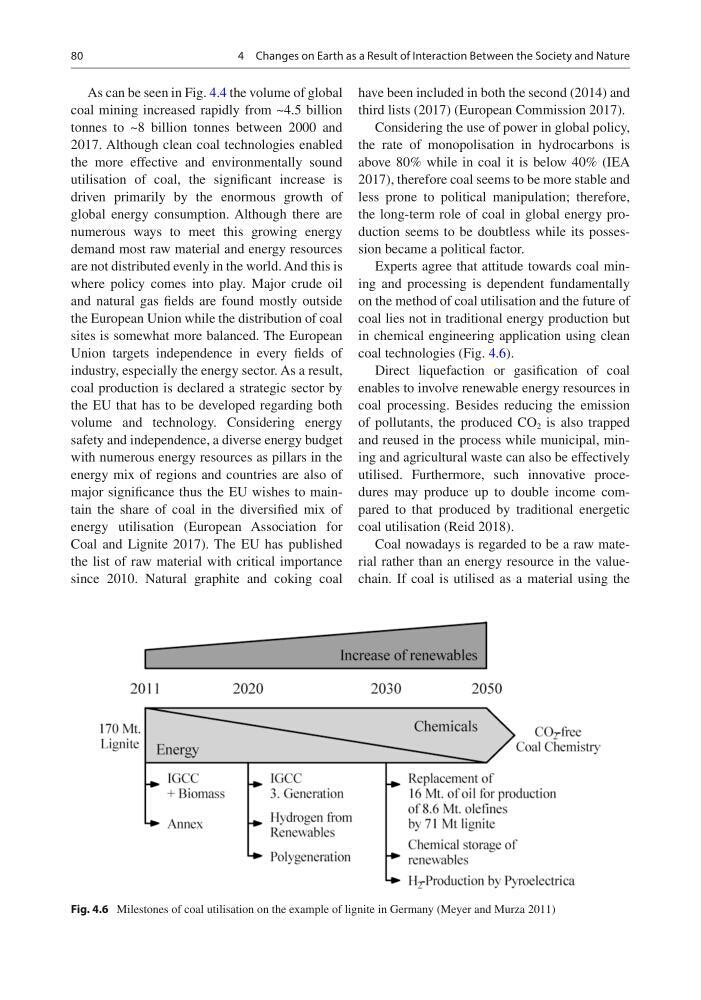
Experts agree that attitude towards coal mining and processing is dependent fundamentally
on the method of coal utilisation and the future of
coal lies not in traditional energy production but
in chemical engineering application using clean
coal technologies (Fig. 4.6).
Direct liquefaction or gasification of coal
enables to involve renewable energy resources in
coal processing. Besides reducing the emission
of pollutants, the produced CO 2 is also trapped
and reused in the process while municipal, mining and agricultural waste can also be effectively
utilised. Furthermore, such innovative procedures may produce up to double income compared to that produced by traditional energetic
coal utilisation (Reid 2018).
Coal nowadays is regarded to be a raw material rather than an energy resource in the valuechain. If coal is utilised as a material using the
Fig. 4.6 Milestones of coal utilisation on the example of lignite in Germany (Meyer and Murza 2011)
4 Changes on Earth as a Result of Interaction Between the Society and Nature
As can be seen in Fig. 4.4 the volume of global
coal mining increased rapidly from ~4.5 billion
tonnes to ~8 billion tonnes between 2000 and
2017. Although clean coal technologies enabled
the more effective and environmentally sound
utilisation of coal, the significant increase is
driven primarily by the enormous growth of
global energy consumption. Although there are
numerous ways to meet this growing energy
demand most raw material and energy resources
are not distributed evenly in the world. And this is
where policy comes into play. Major crude oil
and natural gas fields are found mostly outside
the European Union while the distribution of coal
sites is somewhat more balanced. The European
Union targets independence in every fields of
industry, especially the energy sector. As a result,
coal production is declared a strategic sector by
the EU that has to be developed regarding both
volume and technology. Considering energy
safety and independence, a diverse energy budget
with numerous energy resources as pillars in the
energy mix of regions and countries are also of
major significance thus the EU wishes to maintain the share of coal in the diversified mix of
energy utilisation (European Association for
Coal and Lignite 2017). The EU has published
the list of raw material with critical importance
since 2010. Natural graphite and coking coal
have been included in both the second (2014) and
third lists (2017) (European Commission 2017).
Considering the use of power in global policy,
the rate of monopolisation in hydrocarbons is
above 80% while in coal it is below 40% (IEA
2017), therefore coal seems to be more stable and
less prone to political manipulation; therefore,
the long-term role of coal in global energy production seems to be doubtless while its possession became a political factor.
Experts agree that attitude towards coal mining and processing is dependent fundamentally
on the method of coal utilisation and the future of
coal lies not in traditional energy production but
in chemical engineering application using clean
coal technologies (Fig. 4.6).
Direct liquefaction or gasification of coal
enables to involve renewable energy resources in
coal processing. Besides reducing the emission
of pollutants, the produced CO 2 is also trapped
and reused in the process while municipal, mining and agricultural waste can also be effectively
utilised. Furthermore, such innovative procedures may produce up to double income compared to that produced by traditional energetic
coal utilisation (Reid 2018).
Coal nowadays is regarded to be a raw material rather than an energy resource in the valuechain. If coal is utilised as a material using the
Fig. 4.6 Milestones of coal utilisation on the example of lignite in Germany (Meyer and Murza 2011)
4 Changes on Earth as a Result of Interaction Between the Society and Nature