

79
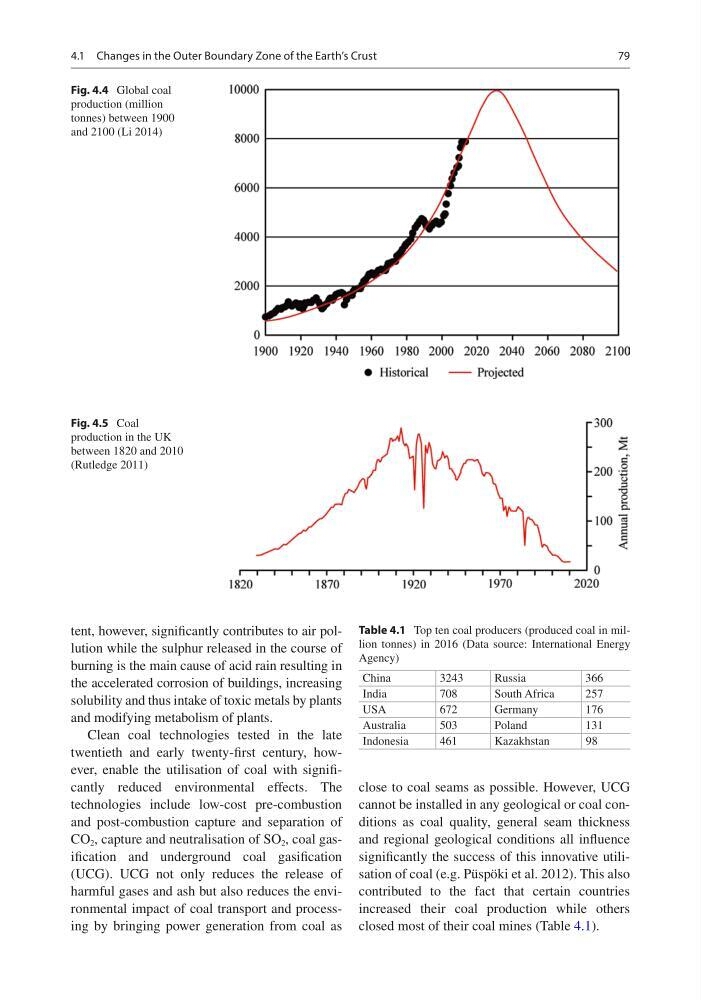
Fig. 4.4 Global coal
production (million
tonnes) between 1900
and 2100 (Li 2014)
Fig. 4.5 Coal
production in the UK
between 1820 and 2010
(Rutledge 2011)
tent, however, significantly contributes to air pollution while the sulphur released in the course of
burning is the main cause of acid rain resulting in
the accelerated corrosion of buildings, increasing
solubility and thus intake of toxic metals by plants
and modifying metabolism of plants.
Clean coal technologies tested in the late
twentieth and early twenty-first century, however, enable the utilisation of coal with significantly reduced environmental effects. The
technologies include low-cost pre-combustion
and post- combustion capture and separation of
CO 2 , capture and neutralisation of SO 2 , coal gasification and underground coal gasification
(UCG). UCG not only reduces the release of
harmful gases and ash but also reduces the environmental impact of coal transport and processing by bringing power generation from coal as
close to coal seams as possible. However, UCG
cannot be installed in any geological or coal conditions as coal quality, general seam thickness
and regional geological conditions all influence
significantly the success of this innovative utilisation of coal (e.g. Püspöki et al. 2012). This also
contributed to the fact that certain countries
increased their coal production while others
closed most of their coal mines (Table 4.1).
Table 4.1 Top ten coal producers (produced coal in million tonnes) in 2016 (Data source: International Energy
Agency)
China
3243
Russia
366
India
708
South Africa
257
USA
672
Germany
176
Australia
503
Poland
131
Indonesia
461
Kazakhstan
98
4.1 Changes in the Outer Boundary Zone of the Earth’s Crust
Fig. 4.4 Global coal
production (million
tonnes) between 1900
and 2100 (Li 2014)
Fig. 4.5 Coal
production in the UK
between 1820 and 2010
(Rutledge 2011)
tent, however, significantly contributes to air pollution while the sulphur released in the course of
burning is the main cause of acid rain resulting in
the accelerated corrosion of buildings, increasing
solubility and thus intake of toxic metals by plants
and modifying metabolism of plants.
Clean coal technologies tested in the late
twentieth and early twenty-first century, however, enable the utilisation of coal with significantly reduced environmental effects. The
technologies include low-cost pre-combustion
and post- combustion capture and separation of
CO 2 , capture and neutralisation of SO 2 , coal gasification and underground coal gasification
(UCG). UCG not only reduces the release of
harmful gases and ash but also reduces the environmental impact of coal transport and processing by bringing power generation from coal as
close to coal seams as possible. However, UCG
cannot be installed in any geological or coal conditions as coal quality, general seam thickness
and regional geological conditions all influence
significantly the success of this innovative utilisation of coal (e.g. Püspöki et al. 2012). This also
contributed to the fact that certain countries
increased their coal production while others
closed most of their coal mines (Table 4.1).
Table 4.1 Top ten coal producers (produced coal in million tonnes) in 2016 (Data source: International Energy
Agency)
China
3243
Russia
366
India
708
South Africa
257
USA
672
Germany
176
Australia
503
Poland
131
Indonesia
461
Kazakhstan
98
4.1 Changes in the Outer Boundary Zone of the Earth’s Crust