

43
Following the above preliminaries, the programme was run with different assumptions and
several versions were obtained for the development of the future. They were called model versions or scenarios. The authors emphasized that
a prognosis not similar to meteorological reports
was planned to be given instead scenarios were
studied from which humans can choose. Model
versions help making the decision.
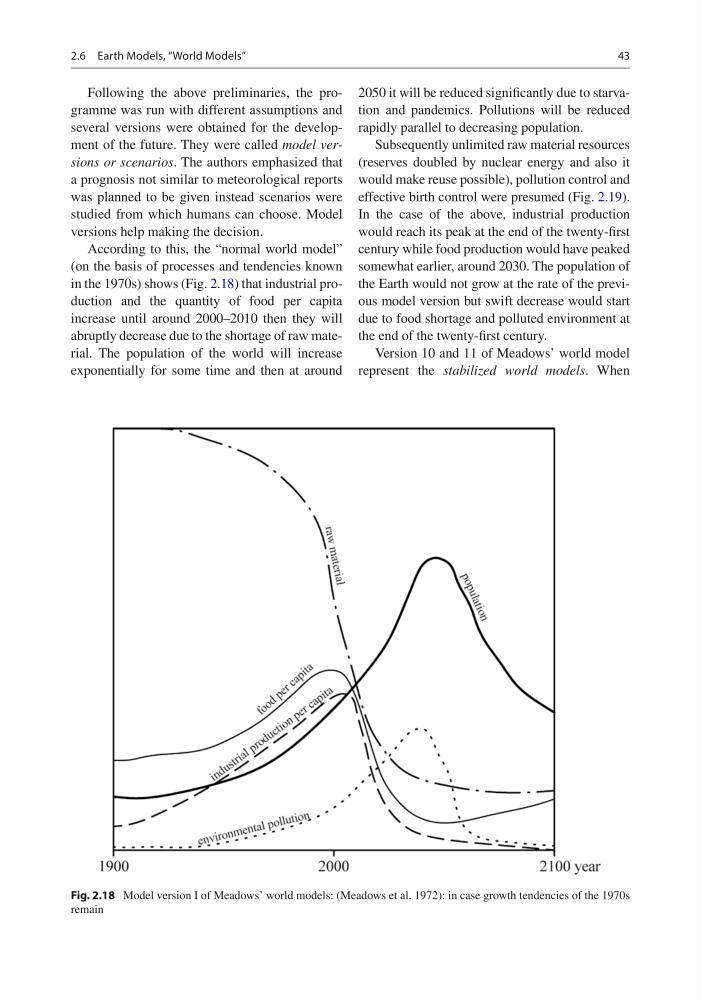
According to this, the “normal world model”
(on the basis of processes and tendencies known
in the 1970s) shows (Fig. 2.18) that industrial production and the quantity of food per capita
increase until around 2000–2010 then they will
abruptly decrease due to the shortage of raw material. The population of the world will increase
exponentially for some time and then at around
2050 it will be reduced significantly due to starvation and pandemics. Pollutions will be reduced
rapidly parallel to decreasing population.
Subsequently unlimited raw material resources
(reserves doubled by nuclear energy and also it
would make reuse possible), pollution control and
effective birth control were presumed (Fig. 2.19).
In the case of the above, industrial production
would reach its peak at the end of the twenty-first
century while food production would have peaked
somewhat earlier, around 2030. The population of
the Earth would not grow at the rate of the previous model version but swift decrease would start
due to food shortage and polluted environment at
the end of the twenty-first century.
Version 10 and 11 of Meadows’ world model
represent the stabilized world models. When
Fig. 2.18 Model version I of Meadows’ world models: (Meadows et al. 1972): in case growth tendencies of the 1970s
remain
2.6 Earth Models, “World Models”
Following the above preliminaries, the programme was run with different assumptions and
several versions were obtained for the development of the future. They were called model versions or scenarios. The authors emphasized that
a prognosis not similar to meteorological reports
was planned to be given instead scenarios were
studied from which humans can choose. Model
versions help making the decision.
According to this, the “normal world model”
(on the basis of processes and tendencies known
in the 1970s) shows (Fig. 2.18) that industrial production and the quantity of food per capita
increase until around 2000–2010 then they will
abruptly decrease due to the shortage of raw material. The population of the world will increase
exponentially for some time and then at around
2050 it will be reduced significantly due to starvation and pandemics. Pollutions will be reduced
rapidly parallel to decreasing population.
Subsequently unlimited raw material resources
(reserves doubled by nuclear energy and also it
would make reuse possible), pollution control and
effective birth control were presumed (Fig. 2.19).
In the case of the above, industrial production
would reach its peak at the end of the twenty-first
century while food production would have peaked
somewhat earlier, around 2030. The population of
the Earth would not grow at the rate of the previous model version but swift decrease would start
due to food shortage and polluted environment at
the end of the twenty-first century.
Version 10 and 11 of Meadows’ world model
represent the stabilized world models. When
Fig. 2.18 Model version I of Meadows’ world models: (Meadows et al. 1972): in case growth tendencies of the 1970s
remain
2.6 Earth Models, “World Models”