

29
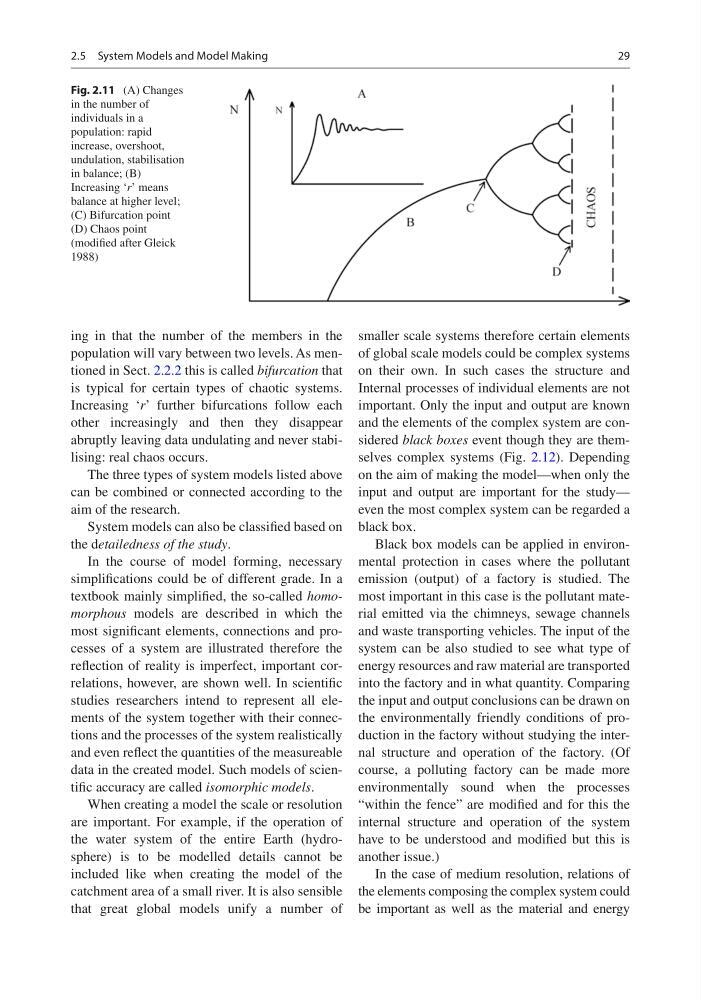
ing in that the number of the members in the
population will vary between two levels. As mentioned in Sect. 2.2.2 this is called bifurcation that
is typical for certain types of chaotic systems.
Increasing ‘r’ further bifurcations follow each
other increasingly and then they disappear
abruptly leaving data undulating and never stabilising: real chaos occurs.
The three types of system models listed above
can be combined or connected according to the
aim of the research.
System models can also be classified based on
the detailedness of the study.
In the course of model forming, necessary
simplifications could be of different grade. In a
textbook mainly simplified, the so-called homomorphous models are described in which the
most significant elements, connections and processes of a system are illustrated therefore the
reflection of reality is imperfect, important correlations, however, are shown well. In scientific
studies researchers intend to represent all elements of the system together with their connections and the processes of the system realistically
and even reflect the quantities of the measureable
data in the created model. Such models of scientific accuracy are called isomorphic models.
When creating a model the scale or resolution
are important. For example, if the operation of
the water system of the entire Earth (hydrosphere) is to be modelled details cannot be
included like when creating the model of the
catchment area of a small river. It is also sensible
that great global models unify a number of
smaller scale systems therefore certain elements
of global scale models could be complex systems
on their own. In such cases the structure and
Internal processes of individual elements are not
important. Only the input and output are known
and the elements of the complex system are considered black boxes event though they are themselves complex systems (Fig. 2.12). Depending
on the aim of making the model—when only the
input and output are important for the study—
even the most complex system can be regarded a
black box.
Black box models can be applied in environmental protection in cases where the pollutant
emission (output) of a factory is studied. The
most important in this case is the pollutant material emitted via the chimneys, sewage channels
and waste transporting vehicles. The input of the
system can be also studied to see what type of
energy resources and raw material are transported
into the factory and in what quantity. Comparing
the input and output conclusions can be drawn on
the environmentally friendly conditions of production in the factory without studying the internal structure and operation of the factory. (Of
course, a polluting factory can be made more
environmentally sound when the processes
“within the fence” are modified and for this the
internal structure and operation of the system
have to be understood and modified but this is
another issue.)
In the case of medium resolution, relations of
the elements composing the complex system could
be important as well as the material and energy
Fig. 2.11 (A) Changes
in the number of
individuals in a
population: rapid
increase, overshoot,
undulation, stabilisation
in balance; (B)
Increasing ‘r’ means
balance at higher level;
(C) Bifurcation point
(D) Chaos point
(modified after Gleick
1988)
2.5 System Models and Model Making
ing in that the number of the members in the
population will vary between two levels. As mentioned in Sect. 2.2.2 this is called bifurcation that
is typical for certain types of chaotic systems.
Increasing ‘r’ further bifurcations follow each
other increasingly and then they disappear
abruptly leaving data undulating and never stabilising: real chaos occurs.
The three types of system models listed above
can be combined or connected according to the
aim of the research.
System models can also be classified based on
the detailedness of the study.
In the course of model forming, necessary
simplifications could be of different grade. In a
textbook mainly simplified, the so-called homomorphous models are described in which the
most significant elements, connections and processes of a system are illustrated therefore the
reflection of reality is imperfect, important correlations, however, are shown well. In scientific
studies researchers intend to represent all elements of the system together with their connections and the processes of the system realistically
and even reflect the quantities of the measureable
data in the created model. Such models of scientific accuracy are called isomorphic models.
When creating a model the scale or resolution
are important. For example, if the operation of
the water system of the entire Earth (hydrosphere) is to be modelled details cannot be
included like when creating the model of the
catchment area of a small river. It is also sensible
that great global models unify a number of
smaller scale systems therefore certain elements
of global scale models could be complex systems
on their own. In such cases the structure and
Internal processes of individual elements are not
important. Only the input and output are known
and the elements of the complex system are considered black boxes event though they are themselves complex systems (Fig. 2.12). Depending
on the aim of making the model—when only the
input and output are important for the study—
even the most complex system can be regarded a
black box.
Black box models can be applied in environmental protection in cases where the pollutant
emission (output) of a factory is studied. The
most important in this case is the pollutant material emitted via the chimneys, sewage channels
and waste transporting vehicles. The input of the
system can be also studied to see what type of
energy resources and raw material are transported
into the factory and in what quantity. Comparing
the input and output conclusions can be drawn on
the environmentally friendly conditions of production in the factory without studying the internal structure and operation of the factory. (Of
course, a polluting factory can be made more
environmentally sound when the processes
“within the fence” are modified and for this the
internal structure and operation of the system
have to be understood and modified but this is
another issue.)
In the case of medium resolution, relations of
the elements composing the complex system could
be important as well as the material and energy
Fig. 2.11 (A) Changes
in the number of
individuals in a
population: rapid
increase, overshoot,
undulation, stabilisation
in balance; (B)
Increasing ‘r’ means
balance at higher level;
(C) Bifurcation point
(D) Chaos point
(modified after Gleick
1988)
2.5 System Models and Model Making