

222
relations of cities fundamentally from economy
point of view. Scientists came to the conclusion
that each global city establishes connections with
cities belonging to the same category. Taylor
(2004) classified world cities into three categories based on their global connections: alpha
(above 5 million residents and 20 million people
in its attraction zone), beta and gamma cities
(1–5 million residents and 10 million people in
their attraction zone). The latter two are differentiated on the basis of their position in obtaining
strategic business services. These cities form
separate networks crossing over national borders.
Nowadays, power centres controlling globalisation can be found in metropolises where transnational company centres are assembled.
Global civil society networks connect the
politically most active population of the world.
The civil sphere needs to be strengthened globally in order to gain a major role in realising sustainable development, however, its activity is
already regarded to be very important. (Civil
organisations are treated as enemies in autocratic
countries limiting their activities.)
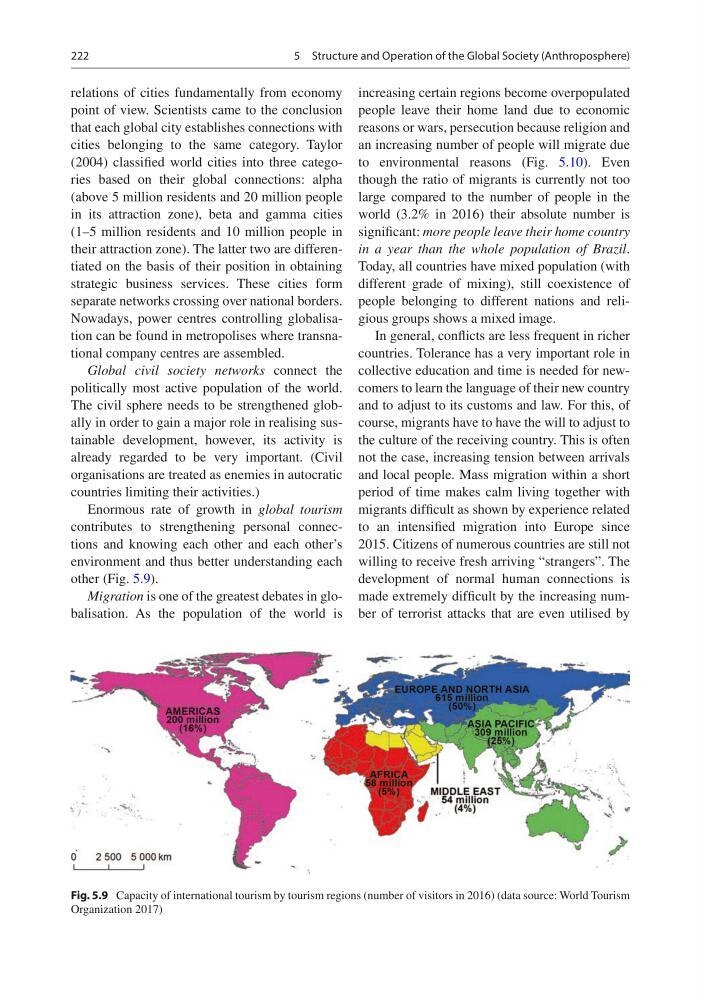
Enormous rate of growth in global tourism
contributes to strengthening personal connections and knowing each other and each other’s
environment and thus better understanding each
other (Fig. 5.9).
Migration is one of the greatest debates in globalisation. As the population of the world is
increasing certain regions become overpopulated
people leave their home land due to economic
reasons or wars, persecution because religion and
an increasing number of people will migrate due
to environmental reasons (Fig. 5.10). Even
though the ratio of migrants is currently not too
large compared to the number of people in the
world (3.2% in 2016) their absolute number is
significant: more people leave their home country
in a year than the whole population of Brazil.
Today, all countries have mixed population (with
different grade of mixing), still coexistence of
people belonging to different nations and religious groups shows a mixed image.
In general, conflicts are less frequent in richer
countries. Tolerance has a very important role in
collective education and time is needed for newcomers to learn the language of their new country
and to adjust to its customs and law. For this, of
course, migrants have to have the will to adjust to
the culture of the receiving country. This is often
not the case, increasing tension between arrivals
and local people. Mass migration within a short
period of time makes calm living together with
migrants difficult as shown by experience related
to an intensified migration into Europe since
2015. Citizens of numerous countries are still not
willing to receive fresh arriving “strangers”. The
development of normal human connections is
made extremely difficult by the increasing number of terrorist attacks that are even utilised by
Fig. 5.9 Capacity of international tourism by tourism regions (number of visitors in 2016) (data source: World Tourism
Organization 2017)
5 Structure and Operation of the Global Society (Anthroposphere)
relations of cities fundamentally from economy
point of view. Scientists came to the conclusion
that each global city establishes connections with
cities belonging to the same category. Taylor
(2004) classified world cities into three categories based on their global connections: alpha
(above 5 million residents and 20 million people
in its attraction zone), beta and gamma cities
(1–5 million residents and 10 million people in
their attraction zone). The latter two are differentiated on the basis of their position in obtaining
strategic business services. These cities form
separate networks crossing over national borders.
Nowadays, power centres controlling globalisation can be found in metropolises where transnational company centres are assembled.
Global civil society networks connect the
politically most active population of the world.
The civil sphere needs to be strengthened globally in order to gain a major role in realising sustainable development, however, its activity is
already regarded to be very important. (Civil
organisations are treated as enemies in autocratic
countries limiting their activities.)
Enormous rate of growth in global tourism
contributes to strengthening personal connections and knowing each other and each other’s
environment and thus better understanding each
other (Fig. 5.9).
Migration is one of the greatest debates in globalisation. As the population of the world is
increasing certain regions become overpopulated
people leave their home land due to economic
reasons or wars, persecution because religion and
an increasing number of people will migrate due
to environmental reasons (Fig. 5.10). Even
though the ratio of migrants is currently not too
large compared to the number of people in the
world (3.2% in 2016) their absolute number is
significant: more people leave their home country
in a year than the whole population of Brazil.
Today, all countries have mixed population (with
different grade of mixing), still coexistence of
people belonging to different nations and religious groups shows a mixed image.
In general, conflicts are less frequent in richer
countries. Tolerance has a very important role in
collective education and time is needed for newcomers to learn the language of their new country
and to adjust to its customs and law. For this, of
course, migrants have to have the will to adjust to
the culture of the receiving country. This is often
not the case, increasing tension between arrivals
and local people. Mass migration within a short
period of time makes calm living together with
migrants difficult as shown by experience related
to an intensified migration into Europe since
2015. Citizens of numerous countries are still not
willing to receive fresh arriving “strangers”. The
development of normal human connections is
made extremely difficult by the increasing number of terrorist attacks that are even utilised by
Fig. 5.9 Capacity of international tourism by tourism regions (number of visitors in 2016) (data source: World Tourism
Organization 2017)
5 Structure and Operation of the Global Society (Anthroposphere)