

221
increasingly stiff and extreme. In the USA, for
example, one-third of adults reject any new ideas
including proven facts. Such people are easy to
manipulate.
Since information flow, data collection and
processing practically influence everything in the
society from individuals via the economy to policy, this information flow is regarded the central
layer of the society. At present, it is difficult to
decide whether global data and information flow
will contribute or impede sustainable development. It is an important question whether the
Internet will become the tool of global interconnectivity or a tool of power for politicians acting
against interconnectivity. It was also observed
that, for example, the users of Facebook generally form closed opinion groups that are not
interchangeable. This provides no help for global
interconnectivity. Also, a frequent phenomenon is
that political powers can control or even prohibit
information flow and may employ professional
hackers to achieve their goals. Therefore, the
political power layer is called control layer.
Harari (2016) regards data processing (dataism) the determinative process of the twenty-first
century and analyses it in detail. Data processing
controls our world according to algorithms generally effective to the biochemical processes of
living creatures, electronic algorithms and communities. According to this view, human societies are data processing systems competing with
each other: capitalism uses distributed while
communism uses centralised processing.
Distributed processing works better than the centralised one (at least at the time of developed data
processing technologies) therefore capitalism is
the more developed system.
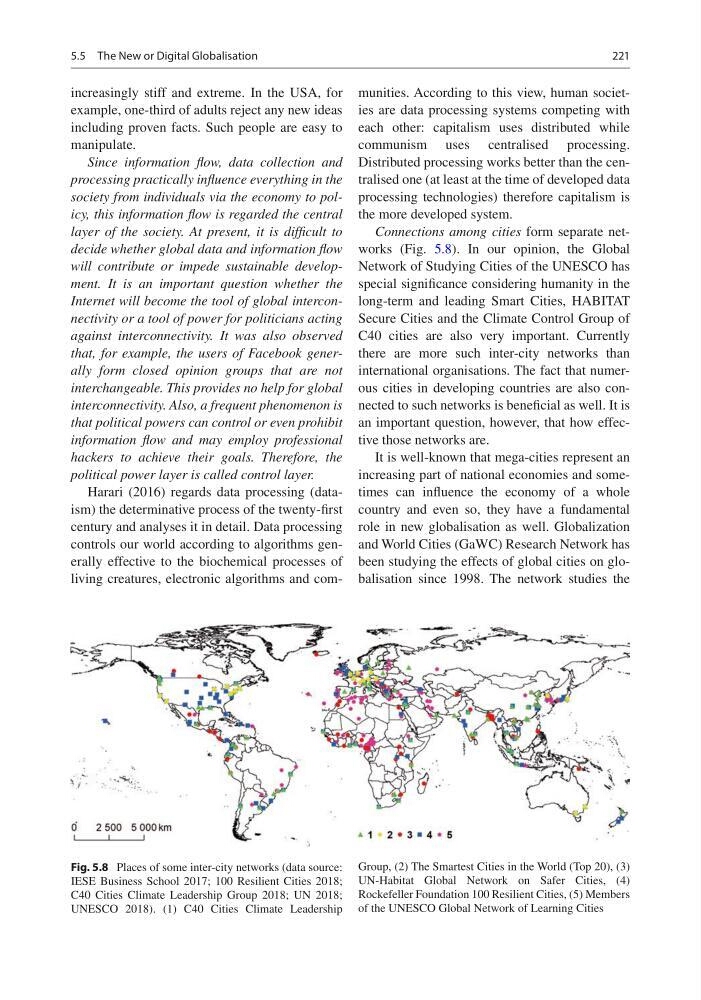
Connections among cities form separate networks (Fig. 5.8). In our opinion, the Global
Network of Studying Cities of the UNESCO has
special significance considering humanity in the
long-term and leading Smart Cities, HABITAT
Secure Cities and the Climate Control Group of
C40 cities are also very important. Currently
there are more such inter-city networks than
international organisations. The fact that numerous cities in developing countries are also connected to such networks is beneficial as well. It is
an important question, however, that how effective those networks are.
It is well-known that mega-cities represent an
increasing part of national economies and sometimes can influence the economy of a whole
country and even so, they have a fundamental
role in new globalisation as well. Globalization
and World Cities (GaWC) Research Network has
been studying the effects of global cities on globalisation since 1998. The network studies the
Fig. 5.8 Places of some inter-city networks (data source:
IESE Business School 2017; 100 Resilient Cities 2018;
C40 Cities Climate Leadership Group 2018; UN 2018;
UNESCO 2018). (1) C40 Cities Climate Leadership
Group, (2) The Smartest Cities in the World (Top 20), (3)
UN-Habitat Global Network on Safer Cities, (4)
Rockefeller Foundation 100 Resilient Cities, (5) Members
of the UNESCO Global Network of Learning Cities
5.5 The New or Digital Globalisation
increasingly stiff and extreme. In the USA, for
example, one-third of adults reject any new ideas
including proven facts. Such people are easy to
manipulate.
Since information flow, data collection and
processing practically influence everything in the
society from individuals via the economy to policy, this information flow is regarded the central
layer of the society. At present, it is difficult to
decide whether global data and information flow
will contribute or impede sustainable development. It is an important question whether the
Internet will become the tool of global interconnectivity or a tool of power for politicians acting
against interconnectivity. It was also observed
that, for example, the users of Facebook generally form closed opinion groups that are not
interchangeable. This provides no help for global
interconnectivity. Also, a frequent phenomenon is
that political powers can control or even prohibit
information flow and may employ professional
hackers to achieve their goals. Therefore, the
political power layer is called control layer.
Harari (2016) regards data processing (dataism) the determinative process of the twenty-first
century and analyses it in detail. Data processing
controls our world according to algorithms generally effective to the biochemical processes of
living creatures, electronic algorithms and communities. According to this view, human societies are data processing systems competing with
each other: capitalism uses distributed while
communism uses centralised processing.
Distributed processing works better than the centralised one (at least at the time of developed data
processing technologies) therefore capitalism is
the more developed system.
Connections among cities form separate networks (Fig. 5.8). In our opinion, the Global
Network of Studying Cities of the UNESCO has
special significance considering humanity in the
long-term and leading Smart Cities, HABITAT
Secure Cities and the Climate Control Group of
C40 cities are also very important. Currently
there are more such inter-city networks than
international organisations. The fact that numerous cities in developing countries are also connected to such networks is beneficial as well. It is
an important question, however, that how effective those networks are.
It is well-known that mega-cities represent an
increasing part of national economies and sometimes can influence the economy of a whole
country and even so, they have a fundamental
role in new globalisation as well. Globalization
and World Cities (GaWC) Research Network has
been studying the effects of global cities on globalisation since 1998. The network studies the
Fig. 5.8 Places of some inter-city networks (data source:
IESE Business School 2017; 100 Resilient Cities 2018;
C40 Cities Climate Leadership Group 2018; UN 2018;
UNESCO 2018). (1) C40 Cities Climate Leadership
Group, (2) The Smartest Cities in the World (Top 20), (3)
UN-Habitat Global Network on Safer Cities, (4)
Rockefeller Foundation 100 Resilient Cities, (5) Members
of the UNESCO Global Network of Learning Cities
5.5 The New or Digital Globalisation