

220
integration of Canada, the United States and
Mexico is increasing and it will result in the formation of the North American Union.
Most people in South America live in cities
along the shores of either the Atlantic or the
Pacific Ocean. Thus, trade is mostly carried out
via the ocean, however, interconnection of the
countries of the continent has been increased by
recent energy and transport connections developed via the continent contributing to a real
South American Union.
Regarding post-colonisation regions, Southeastern Asia develops most intensely towards a
functional integration. Connections among countries are advanced mostly in the fields of trade,
transport, energy infrastructure and supply chain
complementaries. Khanna refers to this region as
Pax Asiana.
Africa is regarded to be a collection of subregions, however, Khanna calls attention to the
increase of interconnectivity here as well. In Pax
Africana new transcontinental highways and railways, electric energy networks, oil and gas pipelines connect the countries.
The countries in Northern Africa and the
Middle East (Pax Arabia) still wait for reorganisation. New energy and water infrastructure
between countries rich and poor in resources
could support a sensible division of resources.
Developed transport routes could transform
Arabian civilisation into a “collection of city
oases” (Khanna 2016).
The World Wide Web connects not only production companies, trade units and service companies but the majority of people capable of
reading and writing. Mobile devices make
accessibility to the Internet unlimited even in
time. Global dataflow between continents has
grown immensely, measured in terabyte per second (Tbps).
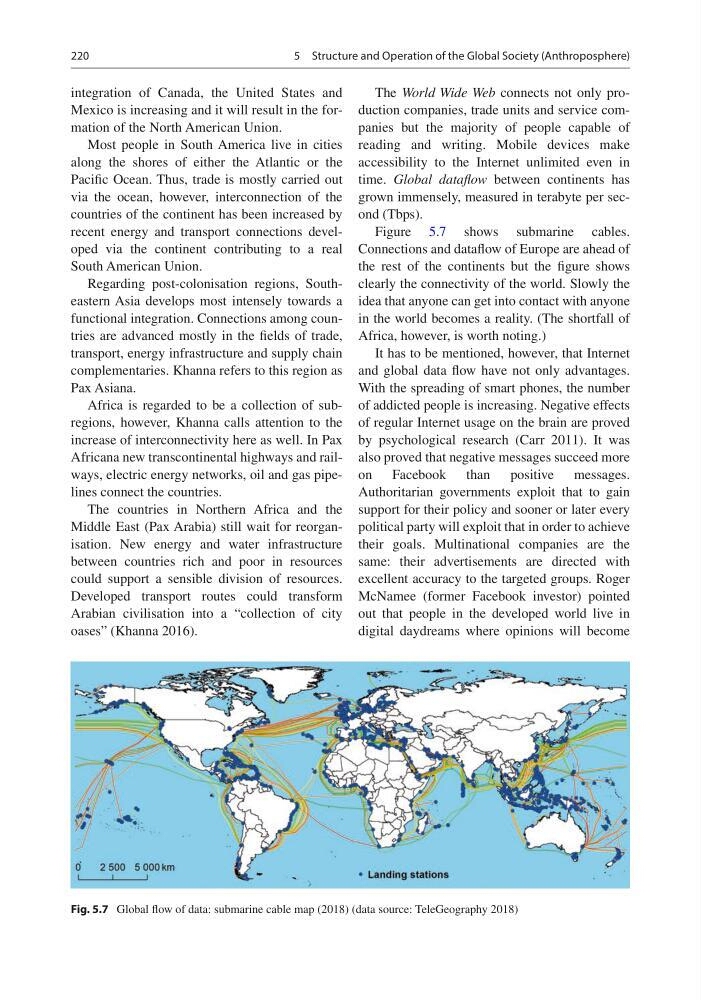
Figure 5.7 shows submarine cables.
Connections and dataflow of Europe are ahead of
the rest of the continents but the figure shows
clearly the connectivity of the world. Slowly the
idea that anyone can get into contact with anyone
in the world becomes a reality. (The shortfall of
Africa, however, is worth noting.)
It has to be mentioned, however, that Internet
and global data flow have not only advantages.
With the spreading of smart phones, the number
of addicted people is increasing. Negative effects
of regular Internet usage on the brain are proved
by psychological research (Carr 2011). It was
also proved that negative messages succeed more
on Facebook than positive messages.
Authoritarian governments exploit that to gain
support for their policy and sooner or later every
political party will exploit that in order to achieve
their goals. Multinational companies are the
same: their advertisements are directed with
excellent accuracy to the targeted groups. Roger
McNamee (former Facebook investor) pointed
out that people in the developed world live in
digital daydreams where opinions will become
Fig. 5.7 Global flow of data: submarine cable map (2018) (data source: TeleGeography 2018)
5 Structure and Operation of the Global Society (Anthroposphere)
integration of Canada, the United States and
Mexico is increasing and it will result in the formation of the North American Union.
Most people in South America live in cities
along the shores of either the Atlantic or the
Pacific Ocean. Thus, trade is mostly carried out
via the ocean, however, interconnection of the
countries of the continent has been increased by
recent energy and transport connections developed via the continent contributing to a real
South American Union.
Regarding post-colonisation regions, Southeastern Asia develops most intensely towards a
functional integration. Connections among countries are advanced mostly in the fields of trade,
transport, energy infrastructure and supply chain
complementaries. Khanna refers to this region as
Pax Asiana.
Africa is regarded to be a collection of subregions, however, Khanna calls attention to the
increase of interconnectivity here as well. In Pax
Africana new transcontinental highways and railways, electric energy networks, oil and gas pipelines connect the countries.
The countries in Northern Africa and the
Middle East (Pax Arabia) still wait for reorganisation. New energy and water infrastructure
between countries rich and poor in resources
could support a sensible division of resources.
Developed transport routes could transform
Arabian civilisation into a “collection of city
oases” (Khanna 2016).
The World Wide Web connects not only production companies, trade units and service companies but the majority of people capable of
reading and writing. Mobile devices make
accessibility to the Internet unlimited even in
time. Global dataflow between continents has
grown immensely, measured in terabyte per second (Tbps).
Figure 5.7 shows submarine cables.
Connections and dataflow of Europe are ahead of
the rest of the continents but the figure shows
clearly the connectivity of the world. Slowly the
idea that anyone can get into contact with anyone
in the world becomes a reality. (The shortfall of
Africa, however, is worth noting.)
It has to be mentioned, however, that Internet
and global data flow have not only advantages.
With the spreading of smart phones, the number
of addicted people is increasing. Negative effects
of regular Internet usage on the brain are proved
by psychological research (Carr 2011). It was
also proved that negative messages succeed more
on Facebook than positive messages.
Authoritarian governments exploit that to gain
support for their policy and sooner or later every
political party will exploit that in order to achieve
their goals. Multinational companies are the
same: their advertisements are directed with
excellent accuracy to the targeted groups. Roger
McNamee (former Facebook investor) pointed
out that people in the developed world live in
digital daydreams where opinions will become
Fig. 5.7 Global flow of data: submarine cable map (2018) (data source: TeleGeography 2018)
5 Structure and Operation of the Global Society (Anthroposphere)