

219
(EEZ) is included in the modified version of
Maritime Law Convention of the UN of 1994
extending 200 nautical miles from the coastline.
In this zone the seashore state owns exclusive
rights for excavating seabed resources (O’Rourke
2018). More than one-third of the World Ocean is
included in EEZ of all seashore countries. Until
October 2017 seashore countries handed in 78
territorial requests in 30 cases of which conflicts
developed (Tuerk 2017).
Antarctica is a special case regarding division
among nations as if the whole continent forms an
international area where mining is prohibited
according to the Antarctic Environmental Protocol
of 1991 (Rothwell 2000). Despite this, many
countries wish to explore and utilise resources of
the areas supervised by them. The Antarctic
Treaty provides no right for such demand.
Although the future is uncertain many people
considers, luckily, that the protection of the natural environment comes first in Antarctica and in
every marine area that are ecologically sensitive.
In the opinion of the authors, there is still a
long way to overwrite political borders with the
global interconnectivity of states/people and
demands for areas that are still to be conquered.
It has to be accepted, however, as a fact that apart
from that mentioned above (information flow,
development of mega-infrastructures) a number
of other actions contribute to the growth of interconnectivity in the global society.
One factor behind this growth is decentralisation: increasing power of regions, local governments opposing central governments. This,
however, cannot be regarded global today. There
are some countries that still have very strong central power (North Korea, Cuba, Venezuela, China,
Russia) and also democracies where central
power increases central control. The authors
think that regional and local control would enable
a more reasonable and environmentally sound
utilisation of local resources therefore decentralisation has a future but opposition from central
powers is strong in many countries.
“Dilution”, i.e. genetic mingling of races and
nations also increase interconnectivity. Further
construction of mega-infrastructure (cables, railways, channels) also intensifies this.
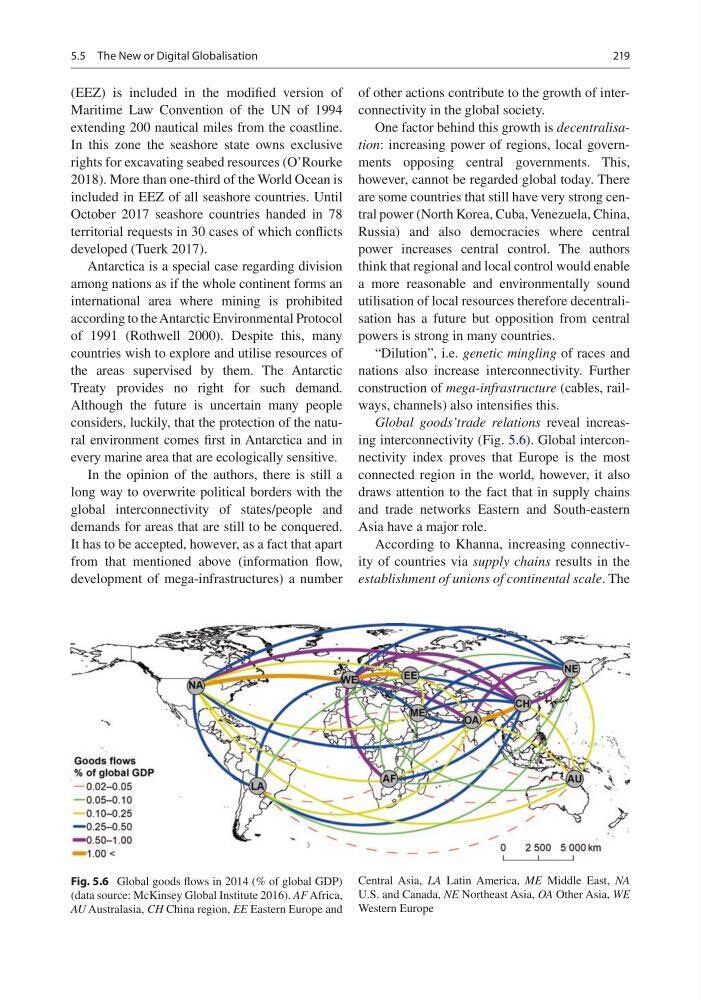
Global goods’trade relations reveal increasing interconnectivity (Fig. 5.6). Global interconnectivity index proves that Europe is the most
connected region in the world, however, it also
draws attention to the fact that in supply chains
and trade networks Eastern and South-eastern
Asia have a major role.
According to Khanna, increasing connectivity of countries via supply chains results in the
establishment of unions of continental scale. The
Fig. 5.6 Global goods flows in 2014 (% of global GDP)
(data source: McKinsey Global Institute 2016). AF Africa,
AU Australasia, CH China region, EE Eastern Europe and
Central Asia, LA Latin America, ME Middle East, NA
U.S. and Canada, NE Northeast Asia, OA Other Asia, WE
Western Europe
5.5 The New or Digital Globalisation
(EEZ) is included in the modified version of
Maritime Law Convention of the UN of 1994
extending 200 nautical miles from the coastline.
In this zone the seashore state owns exclusive
rights for excavating seabed resources (O’Rourke
2018). More than one-third of the World Ocean is
included in EEZ of all seashore countries. Until
October 2017 seashore countries handed in 78
territorial requests in 30 cases of which conflicts
developed (Tuerk 2017).
Antarctica is a special case regarding division
among nations as if the whole continent forms an
international area where mining is prohibited
according to the Antarctic Environmental Protocol
of 1991 (Rothwell 2000). Despite this, many
countries wish to explore and utilise resources of
the areas supervised by them. The Antarctic
Treaty provides no right for such demand.
Although the future is uncertain many people
considers, luckily, that the protection of the natural environment comes first in Antarctica and in
every marine area that are ecologically sensitive.
In the opinion of the authors, there is still a
long way to overwrite political borders with the
global interconnectivity of states/people and
demands for areas that are still to be conquered.
It has to be accepted, however, as a fact that apart
from that mentioned above (information flow,
development of mega-infrastructures) a number
of other actions contribute to the growth of interconnectivity in the global society.
One factor behind this growth is decentralisation: increasing power of regions, local governments opposing central governments. This,
however, cannot be regarded global today. There
are some countries that still have very strong central power (North Korea, Cuba, Venezuela, China,
Russia) and also democracies where central
power increases central control. The authors
think that regional and local control would enable
a more reasonable and environmentally sound
utilisation of local resources therefore decentralisation has a future but opposition from central
powers is strong in many countries.
“Dilution”, i.e. genetic mingling of races and
nations also increase interconnectivity. Further
construction of mega-infrastructure (cables, railways, channels) also intensifies this.
Global goods’trade relations reveal increasing interconnectivity (Fig. 5.6). Global interconnectivity index proves that Europe is the most
connected region in the world, however, it also
draws attention to the fact that in supply chains
and trade networks Eastern and South-eastern
Asia have a major role.
According to Khanna, increasing connectivity of countries via supply chains results in the
establishment of unions of continental scale. The
Fig. 5.6 Global goods flows in 2014 (% of global GDP)
(data source: McKinsey Global Institute 2016). AF Africa,
AU Australasia, CH China region, EE Eastern Europe and
Central Asia, LA Latin America, ME Middle East, NA
U.S. and Canada, NE Northeast Asia, OA Other Asia, WE
Western Europe
5.5 The New or Digital Globalisation