

205
satisfying minimum needs (food, healthy water,
shelter, minimum clothing). The situation is even
worse if higher level of needs for today’s modern
world would be considered (see Sect. 6.1).
One clear consequence of the global economy
is the enormous difference of income in different
countries, and also the development of huge
financial differences within countries and among
groups of people. The worldwide highest income
is earned in Monaco (monthly 15,507 USD). The
smallest budget per capita exists in Madagascar
(33 USD/month). The richest 1% own 45% of the
world’s wealth (Credit Suisse Research Institute
2018). The tragic fact is that in most poor countries due to severe anomalies in property distribution the difference between income/capita of the
richest and poorest groups of people (upper and
lower ten percent = R/P 10%) than in rich countries. According to the 2014 data of World Bank,
the ratio of R/P 10% varies between 40 and
110 in Bolivia, Botswana, Central African
Republic, Haiti, Honduras, Namibia, Niger, panama and Sierra Leone. In contrast this rate is
around 8 on average in the countries of the
European Union.
Apart from R/P ratio the Gini coefficient is
also used for expressing inequalities. This is a
number between 0 and 1, where 0 corresponds to
perfect equality (where everyone has the same
income) and 1 corresponds to perfect inequality
(where one person has all the income—and everyone else has zero income). The value of the index
is frequently given in percentage: extreme values
mean 0% and 100%. The lower the coefficient is
the more balanced income conditions will be in a
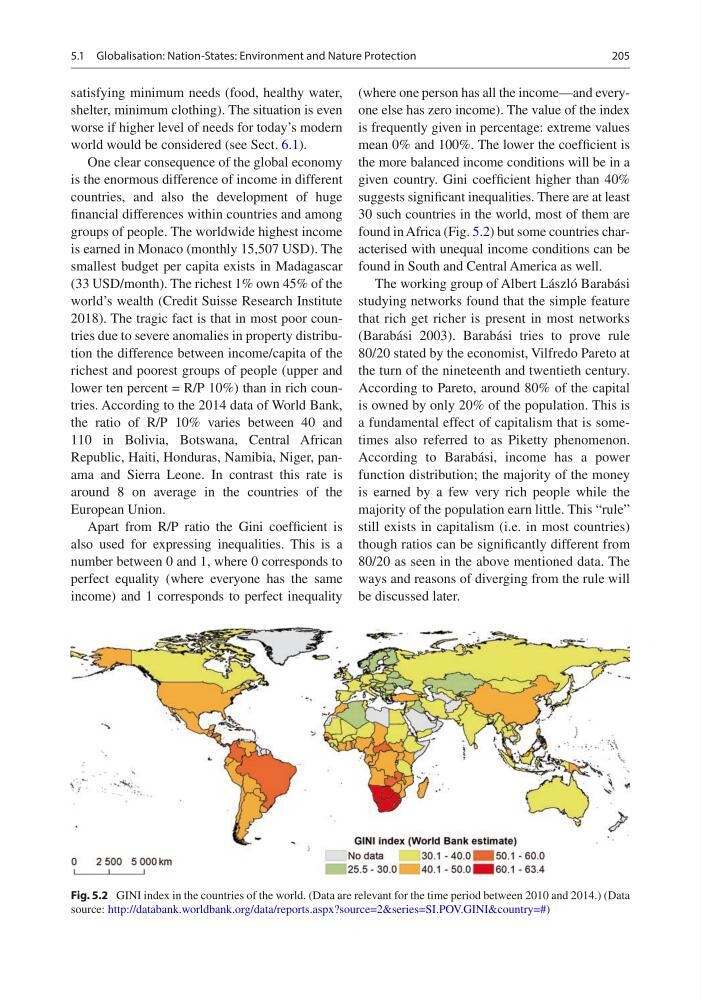
given country. Gini coefficient higher than 40%
suggests significant inequalities. There are at least
30 such countries in the world, most of them are
found in Africa (Fig. 5.2) but some countries characterised with unequal income conditions can be
found in South and Central America as well.
The working group of Albert László Barabási
studying networks found that the simple feature
that rich get richer is present in most networks
(Barabási 2003). Barabási tries to prove rule
80/20 stated by the economist, Vilfredo Pareto at
the turn of the nineteenth and twentieth century.
According to Pareto, around 80% of the capital
is owned by only 20% of the population. This is
a fundamental effect of capitalism that is sometimes also referred to as Piketty phenomenon.
According to Barabási, income has a power
function distribution; the majority of the money
is earned by a few very rich people while the
majority of the population earn little. This “rule”
still exists in capitalism (i.e. in most countries)
though ratios can be significantly different from
80/20 as seen in the above mentioned data. The
ways and reasons of diverging from the rule will
be discussed later.
Fig. 5.2 GINI index in the countries of the world. (Data are relevant for the time period between 2010 and 2014.) (Data
source: http://databank.worldbank.org/data/reports.aspx?source=2&series=SI.POV.GINI&country=#)
5.1 Globalisation: Nation-States: Environment and Nature Protection
satisfying minimum needs (food, healthy water,
shelter, minimum clothing). The situation is even
worse if higher level of needs for today’s modern
world would be considered (see Sect. 6.1).
One clear consequence of the global economy
is the enormous difference of income in different
countries, and also the development of huge
financial differences within countries and among
groups of people. The worldwide highest income
is earned in Monaco (monthly 15,507 USD). The
smallest budget per capita exists in Madagascar
(33 USD/month). The richest 1% own 45% of the
world’s wealth (Credit Suisse Research Institute
2018). The tragic fact is that in most poor countries due to severe anomalies in property distribution the difference between income/capita of the
richest and poorest groups of people (upper and
lower ten percent = R/P 10%) than in rich countries. According to the 2014 data of World Bank,
the ratio of R/P 10% varies between 40 and
110 in Bolivia, Botswana, Central African
Republic, Haiti, Honduras, Namibia, Niger, panama and Sierra Leone. In contrast this rate is
around 8 on average in the countries of the
European Union.
Apart from R/P ratio the Gini coefficient is
also used for expressing inequalities. This is a
number between 0 and 1, where 0 corresponds to
perfect equality (where everyone has the same
income) and 1 corresponds to perfect inequality
(where one person has all the income—and everyone else has zero income). The value of the index
is frequently given in percentage: extreme values
mean 0% and 100%. The lower the coefficient is
the more balanced income conditions will be in a
given country. Gini coefficient higher than 40%
suggests significant inequalities. There are at least
30 such countries in the world, most of them are
found in Africa (Fig. 5.2) but some countries characterised with unequal income conditions can be
found in South and Central America as well.
The working group of Albert László Barabási
studying networks found that the simple feature
that rich get richer is present in most networks
(Barabási 2003). Barabási tries to prove rule
80/20 stated by the economist, Vilfredo Pareto at
the turn of the nineteenth and twentieth century.
According to Pareto, around 80% of the capital
is owned by only 20% of the population. This is
a fundamental effect of capitalism that is sometimes also referred to as Piketty phenomenon.
According to Barabási, income has a power
function distribution; the majority of the money
is earned by a few very rich people while the
majority of the population earn little. This “rule”
still exists in capitalism (i.e. in most countries)
though ratios can be significantly different from
80/20 as seen in the above mentioned data. The
ways and reasons of diverging from the rule will
be discussed later.
Fig. 5.2 GINI index in the countries of the world. (Data are relevant for the time period between 2010 and 2014.) (Data
source: http://databank.worldbank.org/data/reports.aspx?source=2&series=SI.POV.GINI&country=#)
5.1 Globalisation: Nation-States: Environment and Nature Protection