

206
The consequence of the above is almost 1 billion people starving (at least double that number
suffer from quality hunger, those who cannot get
healthy food). Around 2.5 billion people cannot
get healthy potable water and lack adequate
hygiene. With such results not sustainable development but tension among and within countries
succeeds. Human relationships could be
influenced significantly by the attitude of societies to the natural environment.
Environmental globalisation has also been
in the focus of many studies in recent years.
This process is motivated by world trade and
related global transport. Agricultural and craftsman products may be consumed locally or
exported. According to Cherlet et al. (2018),
almost one- third of global arable lands are
associated with international trade via certain
products. (There are huge differences between
certain countries. For example, 87% of the
products of Germany are included in international trade while in the case of Madagascar
this ratio is only 1%.) As a result, demands of
people living in distant areas are connected
with the production of the given regions and
have an impact on it, and the environmental
effects of production could be intensified.
Long-range transport alone increases significantly the emission of pollutants.
There are other indirect consequences of
global trade as well. When, for example, food is
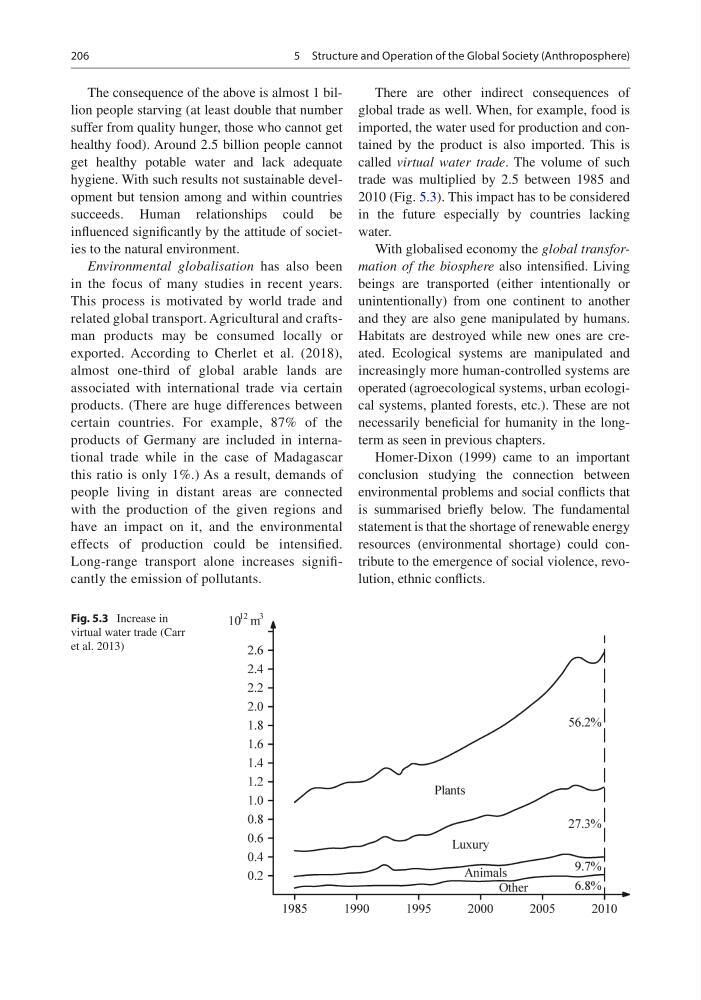
imported, the water used for production and contained by the product is also imported. This is
called virtual water trade. The volume of such
trade was multiplied by 2.5 between 1985 and
2010 (Fig. 5.3). This impact has to be considered
in the future especially by countries lacking
water.
With globalised economy the global transformation of the biosphere also intensified. Living
beings are transported (either intentionally or
unintentionally) from one continent to another
and they are also gene manipulated by humans.
Habitats are destroyed while new ones are created. Ecological systems are manipulated and
increasingly more human-controlled systems are
operated (agroecological systems, urban ecological systems, planted forests, etc.). These are not
necessarily beneficial for humanity in the longterm as seen in previous chapters.
Homer-Dixon (1999) came to an important
conclusion studying the connection between
environmental problems and social conflicts that
is summarised briefly below. The fundamental
statement is that the shortage of renewable energy
resources (environmental shortage) could contribute to the emergence of social violence, revolution, ethnic conflicts.
Fig. 5.3 Increase in
virtual water trade (Carr
et al. 2013)
5 Structure and Operation of the Global Society (Anthroposphere)
The consequence of the above is almost 1 billion people starving (at least double that number
suffer from quality hunger, those who cannot get
healthy food). Around 2.5 billion people cannot
get healthy potable water and lack adequate
hygiene. With such results not sustainable development but tension among and within countries
succeeds. Human relationships could be
influenced significantly by the attitude of societies to the natural environment.
Environmental globalisation has also been
in the focus of many studies in recent years.
This process is motivated by world trade and
related global transport. Agricultural and craftsman products may be consumed locally or
exported. According to Cherlet et al. (2018),
almost one- third of global arable lands are
associated with international trade via certain
products. (There are huge differences between
certain countries. For example, 87% of the
products of Germany are included in international trade while in the case of Madagascar
this ratio is only 1%.) As a result, demands of
people living in distant areas are connected
with the production of the given regions and
have an impact on it, and the environmental
effects of production could be intensified.
Long-range transport alone increases significantly the emission of pollutants.
There are other indirect consequences of
global trade as well. When, for example, food is
imported, the water used for production and contained by the product is also imported. This is
called virtual water trade. The volume of such
trade was multiplied by 2.5 between 1985 and
2010 (Fig. 5.3). This impact has to be considered
in the future especially by countries lacking
water.
With globalised economy the global transformation of the biosphere also intensified. Living
beings are transported (either intentionally or
unintentionally) from one continent to another
and they are also gene manipulated by humans.
Habitats are destroyed while new ones are created. Ecological systems are manipulated and
increasingly more human-controlled systems are
operated (agroecological systems, urban ecological systems, planted forests, etc.). These are not
necessarily beneficial for humanity in the longterm as seen in previous chapters.
Homer-Dixon (1999) came to an important
conclusion studying the connection between
environmental problems and social conflicts that
is summarised briefly below. The fundamental
statement is that the shortage of renewable energy
resources (environmental shortage) could contribute to the emergence of social violence, revolution, ethnic conflicts.
Fig. 5.3 Increase in
virtual water trade (Carr
et al. 2013)
5 Structure and Operation of the Global Society (Anthroposphere)