

195
across Suez Canal and via the Indian Ocean.
The number of commercial ship using the Arctic
route increases each year. Russia rapidly develops its ice breaking ship fleet (currently more
than 70 ships are applied) in order to extend the
shipping season.
The basement of the Arctic Sea is rich in oil
and gas and even in other mineral resources.
Longer ice-free periods help their exploitation.
Countries and companies are already scrambling
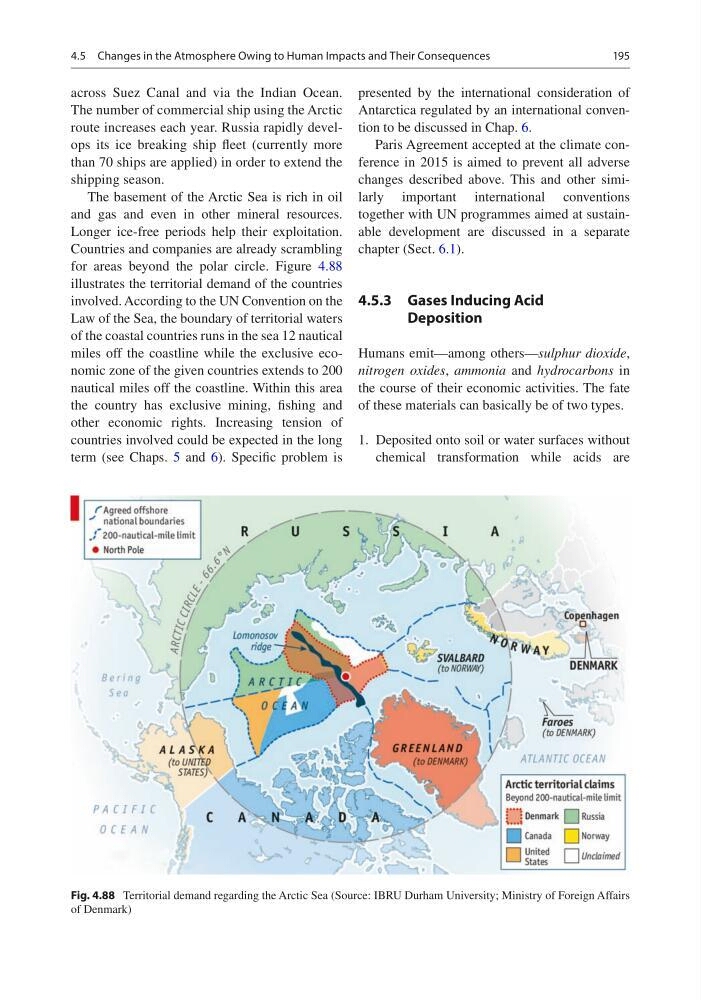
for areas beyond the polar circle. Figure 4.88
illustrates the territorial demand of the countries
involved. According to the UN Convention on the
Law of the Sea, the boundary of territorial waters
of the coastal countries runs in the sea 12 nautical
miles off the coastline while the exclusive economic zone of the given countries extends to 200
nautical miles off the coastline. Within this area
the country has exclusive mining, fishing and
other economic rights. Increasing tension of
countries involved could be expected in the long
term (see Chaps. 5 and 6). Specific problem is
presented by the international consideration of
Antarctica regulated by an international convention to be discussed in Chap. 6.
Paris Agreement accepted at the climate conference in 2015 is aimed to prevent all adverse
changes described above. This and other similarly important international conventions
together with UN programmes aimed at sustainable development are discussed in a separate
chapter (Sect. 6.1).
4.5.3 Gases Inducing Acid
Deposition
Humans emit—among others—sulphur dioxide,
nitrogen oxides, ammonia and hydrocarbons in
the course of their economic activities. The fate
of these materials can basically be of two types.
1. Deposited onto soil or water surfaces without
chemical transformation while acids are
Fig. 4.88 Territorial demand regarding the Arctic Sea (Source: IBRU Durham University; Ministry of Foreign Affairs
of Denmark)
4.5 Changes in the Atmosphere Owing to Human Impacts and Their Consequences
across Suez Canal and via the Indian Ocean.
The number of commercial ship using the Arctic
route increases each year. Russia rapidly develops its ice breaking ship fleet (currently more
than 70 ships are applied) in order to extend the
shipping season.
The basement of the Arctic Sea is rich in oil
and gas and even in other mineral resources.
Longer ice-free periods help their exploitation.
Countries and companies are already scrambling
for areas beyond the polar circle. Figure 4.88
illustrates the territorial demand of the countries
involved. According to the UN Convention on the
Law of the Sea, the boundary of territorial waters
of the coastal countries runs in the sea 12 nautical
miles off the coastline while the exclusive economic zone of the given countries extends to 200
nautical miles off the coastline. Within this area
the country has exclusive mining, fishing and
other economic rights. Increasing tension of
countries involved could be expected in the long
term (see Chaps. 5 and 6). Specific problem is
presented by the international consideration of
Antarctica regulated by an international convention to be discussed in Chap. 6.
Paris Agreement accepted at the climate conference in 2015 is aimed to prevent all adverse
changes described above. This and other similarly important international conventions
together with UN programmes aimed at sustainable development are discussed in a separate
chapter (Sect. 6.1).
4.5.3 Gases Inducing Acid
Deposition
Humans emit—among others—sulphur dioxide,
nitrogen oxides, ammonia and hydrocarbons in
the course of their economic activities. The fate
of these materials can basically be of two types.
1. Deposited onto soil or water surfaces without
chemical transformation while acids are
Fig. 4.88 Territorial demand regarding the Arctic Sea (Source: IBRU Durham University; Ministry of Foreign Affairs
of Denmark)
4.5 Changes in the Atmosphere Owing to Human Impacts and Their Consequences