

196
formed as these material react with water (soil
moisture). Such is the dry deposition of SO 2 .
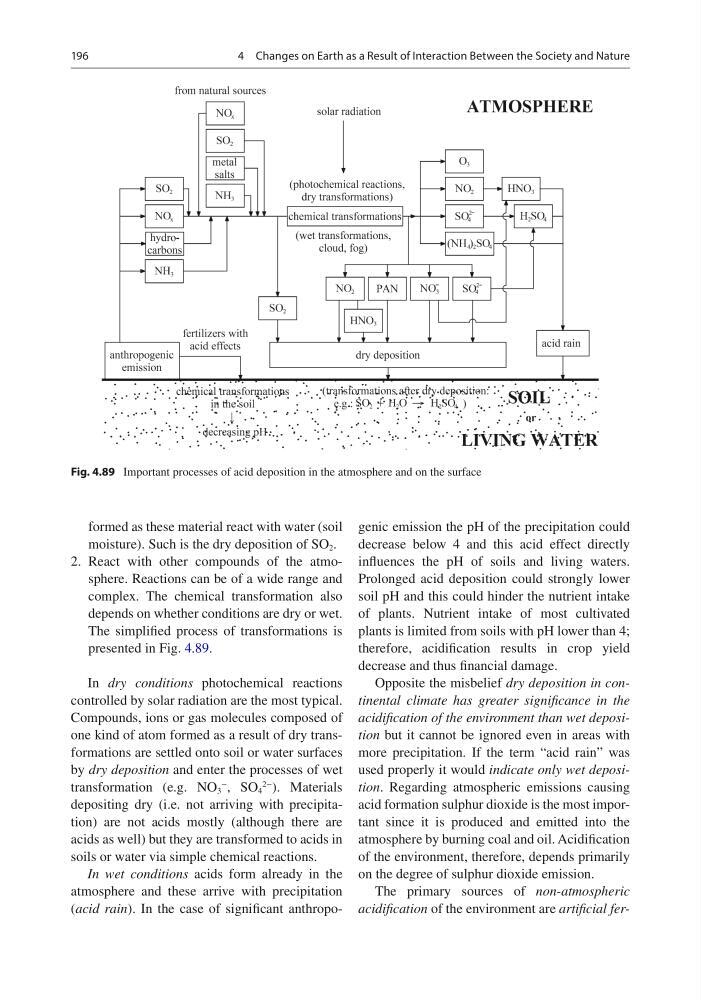
2. React with other compounds of the atmosphere. Reactions can be of a wide range and
complex. The chemical transformation also
depends on whether conditions are dry or wet.
The simplified process of transformations is
presented in Fig. 4.89.
In dry conditions photochemical reactions
controlled by solar radiation are the most typical.
Compounds, ions or gas molecules composed of
one kind of atom formed as a result of dry transformations are settled onto soil or water surfaces
by dry deposition and enter the processes of wet
transformation (e.g. NO 3
−
, SO 4
2−
). Materials
depositing dry (i.e. not arriving with precipitation) are not acids mostly (although there are
acids as well) but they are transformed to acids in
soils or water via simple chemical reactions.
In wet conditions acids form already in the
atmosphere and these arrive with precipitation
(acid rain). In the case of significant anthropogenic emission the pH of the precipitation could
decrease below 4 and this acid effect directly
influences the pH of soils and living waters.
Prolonged acid deposition could strongly lower
soil pH and this could hinder the nutrient intake
of plants. Nutrient intake of most cultivated
plants is limited from soils with pH lower than 4;
therefore, acidification results in crop yield
decrease and thus financial damage.
Opposite the misbelief dry deposition in continental climate has greater significance in the
acidification of the environment than wet deposition but it cannot be ignored even in areas with
more precipitation. If the term “acid rain” was
used properly it would indicate only wet deposition. Regarding atmospheric emissions causing
acid formation sulphur dioxide is the most important since it is produced and emitted into the
atmosphere by burning coal and oil. Acidification
of the environment, therefore, depends primarily
on the degree of sulphur dioxide emission.
The primary sources of non-atmospheric
acidification of the environment are artificial ferFig. 4.89 Important processes of acid deposition in the atmosphere and on the surface
4 Changes on Earth as a Result of Interaction Between the Society and Nature
formed as these material react with water (soil
moisture). Such is the dry deposition of SO 2 .
2. React with other compounds of the atmosphere. Reactions can be of a wide range and
complex. The chemical transformation also
depends on whether conditions are dry or wet.
The simplified process of transformations is
presented in Fig. 4.89.
In dry conditions photochemical reactions
controlled by solar radiation are the most typical.
Compounds, ions or gas molecules composed of
one kind of atom formed as a result of dry transformations are settled onto soil or water surfaces
by dry deposition and enter the processes of wet
transformation (e.g. NO 3
−
, SO 4
2−
). Materials
depositing dry (i.e. not arriving with precipitation) are not acids mostly (although there are
acids as well) but they are transformed to acids in
soils or water via simple chemical reactions.
In wet conditions acids form already in the
atmosphere and these arrive with precipitation
(acid rain). In the case of significant anthropogenic emission the pH of the precipitation could
decrease below 4 and this acid effect directly
influences the pH of soils and living waters.
Prolonged acid deposition could strongly lower
soil pH and this could hinder the nutrient intake
of plants. Nutrient intake of most cultivated
plants is limited from soils with pH lower than 4;
therefore, acidification results in crop yield
decrease and thus financial damage.
Opposite the misbelief dry deposition in continental climate has greater significance in the
acidification of the environment than wet deposition but it cannot be ignored even in areas with
more precipitation. If the term “acid rain” was
used properly it would indicate only wet deposition. Regarding atmospheric emissions causing
acid formation sulphur dioxide is the most important since it is produced and emitted into the
atmosphere by burning coal and oil. Acidification
of the environment, therefore, depends primarily
on the degree of sulphur dioxide emission.
The primary sources of non-atmospheric
acidification of the environment are artificial ferFig. 4.89 Important processes of acid deposition in the atmosphere and on the surface
4 Changes on Earth as a Result of Interaction Between the Society and Nature