

191
Table 4.19 contains different scenarios
together with the related data of global mean surface temperature and global mean sea level rise in
the middle and at the end of the twenty-first
century.
The two main reasons of sea level rise were
thermal expansion of seawater and the melt of
land ice sheets in the last century. These were
responsible for 90% of the more than 200 mm of
sea level rise. The remaining 10% is caused by
several factors including the flow of groundwater
extracted by humans into the ocean. The warming of the upper 500 metre of the ocean resulted
in a rise of around 80 mm. Further 100–110 mm
rise was caused by the melting of land glaciers
and ice sheets. Even the complete melting of sea
ice (like the ice sheet of the Arctic Ocean) would
not cause any sea level rise since the volume of
the water produced by the melting of this ice is
exactly the same as the volume of the ice floating
in the water of the sea (Archimedes’ principle).
According to measurements, the ratio of sea level
rise caused by melting has been increasing compared to thermal expansion recently and sea level
rise accelerated (Lindsey 2018). This tendency is
expected to continue over the twenty-first century. Ice sheets in Greenland and Antarctica are
huge water reservoirs; therefore, if the melting of
their ice cover does not stop in the coming centuries, humans will get into serious trouble.
Representative Concentration Pathways
(RCPs) are consistent sets of projections of only
the components of radiative forcing. The RCP
2.6 scenario is a so-called peak scenario, which
means the radiative forcing level reaches 3.1 W/
m
2
by the middle of the twenty-first century but
returns to 2.6 W/m
2
by 2100. The probability of
this scenario, however, is small. Increasing data
of the scenarios presume increasing anthropogenic GHG emission.
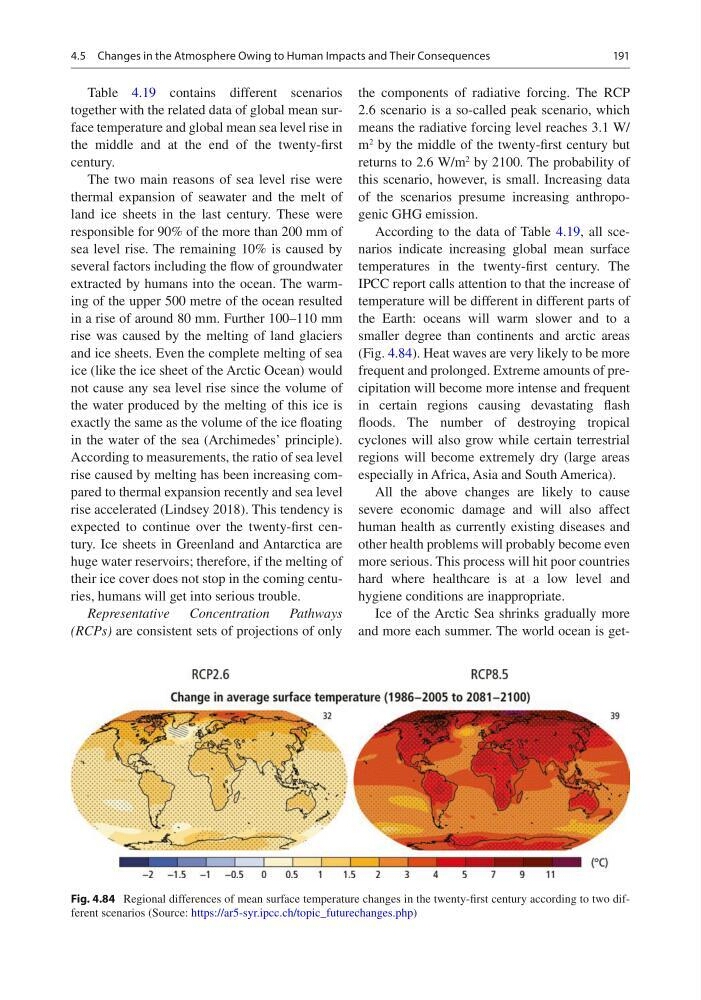
According to the data of Table 4.19, all scenarios indicate increasing global mean surface
temperatures in the twenty-first century. The
IPCC report calls attention to that the increase of
temperature will be different in different parts of
the Earth: oceans will warm slower and to a
smaller degree than continents and arctic areas
(Fig. 4.84). Heat waves are very likely to be more
frequent and prolonged. Extreme amounts of precipitation will become more intense and frequent
in certain regions causing devastating flash
floods. The number of destroying tropical
cyclones will also grow while certain terrestrial
regions will become extremely dry (large areas
especially in Africa, Asia and South America).
All the above changes are likely to cause
severe economic damage and will also affect
human health as currently existing diseases and
other health problems will probably become even
more serious. This process will hit poor countries
hard where healthcare is at a low level and
hygiene conditions are inappropriate.
Ice of the Arctic Sea shrinks gradually more
and more each summer. The world ocean is getFig. 4.84 Regional differences of mean surface temperature changes in the twenty-first century according to two different scenarios (Source: https://ar5-syr.ipcc.ch/topic_futurechanges.php)
4.5 Changes in the Atmosphere Owing to Human Impacts and Their Consequences
Table 4.19 contains different scenarios
together with the related data of global mean surface temperature and global mean sea level rise in
the middle and at the end of the twenty-first
century.
The two main reasons of sea level rise were
thermal expansion of seawater and the melt of
land ice sheets in the last century. These were
responsible for 90% of the more than 200 mm of
sea level rise. The remaining 10% is caused by
several factors including the flow of groundwater
extracted by humans into the ocean. The warming of the upper 500 metre of the ocean resulted
in a rise of around 80 mm. Further 100–110 mm
rise was caused by the melting of land glaciers
and ice sheets. Even the complete melting of sea
ice (like the ice sheet of the Arctic Ocean) would
not cause any sea level rise since the volume of
the water produced by the melting of this ice is
exactly the same as the volume of the ice floating
in the water of the sea (Archimedes’ principle).
According to measurements, the ratio of sea level
rise caused by melting has been increasing compared to thermal expansion recently and sea level
rise accelerated (Lindsey 2018). This tendency is
expected to continue over the twenty-first century. Ice sheets in Greenland and Antarctica are
huge water reservoirs; therefore, if the melting of
their ice cover does not stop in the coming centuries, humans will get into serious trouble.
Representative Concentration Pathways
(RCPs) are consistent sets of projections of only
the components of radiative forcing. The RCP
2.6 scenario is a so-called peak scenario, which
means the radiative forcing level reaches 3.1 W/
m
2
by the middle of the twenty-first century but
returns to 2.6 W/m
2
by 2100. The probability of
this scenario, however, is small. Increasing data
of the scenarios presume increasing anthropogenic GHG emission.
According to the data of Table 4.19, all scenarios indicate increasing global mean surface
temperatures in the twenty-first century. The
IPCC report calls attention to that the increase of
temperature will be different in different parts of
the Earth: oceans will warm slower and to a
smaller degree than continents and arctic areas
(Fig. 4.84). Heat waves are very likely to be more
frequent and prolonged. Extreme amounts of precipitation will become more intense and frequent
in certain regions causing devastating flash
floods. The number of destroying tropical
cyclones will also grow while certain terrestrial
regions will become extremely dry (large areas
especially in Africa, Asia and South America).
All the above changes are likely to cause
severe economic damage and will also affect
human health as currently existing diseases and
other health problems will probably become even
more serious. This process will hit poor countries
hard where healthcare is at a low level and
hygiene conditions are inappropriate.
Ice of the Arctic Sea shrinks gradually more
and more each summer. The world ocean is getFig. 4.84 Regional differences of mean surface temperature changes in the twenty-first century according to two different scenarios (Source: https://ar5-syr.ipcc.ch/topic_futurechanges.php)
4.5 Changes in the Atmosphere Owing to Human Impacts and Their Consequences