

192
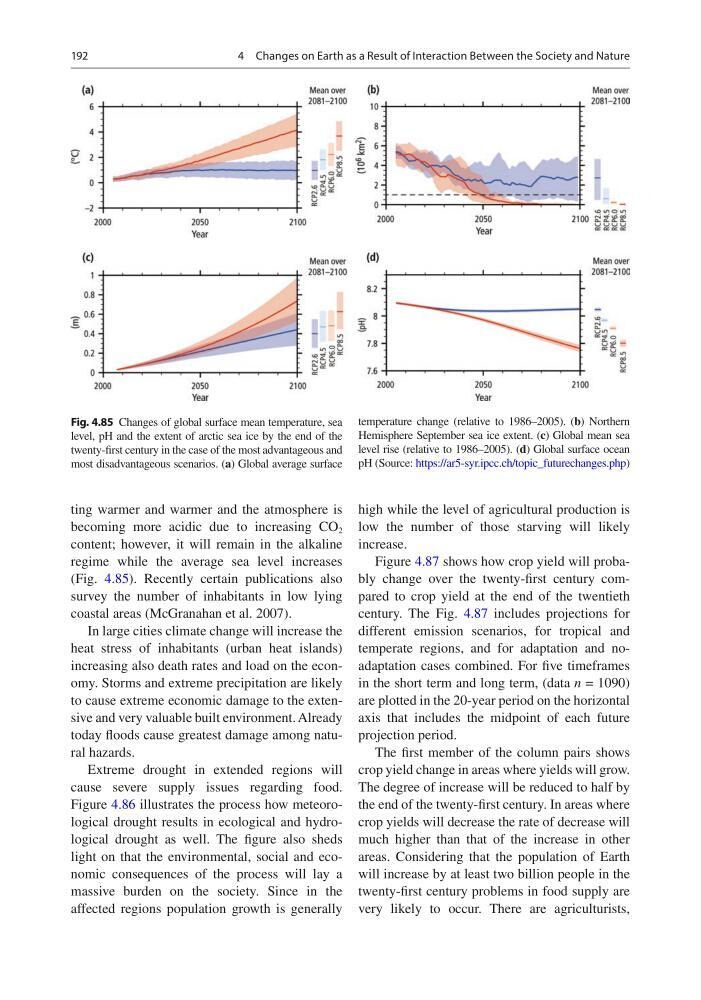
ting warmer and warmer and the atmosphere is
becoming more acidic due to increasing CO 2
content; however, it will remain in the alkaline
regime while the average sea level increases
(Fig. 4.85). Recently certain publications also
survey the number of inhabitants in low lying
coastal areas (McGranahan et al. 2007).
In large cities climate change will increase the
heat stress of inhabitants (urban heat islands)
increasing also death rates and load on the economy. Storms and extreme precipitation are likely
to cause extreme economic damage to the extensive and very valuable built environment. Already
today floods cause greatest damage among natural hazards.
Extreme drought in extended regions will
cause severe supply issues regarding food.
Figure 4.86 illustrates the process how meteorological drought results in ecological and hydrological drought as well. The figure also sheds
light on that the environmental, social and economic consequences of the process will lay a
massive burden on the society. Since in the
affected regions population growth is generally
high while the level of agricultural production is
low the number of those starving will likely
increase.
Figure 4.87 shows how crop yield will probably change over the twenty-first century compared to crop yield at the end of the twentieth
century. The Fig. 4.87 includes projections for
different emission scenarios, for tropical and
temperate regions, and for adaptation and noadaptation cases combined. For five timeframes
in the short term and long term, (data n = 1090)
are plotted in the 20-year period on the horizontal
axis that includes the midpoint of each future
projection period.
The first member of the column pairs shows
crop yield change in areas where yields will grow.
The degree of increase will be reduced to half by
the end of the twenty-first century. In areas where
crop yields will decrease the rate of decrease will
much higher than that of the increase in other
areas. Considering that the population of Earth
will increase by at least two billion people in the
twenty-first century problems in food supply are
very likely to occur. There are agriculturists,
Fig. 4.85 Changes of global surface mean temperature, sea
level, pH and the extent of arctic sea ice by the end of the
twenty-first century in the case of the most advantageous and
most disadvantageous scenarios. (a) Global average surface
temperature change (relative to 1986–2005). (b) Northern
Hemisphere September sea ice extent. (c) Global mean sea
level rise (relative to 1986–2005). (d) Global surface ocean
pH (Source: https://ar5-syr.ipcc.ch/topic_futurechanges.php)
4 Changes on Earth as a Result of Interaction Between the Society and Nature
ting warmer and warmer and the atmosphere is
becoming more acidic due to increasing CO 2
content; however, it will remain in the alkaline
regime while the average sea level increases
(Fig. 4.85). Recently certain publications also
survey the number of inhabitants in low lying
coastal areas (McGranahan et al. 2007).
In large cities climate change will increase the
heat stress of inhabitants (urban heat islands)
increasing also death rates and load on the economy. Storms and extreme precipitation are likely
to cause extreme economic damage to the extensive and very valuable built environment. Already
today floods cause greatest damage among natural hazards.
Extreme drought in extended regions will
cause severe supply issues regarding food.
Figure 4.86 illustrates the process how meteorological drought results in ecological and hydrological drought as well. The figure also sheds
light on that the environmental, social and economic consequences of the process will lay a
massive burden on the society. Since in the
affected regions population growth is generally
high while the level of agricultural production is
low the number of those starving will likely
increase.
Figure 4.87 shows how crop yield will probably change over the twenty-first century compared to crop yield at the end of the twentieth
century. The Fig. 4.87 includes projections for
different emission scenarios, for tropical and
temperate regions, and for adaptation and noadaptation cases combined. For five timeframes
in the short term and long term, (data n = 1090)
are plotted in the 20-year period on the horizontal
axis that includes the midpoint of each future
projection period.
The first member of the column pairs shows
crop yield change in areas where yields will grow.
The degree of increase will be reduced to half by
the end of the twenty-first century. In areas where
crop yields will decrease the rate of decrease will
much higher than that of the increase in other
areas. Considering that the population of Earth
will increase by at least two billion people in the
twenty-first century problems in food supply are
very likely to occur. There are agriculturists,
Fig. 4.85 Changes of global surface mean temperature, sea
level, pH and the extent of arctic sea ice by the end of the
twenty-first century in the case of the most advantageous and
most disadvantageous scenarios. (a) Global average surface
temperature change (relative to 1986–2005). (b) Northern
Hemisphere September sea ice extent. (c) Global mean sea
level rise (relative to 1986–2005). (d) Global surface ocean
pH (Source: https://ar5-syr.ipcc.ch/topic_futurechanges.php)
4 Changes on Earth as a Result of Interaction Between the Society and Nature