

187
increase is moderate) but the global warming
potential of this gas is 314 times that of carbon
dioxide.
Before the industrial revolution CFCs,
HCFCs, PFCs and HFCs together with halons
were not present in the atmosphere at all. These
are artificial products of the twentieth century.
Their global warming potential is extremely
high, exceeding generally that of carbon dioxide
by three orders of magnitude (Table 4.17) their
atmospheric concentration, however, is three to
eight times smaller than that of CO 2 . Atmospheric
residence time for most of them is also very
significant.
Halogenated hydrocarbons and halons damage the stratospheric ozone layer; therefore, they
are covered by the Vienna Convention (1985)
regulating the emission limits and gradual termination of ozone layer damaging material and by
the associated Montreal Protocol (1987) (for
more details see Sect. 4.5.4). Regarding climate
change, however, it is important to know that the
greenhouse effect of their substitute material, soft
freons (HCFCs) that are considered “ozone
friendly” is also significant (Table 4.17). As a
result of electricity insulator, aluminium, magnesium and semiconductor production the emission
of sulphur hexafluoride (SF 6 ), a gas with
extremely high warming potential and residence
time increases rapidly.
Considering tropospheric ozone among the
gases in Table 4.17 its specific greenhouse effect
is high while its atmospheric residence time is
short and its average concentration is small.
Tropospheric ozone is mostly formed out of
exhaust gases of vehicles to the effect of UV
radiation.
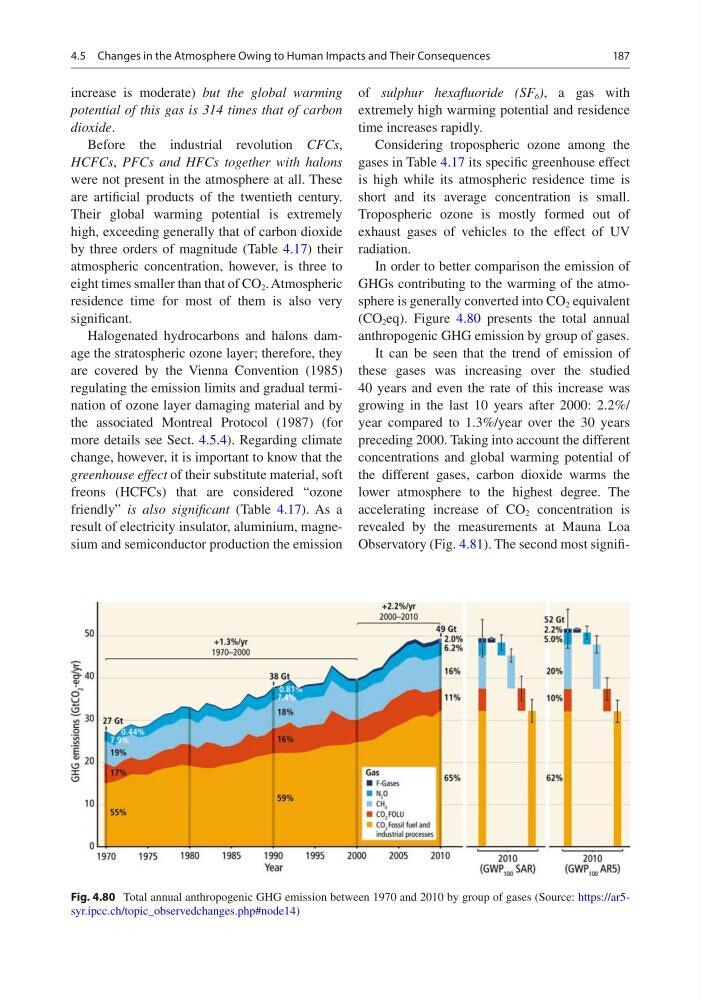
In order to better comparison the emission of
GHGs contributing to the warming of the atmosphere is generally converted into CO 2 equivalent
(CO 2 eq). Figure 4.80 presents the total annual
anthropogenic GHG emission by group of gases.
It can be seen that the trend of emission of
these gases was increasing over the studied
40 years and even the rate of this increase was
growing in the last 10 years after 2000: 2.2%/
year compared to 1.3%/year over the 30 years
preceding 2000. Taking into account the different
concentrations and global warming potential of
the different gases, carbon dioxide warms the
lower atmosphere to the highest degree. The
accelerating increase of CO 2 concentration is
revealed by the measurements at Mauna Loa
Observatory (Fig. 4.81). The second most signifiFig. 4.80 Total annual anthropogenic GHG emission between 1970 and 2010 by group of gases (Source: https://ar5syr.ipcc.ch/topic_observedchanges.php#node14)
4.5 Changes in the Atmosphere Owing to Human Impacts and Their Consequences
increase is moderate) but the global warming
potential of this gas is 314 times that of carbon
dioxide.
Before the industrial revolution CFCs,
HCFCs, PFCs and HFCs together with halons
were not present in the atmosphere at all. These
are artificial products of the twentieth century.
Their global warming potential is extremely
high, exceeding generally that of carbon dioxide
by three orders of magnitude (Table 4.17) their
atmospheric concentration, however, is three to
eight times smaller than that of CO 2 . Atmospheric
residence time for most of them is also very
significant.
Halogenated hydrocarbons and halons damage the stratospheric ozone layer; therefore, they
are covered by the Vienna Convention (1985)
regulating the emission limits and gradual termination of ozone layer damaging material and by
the associated Montreal Protocol (1987) (for
more details see Sect. 4.5.4). Regarding climate
change, however, it is important to know that the
greenhouse effect of their substitute material, soft
freons (HCFCs) that are considered “ozone
friendly” is also significant (Table 4.17). As a
result of electricity insulator, aluminium, magnesium and semiconductor production the emission
of sulphur hexafluoride (SF 6 ), a gas with
extremely high warming potential and residence
time increases rapidly.
Considering tropospheric ozone among the
gases in Table 4.17 its specific greenhouse effect
is high while its atmospheric residence time is
short and its average concentration is small.
Tropospheric ozone is mostly formed out of
exhaust gases of vehicles to the effect of UV
radiation.
In order to better comparison the emission of
GHGs contributing to the warming of the atmosphere is generally converted into CO 2 equivalent
(CO 2 eq). Figure 4.80 presents the total annual
anthropogenic GHG emission by group of gases.
It can be seen that the trend of emission of
these gases was increasing over the studied
40 years and even the rate of this increase was
growing in the last 10 years after 2000: 2.2%/
year compared to 1.3%/year over the 30 years
preceding 2000. Taking into account the different
concentrations and global warming potential of
the different gases, carbon dioxide warms the
lower atmosphere to the highest degree. The
accelerating increase of CO 2 concentration is
revealed by the measurements at Mauna Loa
Observatory (Fig. 4.81). The second most signifiFig. 4.80 Total annual anthropogenic GHG emission between 1970 and 2010 by group of gases (Source: https://ar5syr.ipcc.ch/topic_observedchanges.php#node14)
4.5 Changes in the Atmosphere Owing to Human Impacts and Their Consequences