

170
Table 4.15 Extinct and threatened fresh water fish in some regions of Earth (Source: Abramovitz 1996)
Region
Number of fish
species
Ratio of extinct
species (%)
Ratio of threatened
species (%)
Major threats
Amazon
3000
–
–
Degrading habitat
Asia
1500
–
–
Degrading habitat
North America
950
4
36
Degrading habitat, invasive species
Mexico
(terrestrial land)
200
8
60
Fight for water, environmental
pollution
Europe
193
–
42
Degrading habitat, environmental
pollution
South Africa
94
–
63
Degrading habitat, fight for water,
environmental pollution
Lake Victoria
350
57
43
Invasive species
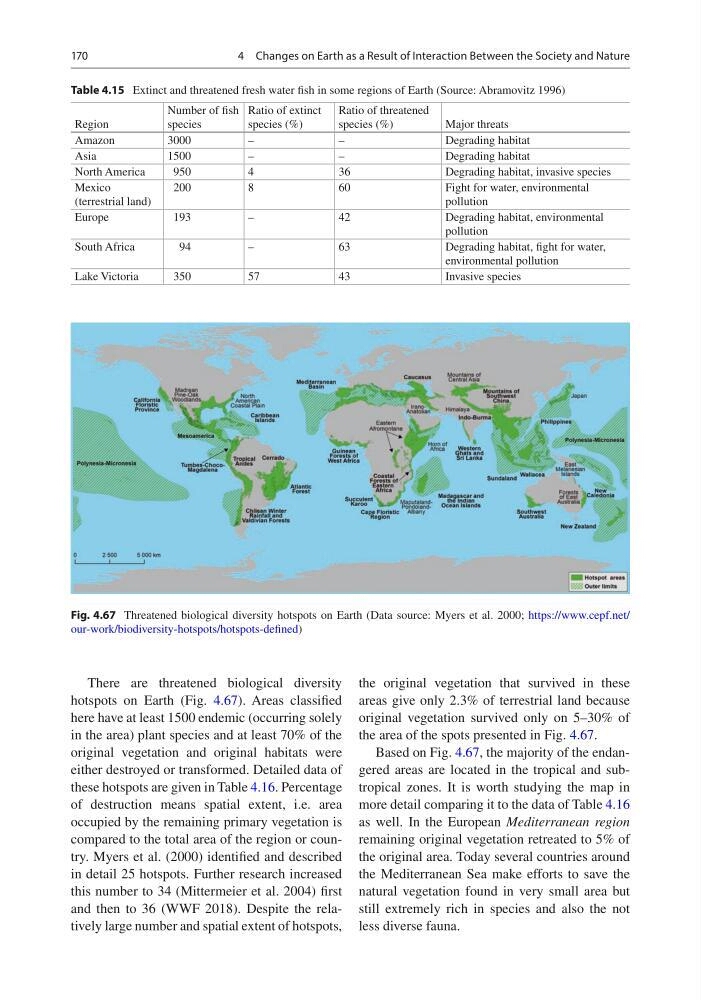
Fig. 4.67 Threatened biological diversity hotspots on Earth (Data source: Myers et al. 2000; https://www.cepf.net/
our-work/biodiversity-hotspots/hotspots-defined)
There are threatened biological diversity
hotspots on Earth (Fig. 4.67). Areas classified
here have at least 1500 endemic (occurring solely
in the area) plant species and at least 70% of the
original vegetation and original habitats were
either destroyed or transformed. Detailed data of
these hotspots are given in Table 4.16. Percentage
of destruction means spatial extent, i.e. area
occupied by the remaining primary vegetation is
compared to the total area of the region or country. Myers et al. (2000) identified and described
in detail 25 hotspots. Further research increased
this number to 34 (Mittermeier et al. 2004) first
and then to 36 (WWF 2018). Despite the relatively large number and spatial extent of hotspots,
the original vegetation that survived in these
areas give only 2.3% of terrestrial land because
original vegetation survived only on 5–30% of
the area of the spots presented in Fig. 4.67.
Based on Fig. 4.67, the majority of the endangered areas are located in the tropical and subtropical zones. It is worth studying the map in
more detail comparing it to the data of Table 4.16
as well. In the European Mediterranean region
remaining original vegetation retreated to 5% of
the original area. Today several countries around
the Mediterranean Sea make efforts to save the
natural vegetation found in very small area but
still extremely rich in species and also the not
less diverse fauna.
4 Changes on Earth as a Result of Interaction Between the Society and Nature
Table 4.15 Extinct and threatened fresh water fish in some regions of Earth (Source: Abramovitz 1996)
Region
Number of fish
species
Ratio of extinct
species (%)
Ratio of threatened
species (%)
Major threats
Amazon
3000
–
–
Degrading habitat
Asia
1500
–
–
Degrading habitat
North America
950
4
36
Degrading habitat, invasive species
Mexico
(terrestrial land)
200
8
60
Fight for water, environmental
pollution
Europe
193
–
42
Degrading habitat, environmental
pollution
South Africa
94
–
63
Degrading habitat, fight for water,
environmental pollution
Lake Victoria
350
57
43
Invasive species
Fig. 4.67 Threatened biological diversity hotspots on Earth (Data source: Myers et al. 2000; https://www.cepf.net/
our-work/biodiversity-hotspots/hotspots-defined)
There are threatened biological diversity
hotspots on Earth (Fig. 4.67). Areas classified
here have at least 1500 endemic (occurring solely
in the area) plant species and at least 70% of the
original vegetation and original habitats were
either destroyed or transformed. Detailed data of
these hotspots are given in Table 4.16. Percentage
of destruction means spatial extent, i.e. area
occupied by the remaining primary vegetation is
compared to the total area of the region or country. Myers et al. (2000) identified and described
in detail 25 hotspots. Further research increased
this number to 34 (Mittermeier et al. 2004) first
and then to 36 (WWF 2018). Despite the relatively large number and spatial extent of hotspots,
the original vegetation that survived in these
areas give only 2.3% of terrestrial land because
original vegetation survived only on 5–30% of
the area of the spots presented in Fig. 4.67.
Based on Fig. 4.67, the majority of the endangered areas are located in the tropical and subtropical zones. It is worth studying the map in
more detail comparing it to the data of Table 4.16
as well. In the European Mediterranean region
remaining original vegetation retreated to 5% of
the original area. Today several countries around
the Mediterranean Sea make efforts to save the
natural vegetation found in very small area but
still extremely rich in species and also the not
less diverse fauna.
4 Changes on Earth as a Result of Interaction Between the Society and Nature