

169
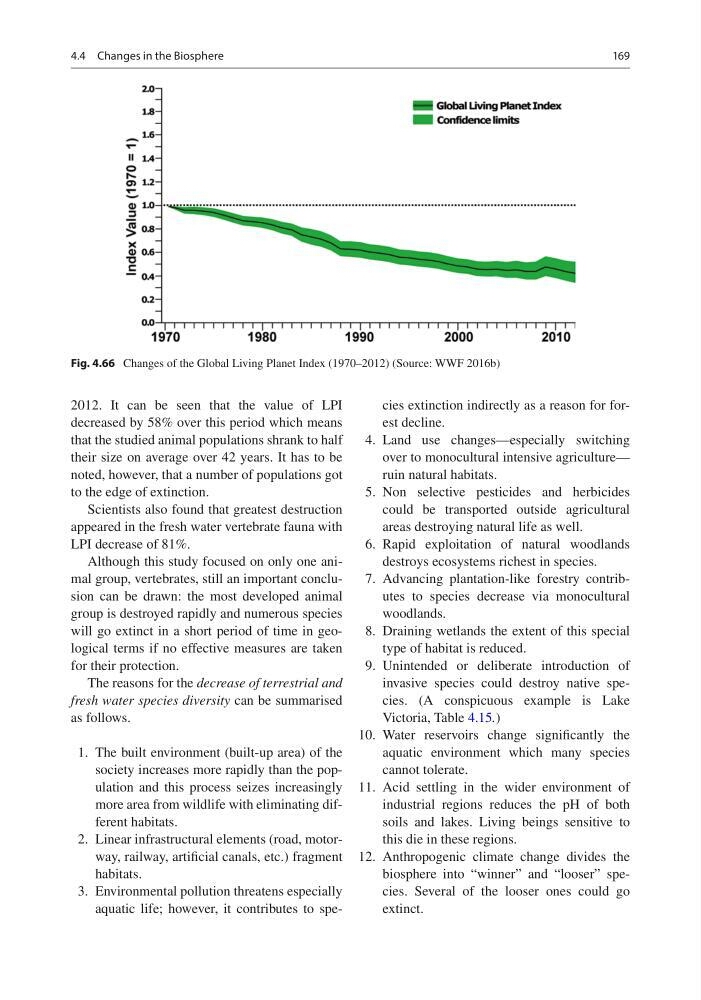
2012. It can be seen that the value of LPI
decreased by 58% over this period which means
that the studied animal populations shrank to half
their size on average over 42 years. It has to be
noted, however, that a number of populations got
to the edge of extinction.
Scientists also found that greatest destruction
appeared in the fresh water vertebrate fauna with
LPI decrease of 81%.
Although this study focused on only one animal group, vertebrates, still an important conclusion can be drawn: the most developed animal
group is destroyed rapidly and numerous species
will go extinct in a short period of time in geological terms if no effective measures are taken
for their protection.
The reasons for the decrease of terrestrial and
fresh water species diversity can be summarised
as follows.
1. The built environment (built-up area) of the
society increases more rapidly than the population and this process seizes increasingly
more area from wildlife with eliminating different habitats.
2. Linear infrastructural elements (road, motorway, railway, artificial canals, etc.) fragment
habitats.
3. Environmental pollution threatens especially
aquatic life; however, it contributes to species extinction indirectly as a reason for forest decline.
4. Land use changes—especially switching
over to monocultural intensive agriculture—
ruin natural habitats.
5. Non selective pesticides and herbicides
could be transported outside agricultural
areas destroying natural life as well.
6. Rapid exploitation of natural woodlands
destroys ecosystems richest in species.
7. Advancing plantation-like forestry contributes to species decrease via monocultural
woodlands.
8. Draining wetlands the extent of this special
type of habitat is reduced.
9. Unintended or deliberate introduction of
invasive species could destroy native species. (A conspicuous example is Lake
Victoria, Table 4.15.)
10. Water reservoirs change significantly the
aquatic environment which many species
cannot tolerate.
11. Acid settling in the wider environment of
industrial regions reduces the pH of both
soils and lakes. Living beings sensitive to
this die in these regions.
12. Anthropogenic climate change divides the
biosphere into “winner” and “looser” species. Several of the looser ones could go
extinct.
Fig. 4.66 Changes of the Global Living Planet Index (1970–2012) (Source: WWF 2016b)
4.4 Changes in the Biosphere
2012. It can be seen that the value of LPI
decreased by 58% over this period which means
that the studied animal populations shrank to half
their size on average over 42 years. It has to be
noted, however, that a number of populations got
to the edge of extinction.
Scientists also found that greatest destruction
appeared in the fresh water vertebrate fauna with
LPI decrease of 81%.
Although this study focused on only one animal group, vertebrates, still an important conclusion can be drawn: the most developed animal
group is destroyed rapidly and numerous species
will go extinct in a short period of time in geological terms if no effective measures are taken
for their protection.
The reasons for the decrease of terrestrial and
fresh water species diversity can be summarised
as follows.
1. The built environment (built-up area) of the
society increases more rapidly than the population and this process seizes increasingly
more area from wildlife with eliminating different habitats.
2. Linear infrastructural elements (road, motorway, railway, artificial canals, etc.) fragment
habitats.
3. Environmental pollution threatens especially
aquatic life; however, it contributes to species extinction indirectly as a reason for forest decline.
4. Land use changes—especially switching
over to monocultural intensive agriculture—
ruin natural habitats.
5. Non selective pesticides and herbicides
could be transported outside agricultural
areas destroying natural life as well.
6. Rapid exploitation of natural woodlands
destroys ecosystems richest in species.
7. Advancing plantation-like forestry contributes to species decrease via monocultural
woodlands.
8. Draining wetlands the extent of this special
type of habitat is reduced.
9. Unintended or deliberate introduction of
invasive species could destroy native species. (A conspicuous example is Lake
Victoria, Table 4.15.)
10. Water reservoirs change significantly the
aquatic environment which many species
cannot tolerate.
11. Acid settling in the wider environment of
industrial regions reduces the pH of both
soils and lakes. Living beings sensitive to
this die in these regions.
12. Anthropogenic climate change divides the
biosphere into “winner” and “looser” species. Several of the looser ones could go
extinct.
Fig. 4.66 Changes of the Global Living Planet Index (1970–2012) (Source: WWF 2016b)
4.4 Changes in the Biosphere