

168
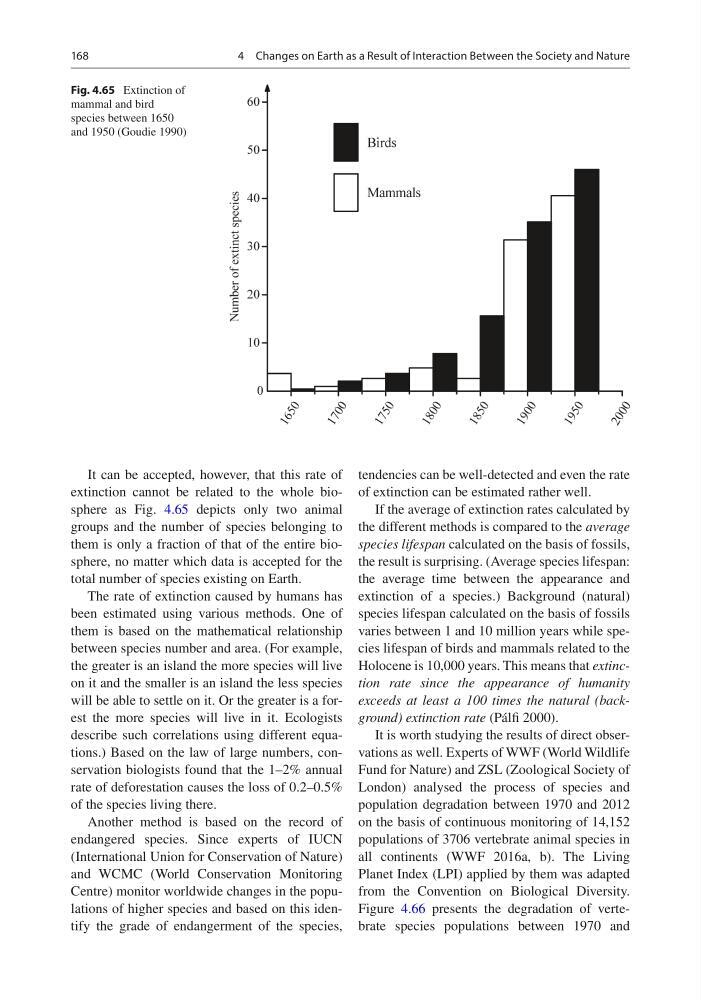
It can be accepted, however, that this rate of
extinction cannot be related to the whole biosphere as Fig. 4.65 depicts only two animal
groups and the number of species belonging to
them is only a fraction of that of the entire biosphere, no matter which data is accepted for the
total number of species existing on Earth.
The rate of extinction caused by humans has
been estimated using various methods. One of
them is based on the mathematical relationship
between species number and area. (For example,
the greater is an island the more species will live
on it and the smaller is an island the less species
will be able to settle on it. Or the greater is a forest the more species will live in it. Ecologists
describe such correlations using different equations.) Based on the law of large numbers, conservation biologists found that the 1–2% annual
rate of deforestation causes the loss of 0.2–0.5%
of the species living there.
Another method is based on the record of
endangered species. Since experts of IUCN
(International Union for Conservation of Nature)
and WCMC (World Conservation Monitoring
Centre) monitor worldwide changes in the populations of higher species and based on this identify the grade of endangerment of the species,
tendencies can be well-detected and even the rate
of extinction can be estimated rather well.
If the average of extinction rates calculated by
the different methods is compared to the average
species lifespan calculated on the basis of fossils,
the result is surprising. (Average species lifespan:
the average time between the appearance and
extinction of a species.) Background (natural)
species lifespan calculated on the basis of fossils
varies between 1 and 10 million years while species lifespan of birds and mammals related to the
Holocene is 10,000 years. This means that extinction rate since the appearance of humanity
exceeds at least a 100 times the natural (background) extinction rate (Pálfi 2000).
It is worth studying the results of direct observations as well. Experts of WWF (World Wildlife
Fund for Nature) and ZSL (Zoological Society of
London) analysed the process of species and
population degradation between 1970 and 2012
on the basis of continuous monitoring of 14,152
populations of 3706 vertebrate animal species in
all continents (WWF 2016a, b). The Living
Planet Index (LPI) applied by them was adapted
from the Convention on Biological Diversity.
Figure 4.66 presents the degradation of vertebrate species populations between 1970 and
Fig. 4.65 Extinction of
mammal and bird
species between 1650
and 1950 (Goudie 1990)
4 Changes on Earth as a Result of Interaction Between the Society and Nature
It can be accepted, however, that this rate of
extinction cannot be related to the whole biosphere as Fig. 4.65 depicts only two animal
groups and the number of species belonging to
them is only a fraction of that of the entire biosphere, no matter which data is accepted for the
total number of species existing on Earth.
The rate of extinction caused by humans has
been estimated using various methods. One of
them is based on the mathematical relationship
between species number and area. (For example,
the greater is an island the more species will live
on it and the smaller is an island the less species
will be able to settle on it. Or the greater is a forest the more species will live in it. Ecologists
describe such correlations using different equations.) Based on the law of large numbers, conservation biologists found that the 1–2% annual
rate of deforestation causes the loss of 0.2–0.5%
of the species living there.
Another method is based on the record of
endangered species. Since experts of IUCN
(International Union for Conservation of Nature)
and WCMC (World Conservation Monitoring
Centre) monitor worldwide changes in the populations of higher species and based on this identify the grade of endangerment of the species,
tendencies can be well-detected and even the rate
of extinction can be estimated rather well.
If the average of extinction rates calculated by
the different methods is compared to the average
species lifespan calculated on the basis of fossils,
the result is surprising. (Average species lifespan:
the average time between the appearance and
extinction of a species.) Background (natural)
species lifespan calculated on the basis of fossils
varies between 1 and 10 million years while species lifespan of birds and mammals related to the
Holocene is 10,000 years. This means that extinction rate since the appearance of humanity
exceeds at least a 100 times the natural (background) extinction rate (Pálfi 2000).
It is worth studying the results of direct observations as well. Experts of WWF (World Wildlife
Fund for Nature) and ZSL (Zoological Society of
London) analysed the process of species and
population degradation between 1970 and 2012
on the basis of continuous monitoring of 14,152
populations of 3706 vertebrate animal species in
all continents (WWF 2016a, b). The Living
Planet Index (LPI) applied by them was adapted
from the Convention on Biological Diversity.
Figure 4.66 presents the degradation of vertebrate species populations between 1970 and
Fig. 4.65 Extinction of
mammal and bird
species between 1650
and 1950 (Goudie 1990)
4 Changes on Earth as a Result of Interaction Between the Society and Nature