

167
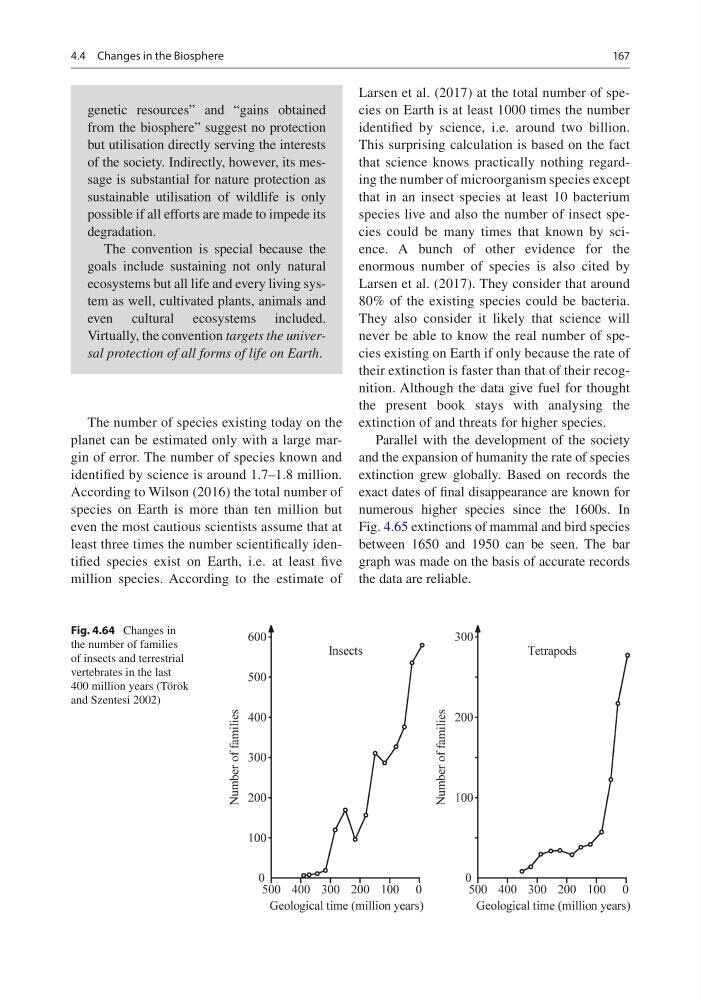
Fig. 4.64 Changes in
the number of families
of insects and terrestrial
vertebrates in the last
400 million years (Török
and Szentesi 2002)
genetic resources” and “gains obtained
from the biosphere” suggest no protection
but utilisation directly serving the interests
of the society. Indirectly, however, its message is substantial for nature protection as
sustainable utilisation of wildlife is only
possible if all efforts are made to impede its
degradation.
The convention is special because the
goals include sustaining not only natural
ecosystems but all life and every living system as well, cultivated plants, animals and
even cultural ecosystems included.
Virtually, the convention targets the universal protection of all forms of life on Earth.
The number of species existing today on the
planet can be estimated only with a large margin of error. The number of species known and
identified by science is around 1.7–1.8 million.
According to Wilson (2016) the total number of
species on Earth is more than ten million but
even the most cautious scientists assume that at
least three times the number scientifically identified species exist on Earth, i.e. at least five
million species. According to the estimate of
Larsen et al. (2017) at the total number of species on Earth is at least 1000 times the number
identified by science, i.e. around two billion.
This surprising calculation is based on the fact
that science knows practically nothing regarding the number of microorganism species except
that in an insect species at least 10 bacterium
species live and also the number of insect species could be many times that known by science. A bunch of other evidence for the
enormous number of species is also cited by
Larsen et al. (2017). They consider that around
80% of the existing species could be bacteria.
They also consider it likely that science will
never be able to know the real number of species existing on Earth if only because the rate of
their extinction is faster than that of their recognition. Although the data give fuel for thought
the present book stays with analysing the
extinction of and threats for higher species.
Parallel with the development of the society
and the expansion of humanity the rate of species
extinction grew globally. Based on records the
exact dates of final disappearance are known for
numerous higher species since the 1600s. In
Fig. 4.65 extinctions of mammal and bird species
between 1650 and 1950 can be seen. The bar
graph was made on the basis of accurate records
the data are reliable.
4.4 Changes in the Biosphere
Fig. 4.64 Changes in
the number of families
of insects and terrestrial
vertebrates in the last
400 million years (Török
and Szentesi 2002)
genetic resources” and “gains obtained
from the biosphere” suggest no protection
but utilisation directly serving the interests
of the society. Indirectly, however, its message is substantial for nature protection as
sustainable utilisation of wildlife is only
possible if all efforts are made to impede its
degradation.
The convention is special because the
goals include sustaining not only natural
ecosystems but all life and every living system as well, cultivated plants, animals and
even cultural ecosystems included.
Virtually, the convention targets the universal protection of all forms of life on Earth.
The number of species existing today on the
planet can be estimated only with a large margin of error. The number of species known and
identified by science is around 1.7–1.8 million.
According to Wilson (2016) the total number of
species on Earth is more than ten million but
even the most cautious scientists assume that at
least three times the number scientifically identified species exist on Earth, i.e. at least five
million species. According to the estimate of
Larsen et al. (2017) at the total number of species on Earth is at least 1000 times the number
identified by science, i.e. around two billion.
This surprising calculation is based on the fact
that science knows practically nothing regarding the number of microorganism species except
that in an insect species at least 10 bacterium
species live and also the number of insect species could be many times that known by science. A bunch of other evidence for the
enormous number of species is also cited by
Larsen et al. (2017). They consider that around
80% of the existing species could be bacteria.
They also consider it likely that science will
never be able to know the real number of species existing on Earth if only because the rate of
their extinction is faster than that of their recognition. Although the data give fuel for thought
the present book stays with analysing the
extinction of and threats for higher species.
Parallel with the development of the society
and the expansion of humanity the rate of species
extinction grew globally. Based on records the
exact dates of final disappearance are known for
numerous higher species since the 1600s. In
Fig. 4.65 extinctions of mammal and bird species
between 1650 and 1950 can be seen. The bar
graph was made on the basis of accurate records
the data are reliable.
4.4 Changes in the Biosphere