

164
and goat instead of gazelle and slowly the domestication of cattle and pig was completed as well.
The principle was again to breed the individuals
with best characteristics for humans.
Ancient people tested the growing of numerous
plants and various animal types as time passed. The
successful species or types yielding more crop,
meat, milk were further grown, bred. Characteristics
of the grown plants and bred animals were modified gradually or developed by mutations and these
became hereditary thus humanity created new
types and species. In the meantime original vegetation and the habitats of natural fauna were gradually deteriorated as increasing areas were cultivated
for feeding an increasing number of people with
agricultural products.
Humanity destroyed habitats and created new
ones. Forests were cleared for wood required by
construction, mining, metal-working and handicraft and of course for agriculture. Swamps were
drained eliminating some wetlands. As time was
nearing present increasing areas were transformed and by creating new habitats new ecosystems were also created unintentionally.
Agroecosystems, urban ecosystems, ecological
systems of abandoned mines, ecological systems
of pastoral lands, etc. were formed in this way.
By the end of the twentieth century the development of science and technology got to the level of
genetically manipulating living organisms
(GMO) thus characteristics of living organisations can be modified deliberately and right away.
Ellis and Ramankutty (2008) call attention to
the fact that the biosphere modified by humanity
occupies larger area than natural living beings.
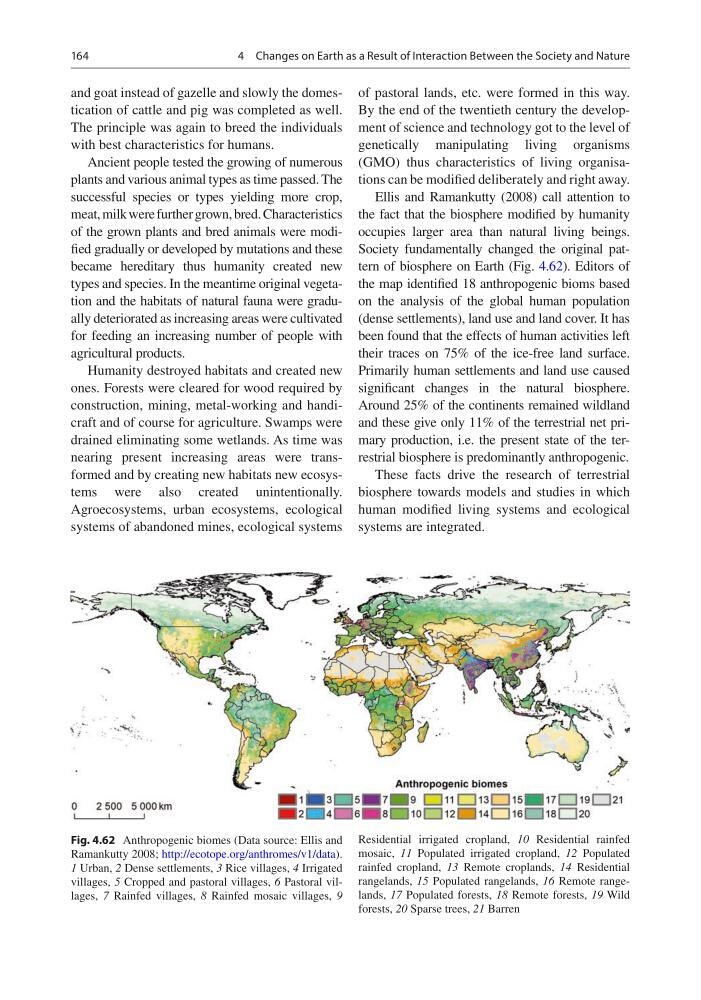
Society fundamentally changed the original pattern of biosphere on Earth (Fig. 4.62). Editors of
the map identified 18 anthropogenic bioms based
on the analysis of the global human population
(dense settlements), land use and land cover. It has
been found that the effects of human activities left
their traces on 75% of the ice-free land surface.
Primarily human settlements and land use caused
significant changes in the natural biosphere.
Around 25% of the continents remained wildland
and these give only 11% of the terrestrial net primary production, i.e. the present state of the terrestrial biosphere is predominantly anthropogenic.
These facts drive the research of terrestrial
biosphere towards models and studies in which
human modified living systems and ecological
systems are integrated.
Fig. 4.62 Anthropogenic biomes (Data source: Ellis and
Ramankutty 2008; http://ecotope.org/anthromes/v1/data).
1 Urban, 2 Dense settlements, 3 Rice villages, 4 Irrigated
villages, 5 Cropped and pastoral villages, 6 Pastoral villages, 7 Rainfed villages, 8 Rainfed mosaic villages, 9
Residential irrigated cropland, 10 Residential rainfed
mosaic, 11 Populated irrigated cropland, 12 Populated
rainfed cropland, 13 Remote croplands, 14 Residential
rangelands, 15 Populated rangelands, 16 Remote rangelands, 17 Populated forests, 18 Remote forests, 19 Wild
forests, 20 Sparse trees, 21 Barren
4 Changes on Earth as a Result of Interaction Between the Society and Nature
and goat instead of gazelle and slowly the domestication of cattle and pig was completed as well.
The principle was again to breed the individuals
with best characteristics for humans.
Ancient people tested the growing of numerous
plants and various animal types as time passed. The
successful species or types yielding more crop,
meat, milk were further grown, bred. Characteristics
of the grown plants and bred animals were modified gradually or developed by mutations and these
became hereditary thus humanity created new
types and species. In the meantime original vegetation and the habitats of natural fauna were gradually deteriorated as increasing areas were cultivated
for feeding an increasing number of people with
agricultural products.
Humanity destroyed habitats and created new
ones. Forests were cleared for wood required by
construction, mining, metal-working and handicraft and of course for agriculture. Swamps were
drained eliminating some wetlands. As time was
nearing present increasing areas were transformed and by creating new habitats new ecosystems were also created unintentionally.
Agroecosystems, urban ecosystems, ecological
systems of abandoned mines, ecological systems
of pastoral lands, etc. were formed in this way.
By the end of the twentieth century the development of science and technology got to the level of
genetically manipulating living organisms
(GMO) thus characteristics of living organisations can be modified deliberately and right away.
Ellis and Ramankutty (2008) call attention to
the fact that the biosphere modified by humanity
occupies larger area than natural living beings.
Society fundamentally changed the original pattern of biosphere on Earth (Fig. 4.62). Editors of
the map identified 18 anthropogenic bioms based
on the analysis of the global human population
(dense settlements), land use and land cover. It has
been found that the effects of human activities left
their traces on 75% of the ice-free land surface.
Primarily human settlements and land use caused
significant changes in the natural biosphere.
Around 25% of the continents remained wildland
and these give only 11% of the terrestrial net primary production, i.e. the present state of the terrestrial biosphere is predominantly anthropogenic.
These facts drive the research of terrestrial
biosphere towards models and studies in which
human modified living systems and ecological
systems are integrated.
Fig. 4.62 Anthropogenic biomes (Data source: Ellis and
Ramankutty 2008; http://ecotope.org/anthromes/v1/data).
1 Urban, 2 Dense settlements, 3 Rice villages, 4 Irrigated
villages, 5 Cropped and pastoral villages, 6 Pastoral villages, 7 Rainfed villages, 8 Rainfed mosaic villages, 9
Residential irrigated cropland, 10 Residential rainfed
mosaic, 11 Populated irrigated cropland, 12 Populated
rainfed cropland, 13 Remote croplands, 14 Residential
rangelands, 15 Populated rangelands, 16 Remote rangelands, 17 Populated forests, 18 Remote forests, 19 Wild
forests, 20 Sparse trees, 21 Barren
4 Changes on Earth as a Result of Interaction Between the Society and Nature