

165
4.4.3 Accelerating Deterioration
of the Biosphere: The Sixth
Great Extinction Period
Zoltán Túri
In order to understand what the sixth extinction
period in the title means a glance has to be taken
at the geological past.
The most special feature of the global Earth
system is the formation of the biosphere of the
planet and its effect on the global system.
Biosphere has been developing for at least 3.5
billion years (the ancient cyanobacteria colonies,
stromatolites are that old) producing ever more
complex organisms becoming at the same time
increasingly diverse. This evolution did not
remain undisturbed in the geological past either
and it is not today. Differentiation of life took
place at a variable rate and the progress broke
from time to time. For more than 3 billion years
life was present only in the sea (and in certain
sedimentary rocks underground according to certain assumptions). Since the atmosphere due to
the lack of appropriate amount of oxygen and
thus ozone forming out of it was not able to filter
out UV rays arriving from the Sun and dangerous
to life, the rock surfaces of the continents were
lifeless.
As data is so vast for the marine fauna in the
last 600 million years of geological history, a
reliable image can be obtained for this time
period (although still not completely accurate)
regarding the changes of biological diversity.
US researchers studied the history of marine
biodiversity (Raup and Sepkoski 1982, 1986,
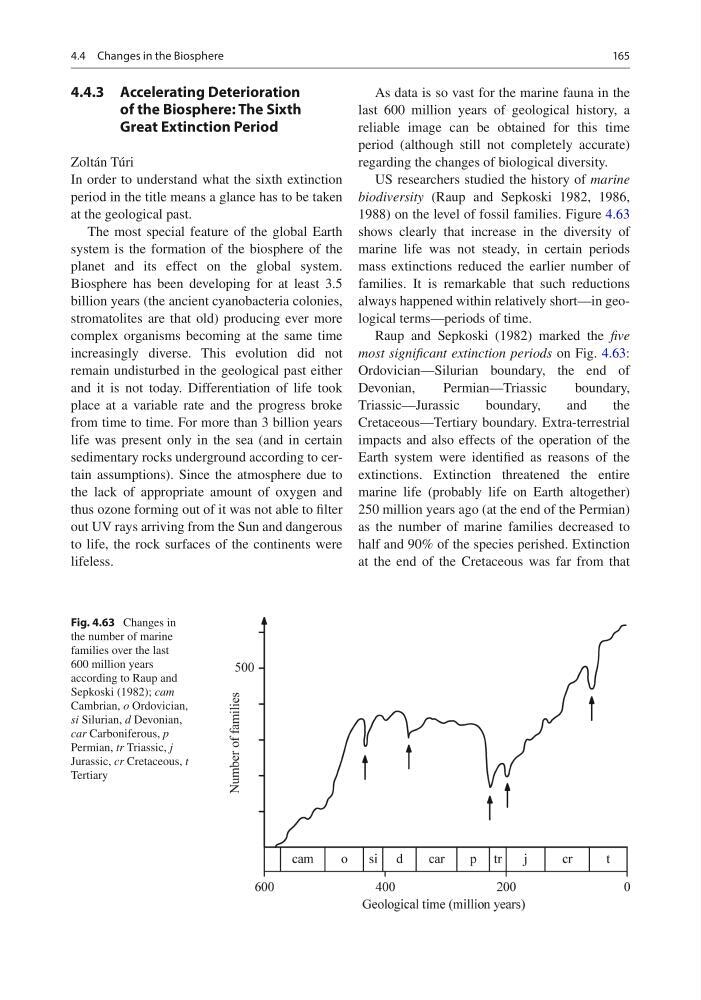
1988) on the level of fossil families. Figure 4.63
shows clearly that increase in the diversity of
marine life was not steady, in certain periods
mass extinctions reduced the earlier number of
families. It is remarkable that such reductions
always happened within relatively short—in geological terms—periods of time.
Raup and Sepkoski (1982) marked the five
most significant extinction periods on Fig. 4.63:
Ordovician—Silurian boundary, the end of
Devonian,
Permian—Triassic
boundary,
Triassic—Jurassic
boundary,
and
the
Cretaceous—Tertiary boundary. Extra-terrestrial
impacts and also effects of the operation of the
Earth system were identified as reasons of the
extinctions. Extinction threatened the entire
marine life (probably life on Earth altogether)
250 million years ago (at the end of the Permian)
as the number of marine families decreased to
half and 90% of the species perished. Extinction
at the end of the Cretaceous was far from that
Fig. 4.63 Changes in
the number of marine
families over the last
600 million years
according to Raup and
Sepkoski (1982); cam
Cambrian, o Ordovician,
si Silurian, d Devonian,
car Carboniferous, p
Permian, tr Triassic, j
Jurassic, cr Cretaceous, t
Tertiary
4.4 Changes in the Biosphere
4.4.3 Accelerating Deterioration
of the Biosphere: The Sixth
Great Extinction Period
Zoltán Túri
In order to understand what the sixth extinction
period in the title means a glance has to be taken
at the geological past.
The most special feature of the global Earth
system is the formation of the biosphere of the
planet and its effect on the global system.
Biosphere has been developing for at least 3.5
billion years (the ancient cyanobacteria colonies,
stromatolites are that old) producing ever more
complex organisms becoming at the same time
increasingly diverse. This evolution did not
remain undisturbed in the geological past either
and it is not today. Differentiation of life took
place at a variable rate and the progress broke
from time to time. For more than 3 billion years
life was present only in the sea (and in certain
sedimentary rocks underground according to certain assumptions). Since the atmosphere due to
the lack of appropriate amount of oxygen and
thus ozone forming out of it was not able to filter
out UV rays arriving from the Sun and dangerous
to life, the rock surfaces of the continents were
lifeless.
As data is so vast for the marine fauna in the
last 600 million years of geological history, a
reliable image can be obtained for this time
period (although still not completely accurate)
regarding the changes of biological diversity.
US researchers studied the history of marine
biodiversity (Raup and Sepkoski 1982, 1986,
1988) on the level of fossil families. Figure 4.63
shows clearly that increase in the diversity of
marine life was not steady, in certain periods
mass extinctions reduced the earlier number of
families. It is remarkable that such reductions
always happened within relatively short—in geological terms—periods of time.
Raup and Sepkoski (1982) marked the five
most significant extinction periods on Fig. 4.63:
Ordovician—Silurian boundary, the end of
Devonian,
Permian—Triassic
boundary,
Triassic—Jurassic
boundary,
and
the
Cretaceous—Tertiary boundary. Extra-terrestrial
impacts and also effects of the operation of the
Earth system were identified as reasons of the
extinctions. Extinction threatened the entire
marine life (probably life on Earth altogether)
250 million years ago (at the end of the Permian)
as the number of marine families decreased to
half and 90% of the species perished. Extinction
at the end of the Cretaceous was far from that
Fig. 4.63 Changes in
the number of marine
families over the last
600 million years
according to Raup and
Sepkoski (1982); cam
Cambrian, o Ordovician,
si Silurian, d Devonian,
car Carboniferous, p
Permian, tr Triassic, j
Jurassic, cr Cretaceous, t
Tertiary
4.4 Changes in the Biosphere