

162
somewhat smaller extent) it contributes significantly to the warming of the atmosphere. If
humanity is going to continue the use of fossil
fuel, positive feedbacks in the continental carbon cycle have to be calculated with that will
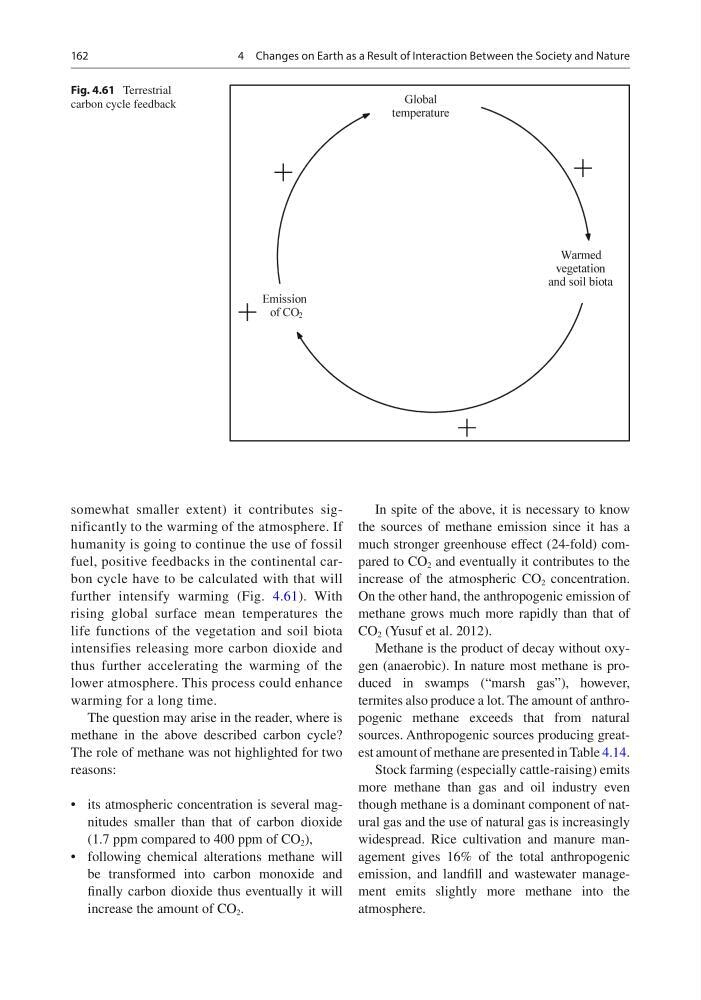
further intensify warming (Fig. 4.61). With
rising global surface mean temperatures the
life functions of the vegetation and soil biota
intensifies releasing more carbon dioxide and
thus further accelerating the warming of the
lower atmosphere. This process could enhance
warming for a long time.
The question may arise in the reader, where is
methane in the above described carbon cycle?
The role of methane was not highlighted for two
reasons:
• its atmospheric concentration is several magnitudes smaller than that of carbon dioxide
(1.7 ppm compared to 400 ppm of CO 2 ),
• following chemical alterations methane will
be transformed into carbon monoxide and
finally carbon dioxide thus eventually it will
increase the amount of CO 2 .
In spite of the above, it is necessary to know
the sources of methane emission since it has a
much stronger greenhouse effect (24-fold) compared to CO 2 and eventually it contributes to the
increase of the atmospheric CO 2 concentration.
On the other hand, the anthropogenic emission of
methane grows much more rapidly than that of
CO 2 (Yusuf et al. 2012).
Methane is the product of decay without oxygen (anaerobic). In nature most methane is produced in swamps (“marsh gas”), however,
termites also produce a lot. The amount of anthropogenic methane exceeds that from natural
sources. Anthropogenic sources producing greatest amount of methane are presented in Table 4.14.
Stock farming (especially cattle-raising) emits
more methane than gas and oil industry even
though methane is a dominant component of natural gas and the use of natural gas is increasingly
widespread. Rice cultivation and manure management gives 16% of the total anthropogenic
emission, and landfill and wastewater management emits slightly more methane into the
atmosphere.
Fig. 4.61 Terrestrial
carbon cycle feedback
4 Changes on Earth as a Result of Interaction Between the Society and Nature
somewhat smaller extent) it contributes significantly to the warming of the atmosphere. If
humanity is going to continue the use of fossil
fuel, positive feedbacks in the continental carbon cycle have to be calculated with that will
further intensify warming (Fig. 4.61). With
rising global surface mean temperatures the
life functions of the vegetation and soil biota
intensifies releasing more carbon dioxide and
thus further accelerating the warming of the
lower atmosphere. This process could enhance
warming for a long time.
The question may arise in the reader, where is
methane in the above described carbon cycle?
The role of methane was not highlighted for two
reasons:
• its atmospheric concentration is several magnitudes smaller than that of carbon dioxide
(1.7 ppm compared to 400 ppm of CO 2 ),
• following chemical alterations methane will
be transformed into carbon monoxide and
finally carbon dioxide thus eventually it will
increase the amount of CO 2 .
In spite of the above, it is necessary to know
the sources of methane emission since it has a
much stronger greenhouse effect (24-fold) compared to CO 2 and eventually it contributes to the
increase of the atmospheric CO 2 concentration.
On the other hand, the anthropogenic emission of
methane grows much more rapidly than that of
CO 2 (Yusuf et al. 2012).
Methane is the product of decay without oxygen (anaerobic). In nature most methane is produced in swamps (“marsh gas”), however,
termites also produce a lot. The amount of anthropogenic methane exceeds that from natural
sources. Anthropogenic sources producing greatest amount of methane are presented in Table 4.14.
Stock farming (especially cattle-raising) emits
more methane than gas and oil industry even
though methane is a dominant component of natural gas and the use of natural gas is increasingly
widespread. Rice cultivation and manure management gives 16% of the total anthropogenic
emission, and landfill and wastewater management emits slightly more methane into the
atmosphere.
Fig. 4.61 Terrestrial
carbon cycle feedback
4 Changes on Earth as a Result of Interaction Between the Society and Nature