

103
telephone, pipelines are also very important but
land traffic networks provide the means for the
greatest volume of material transport and also
have dominance in passenger transport as well.
Road and railway networks are the most
important factors in shaping settlement networks.
Settlements as dwelling places of the population
appear as nodes, patches on maps connected with
roads and railway suitable for transporting goods
and passengers.
The formation and structure of settlement networks are influenced by both natural conditions
and social processes. Growth of democratic
social systems, for example, favours divided networks reflecting even spatial distribution. Apart
from these social effects natural conditions also
influence strongly the characters of a settlement
network. Mountain ranges or valleys in the water
network, for example, provide no place for the
development of an even settlement network, it
will be shaped in accordance with natural conditions (Fig. 4.28). Settlements in the valleys and
roads along the rivers (avoiding gallery forests)
make little harm in the natural environment.
Haggett (2001) presents in detail the theories
that explain the formation of various networks
(model of Kohl, Christaller, Isard, etc.). The most
important fact is that with growing population,
growing attraction and population of cities,
developing transport networks become denser
while nodes become greater and thus their environmental effects intensify as well.
Let us analyse the effects of a settlement network on ecological systems. Species diversity
can only be sustained if living organisms are connected to a network via ecological corridors.
With increasing number and area of settlements
and growing artificial surfaces ecological systems are suppressed and ecological networks are
fragmented by transport networks increasing
density (Fig. 4.29). This process is called fragmentation. Public traffic routes (motorways are
strongest among them) represent ecological barriers for life. They form impenetrable barriers of
some species and hardly crossable obstacles for
others while the movement of species able to fly
(birds, flying insects) is blocked for a smaller
degree. Many of the latter ones are overrun by
cars but these generally cause no significant loss
regarding the number of their population.
The development of road networks can be
characterised by the data that the length of paved
roads exceeds 5, 4.5 and 3 million km in the
European Union, the USA and China respectively.
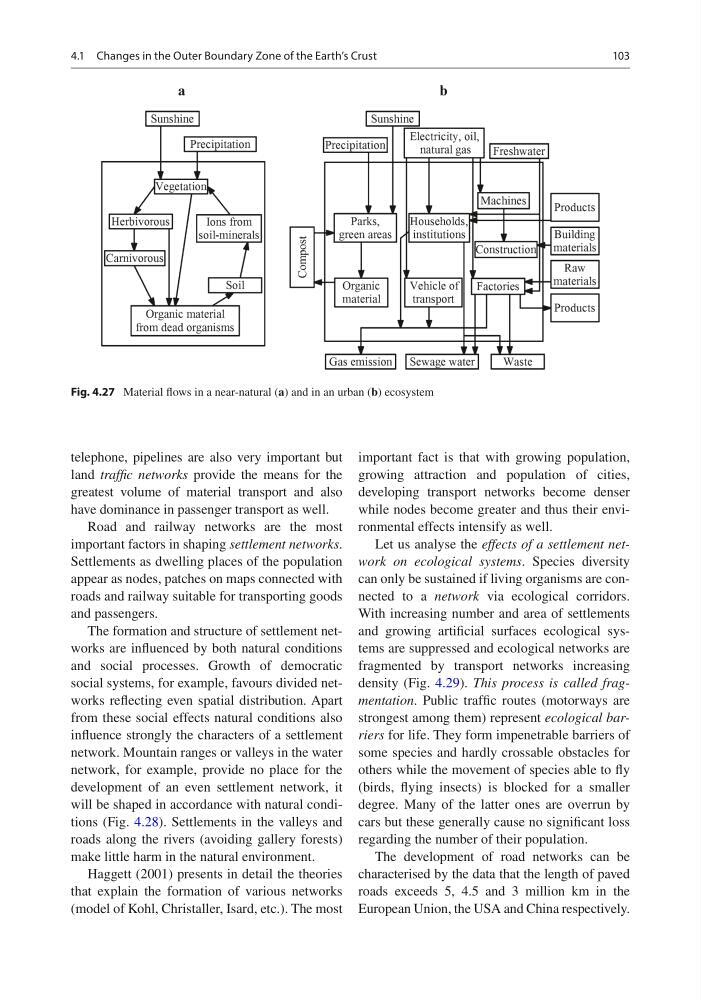
Fig. 4.27 Material flows in a near-natural (a) and in an urban (b) ecosystem
4.1 Changes in the Outer Boundary Zone of the Earth’s Crust
telephone, pipelines are also very important but
land traffic networks provide the means for the
greatest volume of material transport and also
have dominance in passenger transport as well.
Road and railway networks are the most
important factors in shaping settlement networks.
Settlements as dwelling places of the population
appear as nodes, patches on maps connected with
roads and railway suitable for transporting goods
and passengers.
The formation and structure of settlement networks are influenced by both natural conditions
and social processes. Growth of democratic
social systems, for example, favours divided networks reflecting even spatial distribution. Apart
from these social effects natural conditions also
influence strongly the characters of a settlement
network. Mountain ranges or valleys in the water
network, for example, provide no place for the
development of an even settlement network, it
will be shaped in accordance with natural conditions (Fig. 4.28). Settlements in the valleys and
roads along the rivers (avoiding gallery forests)
make little harm in the natural environment.
Haggett (2001) presents in detail the theories
that explain the formation of various networks
(model of Kohl, Christaller, Isard, etc.). The most
important fact is that with growing population,
growing attraction and population of cities,
developing transport networks become denser
while nodes become greater and thus their environmental effects intensify as well.
Let us analyse the effects of a settlement network on ecological systems. Species diversity
can only be sustained if living organisms are connected to a network via ecological corridors.
With increasing number and area of settlements
and growing artificial surfaces ecological systems are suppressed and ecological networks are
fragmented by transport networks increasing
density (Fig. 4.29). This process is called fragmentation. Public traffic routes (motorways are
strongest among them) represent ecological barriers for life. They form impenetrable barriers of
some species and hardly crossable obstacles for
others while the movement of species able to fly
(birds, flying insects) is blocked for a smaller
degree. Many of the latter ones are overrun by
cars but these generally cause no significant loss
regarding the number of their population.
The development of road networks can be
characterised by the data that the length of paved
roads exceeds 5, 4.5 and 3 million km in the
European Union, the USA and China respectively.
Fig. 4.27 Material flows in a near-natural (a) and in an urban (b) ecosystem
4.1 Changes in the Outer Boundary Zone of the Earth’s Crust