

104
According to ecological studies a negative correlation can be found between road length per area
unit and biological diversity. Further adverse
effect is that ditches and edges along roads have a
major role in the spreading of invasive species. It
was observed that coastal plants advanced deep
into the continent along roads that were regularly
salted in Western Europe. Belts of grass along certain roads, however, could have beneficial effects
as well in sustaining certain protected plants.
These are grasslands along roads that are not
sprayed with chemicals but mowed regularly and
form transitional zones between two different
habitats. Such grass belts are called ecotone that
provide shelter for—among others—species that
try to survive along the boundary of two habitats
(e.g. orchids) because they are not able to compete
with the species dominant in the two habitats.
Such beneficial effects, however, fall short of the
disadvantageous ecological effects of the increasing density of settlement and road networks.
In developed countries wildlife underpasses
and overpasses have been designed recently at
motorway and railway constructions. These are
placed in the seasonal or permanent migration
routes of wild animals. Their size is designed so
that largest bodied animals could cross them.
The operation of near-natural areas that are
strongly dissected, fragmented with ecological
barriers suffers from strong disturbances. The
self-sustaining ability of tiny, isolated living
patches (upper edge of Fig. 4.29) ends, selfcontrol typical for natural systems cannot prevail
in them anymore; therefore, they will perish
sooner or later. Life possibilities of ecological
systems are greatly influenced by settlement and
road densities: very dense networks make the survival of natural systems impossible.
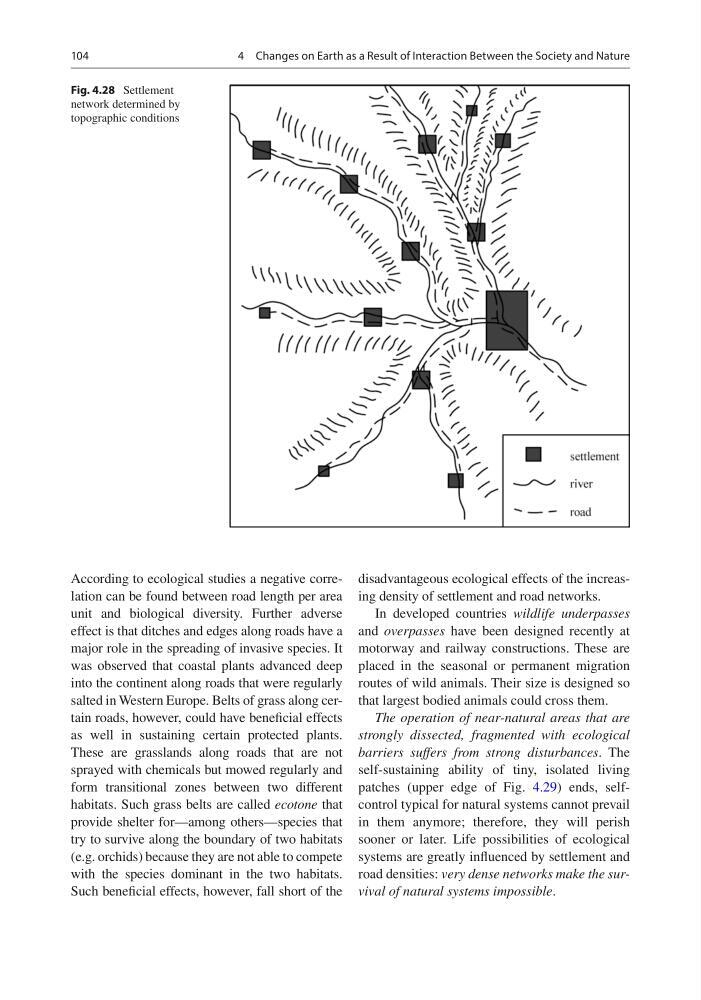
Fig. 4.28 Settlement
network determined by
topographic conditions
4 Changes on Earth as a Result of Interaction Between the Society and Nature
According to ecological studies a negative correlation can be found between road length per area
unit and biological diversity. Further adverse
effect is that ditches and edges along roads have a
major role in the spreading of invasive species. It
was observed that coastal plants advanced deep
into the continent along roads that were regularly
salted in Western Europe. Belts of grass along certain roads, however, could have beneficial effects
as well in sustaining certain protected plants.
These are grasslands along roads that are not
sprayed with chemicals but mowed regularly and
form transitional zones between two different
habitats. Such grass belts are called ecotone that
provide shelter for—among others—species that
try to survive along the boundary of two habitats
(e.g. orchids) because they are not able to compete
with the species dominant in the two habitats.
Such beneficial effects, however, fall short of the
disadvantageous ecological effects of the increasing density of settlement and road networks.
In developed countries wildlife underpasses
and overpasses have been designed recently at
motorway and railway constructions. These are
placed in the seasonal or permanent migration
routes of wild animals. Their size is designed so
that largest bodied animals could cross them.
The operation of near-natural areas that are
strongly dissected, fragmented with ecological
barriers suffers from strong disturbances. The
self-sustaining ability of tiny, isolated living
patches (upper edge of Fig. 4.29) ends, selfcontrol typical for natural systems cannot prevail
in them anymore; therefore, they will perish
sooner or later. Life possibilities of ecological
systems are greatly influenced by settlement and
road densities: very dense networks make the survival of natural systems impossible.
Fig. 4.28 Settlement
network determined by
topographic conditions
4 Changes on Earth as a Result of Interaction Between the Society and Nature