

101
performance is studied it can be declared that
there is practically no correlation between them:
for example, the population density of the very
poor Nepal and the at least 20 times richer
Switzerland hardly differs (196 people/km
2
and
182 people/km
2
respectively).
4.1.2.2 Settlement and Ecological
Networks
The current population of 7.6 billion people of
the Earth (2018) lives in settlements. Society can
be operated only if the settlements are connected
and this connection is diverse, including production, transport of goods, services, flow of information, movement of people (changing jobs,
residence), i.e. all important social activities.
If material, energy and information flow is
viewed from the aspect of a single settlement
then external relations presented in Fig. 4.26
can be experienced. Solar radiation helps the
energy supply of buildings especially if solar
panels transform it into electric energy. In this
way, electric energy can be used for heating,
sanitary hot water or even cooling. Via the glass
surfaces of buildings greenhouse effect can be
beneficial in a cooler environment in the case of
appropriate orientation. The existence of urban
green surfaces also depends on solar energy,
and in some respects (vitamin D) human health
as well.
Apart from solar energy other energy resources
are required as well. These resources today are
mostly fossil fuels transported in wagons (coal),
tank wagons (oil) and/or pipelines (oil, gas). Raw
material required for operating industrial factories are transported with various vehicles to settlements and also technical products and food to
shops.
People living in settlements produce new
products that are transported to other settlements.
Many people arrive daily to most settlements to
work or for services.
Information flow is just as important for the
society as property flow. Information may reach
the population of a settlement from newspapers
transported by lorries or railway, through the
internet, landline or mobile phones to radio and
television.
Running a settlement produces pollutants that
load the environment (gases, sewage, solid
waste—Fig. 4.26) that have to be disposed somehow in order to avoid damage to wildlife or
humans.
Naturally the black box model presented here
cannot illustrate the very complex structure of a
city in full. Gardner (2016) expresses the complex structure with declaring that a city is a system of systems. Its operation is compared to that
of a living organism: the city grows because it
consumes (food, commodities, energy), breathes,
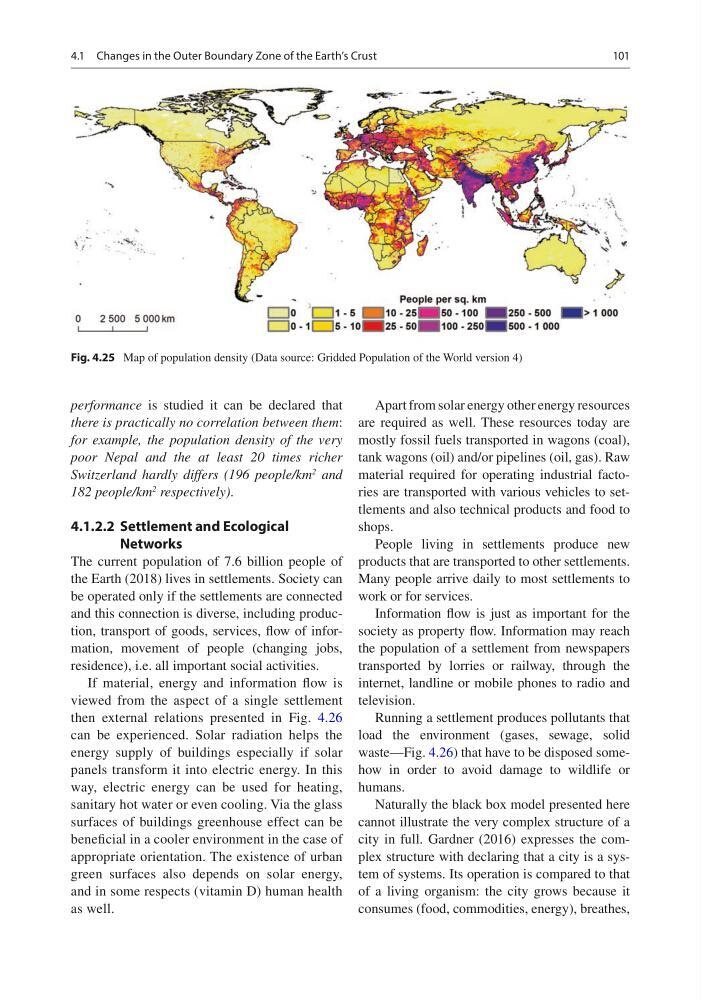
Fig. 4.25 Map of population density (Data source: Gridded Population of the World version 4)
4.1 Changes in the Outer Boundary Zone of the Earth’s Crust
performance is studied it can be declared that
there is practically no correlation between them:
for example, the population density of the very
poor Nepal and the at least 20 times richer
Switzerland hardly differs (196 people/km
2
and
182 people/km
2
respectively).
4.1.2.2 Settlement and Ecological
Networks
The current population of 7.6 billion people of
the Earth (2018) lives in settlements. Society can
be operated only if the settlements are connected
and this connection is diverse, including production, transport of goods, services, flow of information, movement of people (changing jobs,
residence), i.e. all important social activities.
If material, energy and information flow is
viewed from the aspect of a single settlement
then external relations presented in Fig. 4.26
can be experienced. Solar radiation helps the
energy supply of buildings especially if solar
panels transform it into electric energy. In this
way, electric energy can be used for heating,
sanitary hot water or even cooling. Via the glass
surfaces of buildings greenhouse effect can be
beneficial in a cooler environment in the case of
appropriate orientation. The existence of urban
green surfaces also depends on solar energy,
and in some respects (vitamin D) human health
as well.
Apart from solar energy other energy resources
are required as well. These resources today are
mostly fossil fuels transported in wagons (coal),
tank wagons (oil) and/or pipelines (oil, gas). Raw
material required for operating industrial factories are transported with various vehicles to settlements and also technical products and food to
shops.
People living in settlements produce new
products that are transported to other settlements.
Many people arrive daily to most settlements to
work or for services.
Information flow is just as important for the
society as property flow. Information may reach
the population of a settlement from newspapers
transported by lorries or railway, through the
internet, landline or mobile phones to radio and
television.
Running a settlement produces pollutants that
load the environment (gases, sewage, solid
waste—Fig. 4.26) that have to be disposed somehow in order to avoid damage to wildlife or
humans.
Naturally the black box model presented here
cannot illustrate the very complex structure of a
city in full. Gardner (2016) expresses the complex structure with declaring that a city is a system of systems. Its operation is compared to that
of a living organism: the city grows because it
consumes (food, commodities, energy), breathes,
Fig. 4.25 Map of population density (Data source: Gridded Population of the World version 4)
4.1 Changes in the Outer Boundary Zone of the Earth’s Crust