

100
It is worth noting why population increase
practically stopped in developed countries. In
this case again only the most important causes
are discussed in the following. The renowned
demographer, Livi-Bacci (1992) explained
demographic stability by the demographic transition model.
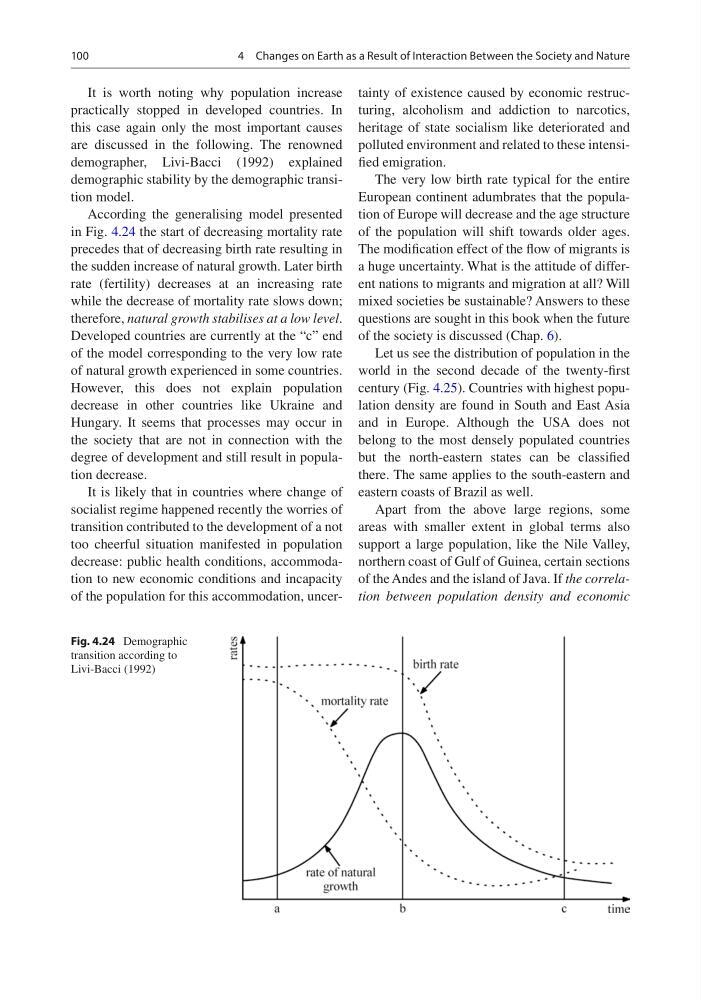
According the generalising model presented
in Fig. 4.24 the start of decreasing mortality rate
precedes that of decreasing birth rate resulting in
the sudden increase of natural growth. Later birth
rate (fertility) decreases at an increasing rate
while the decrease of mortality rate slows down;
therefore, natural growth stabilises at a low level.
Developed countries are currently at the “c” end
of the model corresponding to the very low rate
of natural growth experienced in some countries.
However, this does not explain population
decrease in other countries like Ukraine and
Hungary. It seems that processes may occur in
the society that are not in connection with the
degree of development and still result in population decrease.
It is likely that in countries where change of
socialist regime happened recently the worries of
transition contributed to the development of a not
too cheerful situation manifested in population
decrease: public health conditions, accommodation to new economic conditions and incapacity
of the population for this accommodation, uncertainty of existence caused by economic restructuring, alcoholism and addiction to narcotics,
heritage of state socialism like deteriorated and
polluted environment and related to these intensified emigration.
The very low birth rate typical for the entire
European continent adumbrates that the population of Europe will decrease and the age structure
of the population will shift towards older ages.
The modification effect of the flow of migrants is
a huge uncertainty. What is the attitude of different nations to migrants and migration at all? Will
mixed societies be sustainable? Answers to these
questions are sought in this book when the future
of the society is discussed (Chap. 6).
Let us see the distribution of population in the
world in the second decade of the twenty-first
century (Fig. 4.25). Countries with highest population density are found in South and East Asia
and in Europe. Although the USA does not
belong to the most densely populated countries
but the north-eastern states can be classified
there. The same applies to the south-eastern and
eastern coasts of Brazil as well.
Apart from the above large regions, some
areas with smaller extent in global terms also
support a large population, like the Nile Valley,
northern coast of Gulf of Guinea, certain sections
of the Andes and the island of Java. If the correlation between population density and economic
Fig. 4.24 Demographic
transition according to
Livi-Bacci (1992)
4 Changes on Earth as a Result of Interaction Between the Society and Nature
It is worth noting why population increase
practically stopped in developed countries. In
this case again only the most important causes
are discussed in the following. The renowned
demographer, Livi-Bacci (1992) explained
demographic stability by the demographic transition model.
According the generalising model presented
in Fig. 4.24 the start of decreasing mortality rate
precedes that of decreasing birth rate resulting in
the sudden increase of natural growth. Later birth
rate (fertility) decreases at an increasing rate
while the decrease of mortality rate slows down;
therefore, natural growth stabilises at a low level.
Developed countries are currently at the “c” end
of the model corresponding to the very low rate
of natural growth experienced in some countries.
However, this does not explain population
decrease in other countries like Ukraine and
Hungary. It seems that processes may occur in
the society that are not in connection with the
degree of development and still result in population decrease.
It is likely that in countries where change of
socialist regime happened recently the worries of
transition contributed to the development of a not
too cheerful situation manifested in population
decrease: public health conditions, accommodation to new economic conditions and incapacity
of the population for this accommodation, uncertainty of existence caused by economic restructuring, alcoholism and addiction to narcotics,
heritage of state socialism like deteriorated and
polluted environment and related to these intensified emigration.
The very low birth rate typical for the entire
European continent adumbrates that the population of Europe will decrease and the age structure
of the population will shift towards older ages.
The modification effect of the flow of migrants is
a huge uncertainty. What is the attitude of different nations to migrants and migration at all? Will
mixed societies be sustainable? Answers to these
questions are sought in this book when the future
of the society is discussed (Chap. 6).
Let us see the distribution of population in the
world in the second decade of the twenty-first
century (Fig. 4.25). Countries with highest population density are found in South and East Asia
and in Europe. Although the USA does not
belong to the most densely populated countries
but the north-eastern states can be classified
there. The same applies to the south-eastern and
eastern coasts of Brazil as well.
Apart from the above large regions, some
areas with smaller extent in global terms also
support a large population, like the Nile Valley,
northern coast of Gulf of Guinea, certain sections
of the Andes and the island of Java. If the correlation between population density and economic
Fig. 4.24 Demographic
transition according to
Livi-Bacci (1992)
4 Changes on Earth as a Result of Interaction Between the Society and Nature