

85
today require fractures artificially created by
hydraulic fracturing. Due to increased shale gas
production, the USA is now the top natural gas
producer in the world. Following success in the
USA, shale gas exploration has been started in
countries such as Poland, China, and South
Africa as well.
One of the major problems with shale gas is
the process of increasing the ratio of fractures for
higher efficiency gas production. The process of
hydraulic fracturing or “fracking” water mixed
with a variety of chemicals is forced through the
wellbore casing into the host rock. The highpressure water breaks up (“fracks”) the rock and
gas is released as a result. Sand and other particles
are added to the water as proppants to keep the
fractures in the rock open, enabling the gas to
flow into the casing of the well. Chemicals added
to the water are applied to reduce friction and
inhibit corrosion. After fracking gas or oil is
extracted and 30–70% of the frack fluid (mixture
of water, chemicals, sand) flows back to the surface. Frequently gas-bearing formations also contain water that might also flow up the wellbore to
the surface. Such produced water often contains
salt and other dissolved minerals in high ratio.
For horizontal fracturing toxic and carcinogenic chemicals, i.e. benzene and ethylbenzene,
are supposed to be applied as gelling agents in
the water and chemical mixtures (EPA 2011).
The water, chemicals, and frack fluid that return
to the well’s surface, called flowback or produced
water in the course of fracking, may contain
radioactive materials, heavy metals, natural salts,
and hydrocarbons which exist naturally in shale
rock formations (Howarth et al. 2011). Fracking
chemicals, radioactive materials, heavy metals,
and salts are so difficult to remove from the water
they are remixed with, and would so heavily pollute the water cycle, that most of the flowback is
either recycled into other fracking operations or
injected into deep underground wells, supposedly eliminating such water from the hydrologic
cycle. Anyhow, the increasing amount of heavily
polluted flowback water presents a growing issue
for operators and also a high environmental risk.
Overall, considering proven reserves, global
demand and energy consumption and of course
global energy policy, fossil fuels seem to remain
the decisive energy producers for humanity in the
(at least near) future. No matter how “clean”
those new inventive coal technologies are, or how
“clean” natural gas is compared to coal and oil,
these are fossil, non-renewable energy resources.
Sooner or later they will run out and their production and from the Earth’s crust and subsequent
burning cannot be made sustainable. They are the
dominant sources of anthropogenic carbon dioxide in the atmosphere. The future of coal might
prove to be a wee bit different from hydrocarbons
if we can really regard it and use it as a raw material and not as an energy resource. Its material
application as carbon could bring a brighter
future for the coal industry. But currently these
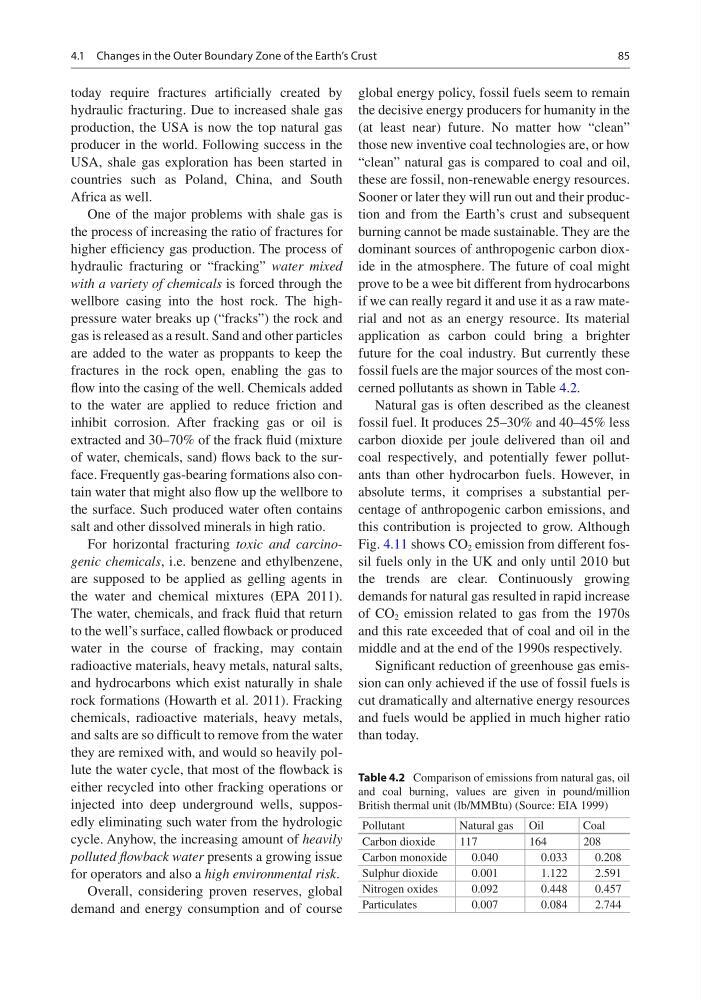
fossil fuels are the major sources of the most concerned pollutants as shown in Table 4.2.
Natural gas is often described as the cleanest
fossil fuel. It produces 25–30% and 40–45% less
carbon dioxide per joule delivered than oil and
coal respectively, and potentially fewer pollutants than other hydrocarbon fuels. However, in
absolute terms, it comprises a substantial percentage of anthropogenic carbon emissions, and
this contribution is projected to grow. Although
Fig. 4.11 shows CO 2 emission from different fossil fuels only in the UK and only until 2010 but
the trends are clear. Continuously growing
demands for natural gas resulted in rapid increase
of CO 2 emission related to gas from the 1970s
and this rate exceeded that of coal and oil in the
middle and at the end of the 1990s respectively.
Significant reduction of greenhouse gas emission can only achieved if the use of fossil fuels is
cut dramatically and alternative energy resources
and fuels would be applied in much higher ratio
than today.
Table 4.2 Comparison of emissions from natural gas, oil
and coal burning, values are given in pound/million
British thermal unit (lb/MMBtu) (Source: EIA 1999)
Pollutant
Natural gas Oil
Coal
Carbon dioxide
117
164
208
Carbon monoxide
0.040
0.033
0.208
Sulphur dioxide
0.001
1.122
2.591
Nitrogen oxides
0.092
0.448
0.457
Particulates
0.007
0.084
2.744
4.1 Changes in the Outer Boundary Zone of the Earth’s Crust
today require fractures artificially created by
hydraulic fracturing. Due to increased shale gas
production, the USA is now the top natural gas
producer in the world. Following success in the
USA, shale gas exploration has been started in
countries such as Poland, China, and South
Africa as well.
One of the major problems with shale gas is
the process of increasing the ratio of fractures for
higher efficiency gas production. The process of
hydraulic fracturing or “fracking” water mixed
with a variety of chemicals is forced through the
wellbore casing into the host rock. The highpressure water breaks up (“fracks”) the rock and
gas is released as a result. Sand and other particles
are added to the water as proppants to keep the
fractures in the rock open, enabling the gas to
flow into the casing of the well. Chemicals added
to the water are applied to reduce friction and
inhibit corrosion. After fracking gas or oil is
extracted and 30–70% of the frack fluid (mixture
of water, chemicals, sand) flows back to the surface. Frequently gas-bearing formations also contain water that might also flow up the wellbore to
the surface. Such produced water often contains
salt and other dissolved minerals in high ratio.
For horizontal fracturing toxic and carcinogenic chemicals, i.e. benzene and ethylbenzene,
are supposed to be applied as gelling agents in
the water and chemical mixtures (EPA 2011).
The water, chemicals, and frack fluid that return
to the well’s surface, called flowback or produced
water in the course of fracking, may contain
radioactive materials, heavy metals, natural salts,
and hydrocarbons which exist naturally in shale
rock formations (Howarth et al. 2011). Fracking
chemicals, radioactive materials, heavy metals,
and salts are so difficult to remove from the water
they are remixed with, and would so heavily pollute the water cycle, that most of the flowback is
either recycled into other fracking operations or
injected into deep underground wells, supposedly eliminating such water from the hydrologic
cycle. Anyhow, the increasing amount of heavily
polluted flowback water presents a growing issue
for operators and also a high environmental risk.
Overall, considering proven reserves, global
demand and energy consumption and of course
global energy policy, fossil fuels seem to remain
the decisive energy producers for humanity in the
(at least near) future. No matter how “clean”
those new inventive coal technologies are, or how
“clean” natural gas is compared to coal and oil,
these are fossil, non-renewable energy resources.
Sooner or later they will run out and their production and from the Earth’s crust and subsequent
burning cannot be made sustainable. They are the
dominant sources of anthropogenic carbon dioxide in the atmosphere. The future of coal might
prove to be a wee bit different from hydrocarbons
if we can really regard it and use it as a raw material and not as an energy resource. Its material
application as carbon could bring a brighter
future for the coal industry. But currently these
fossil fuels are the major sources of the most concerned pollutants as shown in Table 4.2.
Natural gas is often described as the cleanest
fossil fuel. It produces 25–30% and 40–45% less
carbon dioxide per joule delivered than oil and
coal respectively, and potentially fewer pollutants than other hydrocarbon fuels. However, in
absolute terms, it comprises a substantial percentage of anthropogenic carbon emissions, and
this contribution is projected to grow. Although
Fig. 4.11 shows CO 2 emission from different fossil fuels only in the UK and only until 2010 but
the trends are clear. Continuously growing
demands for natural gas resulted in rapid increase
of CO 2 emission related to gas from the 1970s
and this rate exceeded that of coal and oil in the
middle and at the end of the 1990s respectively.
Significant reduction of greenhouse gas emission can only achieved if the use of fossil fuels is
cut dramatically and alternative energy resources
and fuels would be applied in much higher ratio
than today.
Table 4.2 Comparison of emissions from natural gas, oil
and coal burning, values are given in pound/million
British thermal unit (lb/MMBtu) (Source: EIA 1999)
Pollutant
Natural gas Oil
Coal
Carbon dioxide
117
164
208
Carbon monoxide
0.040
0.033
0.208
Sulphur dioxide
0.001
1.122
2.591
Nitrogen oxides
0.092
0.448
0.457
Particulates
0.007
0.084
2.744
4.1 Changes in the Outer Boundary Zone of the Earth’s Crust